Funding & Compliance

E-Rate and CIPA Funding

For most districts, E-Rate is the quiet subsidy that makes broadband affordable — and CIPA is the string attached to it. Understanding how the two connect is the difference between treating certification as a formality you can defend and signing a form you hope nobody checks. Here is how the money flows, what reviewers look at, and how to make the compliance side effortless.

DiscountsOn internet & connectivity
1 signatureCertifies CIPA each year
YearsHow long records must hold up
RepaymentThe cost of getting it wrong

How E-Rate works, in brief

E-Rate is the common name for the schools and libraries universal service program, which discounts the cost of internet access and related connectivity for eligible schools and libraries across the United States. Rather than sending schools a check, the program discounts the bills: the institution pays its share, and the program covers the rest directly with the service provider. Discount levels scale with need, so the highest-poverty and most rural communities receive the deepest discounts.

Each funding year, an institution requests services competitively, files its application paperwork, and — critically for this guide — certifies its compliance status. For any school or library taking discounts on internet access, that certification includes CIPA: a statement that the institution filters as the law requires, has adopted an internet safety policy through a public process, and monitors and educates its students. If you want the full legal picture first, start with What Is CIPA? and come back.

The design is deliberate. Congress wanted public money to connect children to the internet, but not to fund unfiltered access to the internet's worst content. So instead of building an enforcement agency, the law made compliance a self-certified condition of the subsidy — backed by the ability to audit, deny and claw back. That structure puts the burden of proof on the institution, which is why documentation matters as much as the filter itself.

Cast of characters

Who does what in the funding-and-compliance picture

Four parties touch the money or the mandate. Knowing which responsibilities sit where prevents the most common misunderstanding — that a vendor can carry your certification for you.

The program

Commits funding, collects certifications, reviews applications and audits past years when questions arise.

The institution

Applies for discounts, certifies CIPA compliance annually, and owns every record that backs the signature.

The service provider

Delivers the discounted connectivity. Has no role in your CIPA status — the obligations never transfer to them.

The filtering vendor

Supplies the technology protection measure and, ideally, the reports and logs that make your compliance provable.

Why CIPA compliance is the price of the discount

E-Rate and CIPA are two halves of one bargain. The program lowers the cost of connecting students; the law ensures that connection is safe for minors. A district cannot take one half without the other: the moment it accepts discounts on internet access, the filtering, policy and monitoring duties attach.

The mechanism is the annual certification. It is not a survey or a suggestion — it is a formal representation to a federal program that specific safeguards are in place. Districts sometimes assume the certification is checked when it is filed. Mostly it is not; it is relied upon, and checked later if questions arise. That inversion — trust now, verify afterward — is what makes casual certification dangerous.

  • Discounts on internet access trigger the full CIPA duty set
  • Certification is renewed every funding year, not once
  • The institution — not the vendor — is the party certifying
  • Evidence must be producible long after the year it covers

The E-Rate / CIPA bargain

The program provides: discounted internet access and connectivity, with the deepest support for the highest-need schools and libraries.
The institution certifies: a technology protection measure blocking obscene content, child sexual abuse material and material harmful to minors; an adopted internet safety policy; monitoring of minors; and education on appropriate online behavior.
The annual rhythm

Where CIPA sits in the E-Rate funding cycle

Compliance is not a separate calendar — it threads through the same cycle your business office already runs each funding year.

1

Plan and procure services

The district identifies the connectivity it needs and runs the program's competitive process to select providers. This is the moment to confirm that your filtering approach will cover whatever the new services deliver — more bandwidth, new buildings, or a shift toward take-home connectivity.

2

Apply and certify

With services selected, the district files its application and makes its certifications for the funding year, including CIPA status. Before anyone signs, the responsible official should be able to see current evidence: the adopted policy, hearing records, and the filter's blocked-category configuration.

3

Receive discounted services

Once funding is committed, discounts flow through the year on the covered services. Compliance obligations are live this entire time — a filter switched off in February contradicts a certification signed in the fall, even if it is back on by spring.

4

Keep records as you go

Category-level filtering reports, exception logs, monitoring procedures and student-education records accumulate during the year. Saved as they are produced, they cost nothing; reconstructed under audit, they can be impossible.

5

Answer reviews if they come

Applications can be reviewed before funding and audited after it — sometimes years after. The question is always the same: does the evidence show the institution was doing what it certified, when it certified it? Districts with a maintained compliance folder answer in days.

Under the microscope

What an E-Rate reviewer actually examines for CIPA

Reviewers are not filter engineers. They are evidence examiners. Each item below is a document or artifact — and every one of them can exist before anyone asks.

The adopted policy

A dated internet safety policy, formally adopted by the governing body, addressing the elements the law names. A draft, a template, or a policy adopted after the certification date all raise flags.

Notice and hearing records

Proof that the public had reasonable notice and an opportunity to comment before adoption: the published notice, the meeting agenda, and minutes showing the policy was addressed.

Evidence of active filtering

Configuration exports or reports showing that a technology protection measure was in place and blocking the required categories during the funding year in question — not just today.

Consistency over time

Signs that compliance was continuous: periodic reports, change logs for exceptions and unblocks, and no unexplained gaps between what was certified and what the records show.

Education and monitoring

For schools: documentation that students received instruction on appropriate online behavior and cyberbullying, and a written description of how minors' online activity is monitored.

General program records

Beyond CIPA, reviewers verify the ordinary funding paperwork — competitive bidding, invoices, service delivery. Weakness there invites a closer look at everything else, compliance included.

The downside case

What non-compliance actually costs

The consequences are financial, cumulative, and mostly avoidable. Districts rarely lose funding over a filtering opinion — they lose it over missing proof.

ClawbackRepaying discounts already received
DenialPending funding requests refused
ExposureMultiple funding years reviewed at once
TrustBoard and community confidence spent

The direct penalty is recovery of funds: discounts received under an inaccurate certification can be demanded back, and for a connectivity budget built around E-Rate, repayment plus the loss of expected future discounts can swallow the technology budget for years. Because reviews can reach back across funding years, a single unnoticed gap — say, take-home devices that were never filtered — can multiply across every year it went uncorrected.

The indirect costs are slower but real: leadership time consumed by document requests, procurement frozen while questions are open, and the awkward board meeting where someone explains why safety funding is being returned. Set against all that, the cost of maintaining a filter and a folder of records is trivial — which is the whole argument of this page.

The report that answers the audit

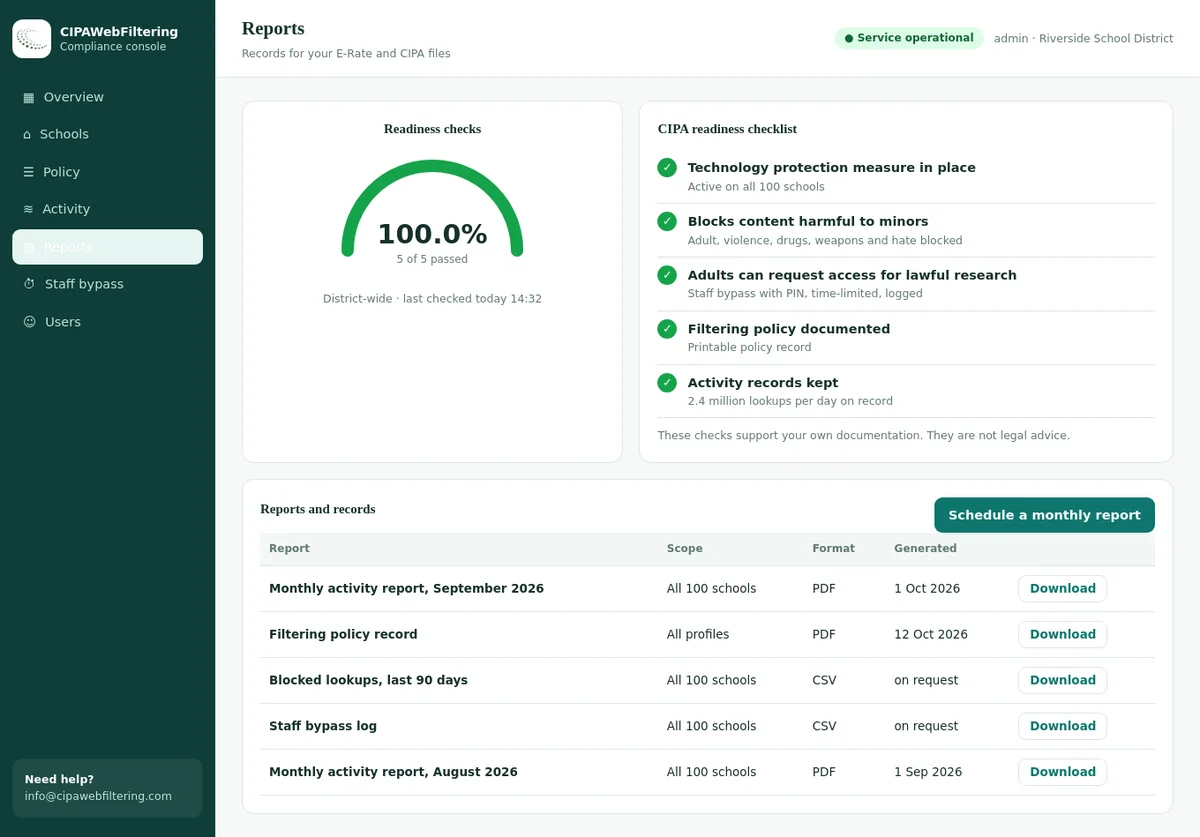
One monthly export tells the whole story: which categories were blocked for which user groups, what exceptions existed and who approved them, and how policy applied to managed devices off-campus.

Blocked categories by group Off-campus enforcement Exception approvals AI-tool policy status

How category filtering turns certification into a formality

The hard way to prove CIPA compliance is to argue that a hand-built blocklist happened to catch the web's worst content. The easy way is structural: block entire content categories — adult, explicit, exploitation, harmful-to-minors — across a dataset that classifies more than 120 million domains into 57+ categories and updates daily. Then the claim you certify is simple and checkable: these categories are blocked, for these groups, everywhere we manage.

Because domains carry multiple category labels, mixed platforms are handled precisely rather than with blanket bans, and SafeSearch enforcement covers the search-engine gap. Policy by grade band keeps elementary and high school appropriately different without separate systems, and the same reporting that satisfies an auditor doubles as your monitoring evidence. Newer risks fold in the same way — a bundled blocklist of 16,000+ AI-tool domains, spanning essay writers, deepfake tools and AI companion chat, keeps generative AI governed under the identical category logic you certify everything else with.

See how this looks in practice on our CIPA-compliant web filter page.

Side by side

The funding outcomes, compared

Same discounts, same rules — very different years, depending on whether compliance was maintained or improvised.

Moment in the cycleMaintained complianceImprovised compliance
Certification daySign after a ten-minute evidence reviewSign on faith and hope nothing surfaces
Document request arrivesForward the compliance folderWeeks of reconstruction and interviews
Filter question raisedCategory reports show continuous blockingOnly today's settings can be shown
Off-campus devices probedPolicy demonstrably follows managed devicesCoverage ends at the firewall — gap admitted
OutcomeFunding continues uninterruptedRecovery, denial, or both on the table

Practical advice for the person who signs

If you are the superintendent, director or authorized official whose name goes on the certification, three habits protect you. First, never certify what you have not seen: before signing, look at the adopted policy, the hearing minutes, and a current filter report with your own eyes. Second, insist that evidence be produced continuously rather than assembled on demand — a folder that grows a few documents each month is authentic in a way a binder built the week before an audit never is. Third, treat every change in your technology stack as a certification question: new filter, new device program, new AI policy, new building — each one should prompt a short check that the compliance story still holds.

It also pays to separate the legal minimum from local choices in your documentation. CIPA requires blocking obscene material, child sexual abuse material and content harmful to minors; it does not require banning social media or every game site. When your records clearly label which blocks are federal requirements and which are district decisions, a reviewer can see immediately that the mandated core is covered — and your board can debate the discretionary edges without anyone fearing the funding is at stake.

Finally, make the vendor relationship work for the paperwork. Your filtering provider should be able to hand you, on request, the artifacts this page keeps mentioning: blocked-category configuration for each user group, historical reports for any month, exception logs, and off-campus enforcement status. If producing that evidence is a struggle, the product is creating audit risk regardless of how well it filters. Work through the full CIPA compliance checklist to see every artifact worth keeping, and review your internet safety policy before the next cycle. Transparent pricing means you can budget the compliance side alongside the connectivity it protects.

Questions

E-Rate and CIPA funding questions

Does every E-Rate participant have to comply with CIPA?
CIPA obligations attach to institutions receiving E-Rate discounts on internet access or internal connections. An institution receiving support only for telecommunications services is generally outside the filtering mandate, though that situation is now uncommon. If internet access is discounted, plan on full compliance.
Who signs the CIPA certification, and what are they attesting?
An authorized official of the school, district or library signs as part of the funding-year paperwork. They attest that the institution enforces a technology protection measure blocking the required content, has adopted an internet safety policy with public notice and a hearing, monitors minors' online activity, and provides education on appropriate online behavior. It is a formal representation, so the signer should personally review the evidence first.
Can we take E-Rate discounts first and become compliant later?
The program includes provisions for institutions still undertaking the actions needed to comply, but they are transitional, not a parking space. The safe operating assumption is that compliance should be in place for any funding year you certify, and that "we were getting to it" is a weak answer to a reviewer examining that year.
How far back can an audit look?
Reviews can examine past funding years, which is why record retention matters. Keep your compliance folder — policy versions, hearing records, filter configurations and reports — for at least as long as your program document-retention obligations require, and treat several years as the practical horizon for producing evidence on request.
Our filter vendor says they are "CIPA certified." Does that settle it?
No vendor certification exists that transfers your obligation. CIPA compliance belongs to the institution: your policy, your public process, your monitoring, your records. A good filter makes the technical measure and its evidence easy — blocked categories, reports, off-campus enforcement — but the certification is yours, and so is the audit.
Does CIPA require us to block social media to keep funding?
No. The blocking requirement covers obscene material, child sexual abuse material and material harmful to minors. Social media policy is a local decision; districts can allow supervised access without endangering discounts, provided the mandated categories are blocked and the rest of the compliance program is in place.
What is the single cheapest thing we can do to reduce funding risk?
Start the compliance folder today. Export the current blocked-category configuration, file the adopted policy and hearing minutes beside it, and schedule a monthly report export. An hour of setup converts nearly every audit scenario from an investigation into an email attachment.
Does our discount level or poverty band change what CIPA requires?
No. The discount percentage determines how much of your bill the program covers, not how much you must filter. A school at a modest discount tier and one receiving the deepest support certify the identical safeguards: the required content categories blocked, an adopted policy, monitoring and student education. The size of the subsidy scales; the compliance floor does not.
Are libraries held to exactly the same standard as schools?
The core filtering duty is shared — both must block obscene material, child sexual abuse material and material harmful to minors on discounted internet access. The education-and-monitoring pieces added by later law are aimed at schools and minors, so a public library's obligations around instructing students on online behavior differ in practice. Libraries should still adopt a policy and be ready to show their filter was active for the funding year.
Do we file extra paperwork to prove CIPA, or only certify?
In the ordinary case you certify — you are not asked to attach the policy or filter reports up front. The evidence stays with you until a review or audit requests it. That is precisely why the certification feels light and the record-keeping feels invisible: nothing forces you to assemble the folder until the moment it is too late to build it. Treat the certification as a promise you can document, not a form you have filed and forgotten.

Keep the discounts. Skip the drama.

We'll show you the exact reports an E-Rate review asks for — generated automatically from category filtering that covers 120M+ domains on campus and off.