Cloud Deployment

Cloud-Based Web Filtering for Schools

Protect every student without buying, racking or babysitting a single appliance. Filtering runs in the cloud, policy lives in one console, and enforcement travels with each managed device — from the computer lab to the kitchen table. Backed by a categorized map of 120 million+ domains that refreshes every day.

0Appliances to install
1 afternoonTypical go-live
57+Content categories
24/7Off-campus coverage
Speed to safe

Live before the buses leave the lot

The defining advantage of cloud filtering is how little stands between signing up and being protected. There is no procurement cycle for hardware, no rack space to find, and no maintenance window to schedule. A typical school follows four short moves.

Point traffic at the service

Update DNS or deploy a lightweight agent to managed devices. Most schools finish this during a planning period — there is nothing to unbox and nothing to cable in.

Step 01 · Deploy

Pick a starter policy

Begin from a sensible K-12 baseline that blocks the categories CIPA cares about — obscene material and content harmful to minors — while leaving education and reference wide open.

Step 02 · Baseline

Shape rules by group

Split policy by grade band, building or user group. A second-grade cart, a high-school journalism class and the front office each get rules that fit how they actually use the web.

Step 03 · Segment

Watch the reports, adjust

Category-level dashboards show what was requested and what was stopped within hours of go-live. Grant the few exceptions teachers ask for and you are in steady state.

Step 04 · Tune

What “cloud-based” actually changes

With an appliance, the filter is a box on your network: you size it, patch it, and replace it when the district grows past it. With cloud-based web filtering for schools, the heavy lifting — classifying domains, matching requests against policy, keeping the category database current — happens on infrastructure we operate, not on hardware you own.

Your side of the arrangement shrinks to the parts that genuinely need local judgment: deciding policy, reviewing reports and handling exceptions. Everything mechanical — capacity, updates, redundancy — is our problem to solve, invisibly.

  • No filter server or appliance to purchase, size or refresh
  • Category data across 120M+ domains, updated daily without patch windows
  • New domains classified as they appear on the web
  • HTTPS and encrypted sites still resolved to their categories

What disappears from your to-do list

Hardware sizing Firmware patching Signature updates RMA shipping Failover drills End-of-life refreshes
What remains: your policy, your reports, your exceptions — managed from one browser tab by whoever owns student safety, even part-time.
Why schools choose cloud

Four problems the cloud model quietly removes

Districts rarely switch filters for fun. They switch when the old model creates work or risk that will not go away. These are the four that come up in nearly every conversation.

Active

The take-home gap

An appliance filters the building; it cannot see a Chromebook on home Wi-Fi. Cloud enforcement rides with the managed device, so the policy a student has in third period is the same policy at 9 p.m. That closes the hours when supervision is thinnest and risk is highest, and it does so without a VPN back-haul that slows everything down.

Active

Scale without forklift upgrades

Adding a new elementary school or doubling a 1:1 program never means re-sizing a box. Capacity is elastic on our side, so a district that grows from two thousand students to ten thousand keeps the same console, the same policies and the same reports — just more devices enrolled. Consolidating districts especially feel this on day one.

Monitored

Single points of failure

When an on-site filter dies, a school faces an ugly choice: no internet, or unfiltered internet while the replacement ships. Cloud filtering runs on redundant infrastructure that we monitor around the clock, so there is no single box in a closet whose power supply decides whether students are protected on a Tuesday morning.

Refreshing

Stale protection

The web adds enormous numbers of new domains every day, and yesterday’s signature file does not know about any of them. Because the category database is maintained centrally and refreshed daily, every school on the service benefits from every new classification the moment it lands — no update to download, schedule or forget.

Device status feed

Enforcing
  • 7:45 a.m. On campus Wi-Fi — policy enforced
  • 3:30 p.m. Public library hotspot — same policy
  • 8:15 p.m. Home network — same policy
  • Saturday Grandparents’ house — still the same policy

One rule set, everywhere the device goes. Nothing for parents to install, nothing for students to switch off by changing networks.

Filtering that follows the backpack

Once a district hands out devices, its duty of care stops being a campus question. The board, parents and your internet safety policy all expect a school-issued laptop to behave like a school-issued laptop wherever it connects.

Cloud filtering is the only model where that expectation is cheap to meet. Enforcement is anchored to the managed device and the student’s group, not to a piece of network gear, so off-campus coverage is not an add-on module — it is simply how the system works.

For districts standardizing across many buildings, this consistency also simplifies the story you tell auditors: one policy engine, one log, every location. See how that plays out at scale on our district filtering page.

The data underneath

A living map of the web, maintained for you

Every filtering decision is only as good as the classification behind it. This is what the cloud service draws on for every request, every day.

120M+Domains categorized
57+Content categories
DailyDatabase refresh
MultiCategories per domain

Multi-category classification matters more than it sounds. A large platform can host chemistry lectures and content no school would permit, so a single label would force an all-or-nothing call. Because each domain carries every category it belongs to, policy can allow the useful face of a mixed site while SafeSearch enforcement and category rules screen the rest.

The same pipeline that classifies established sites also screens newly registered domains as they appear, which is how a proxy site or copycat tool spun up this week is already categorized before a student finds it. If you are comparing this approach to traditional software more broadly, our overview of web filtering software for schools walks through category-based filtering from the ground up.

Honest comparison

Cloud or on-premise? It depends on what you value

Both deployment models run on the same categorized dataset and the same policy engine, so this is a question of operations, not protection. Here is the plain-English trade-off.

ConsiderationCloud deploymentOn-premise appliance
Hardware to buy and maintain None Purchased, patched, refreshed by you
Time to first protected student Hours Weeks of procurement and install
Take-home device coverage Native, follows the device Requires extra tunneling or agents
Growth to new buildings Enroll devices, done Capacity planning per site
Filtering data stays in-network Processed in the cloud Everything stays local
Works during ISP outage (LAN resources) Internet-dependent by nature Local enforcement continues

Some districts have governance rules, board direction or data-handling policies that make local control the deciding factor — and that is a legitimate choice we support with the same category database. If that sounds like your situation, read our companion page on on-site web filtering for schools, which covers the self-hosted model, when it wins, and how a hybrid of the two can work.

Built for the way districts actually grow

School systems rarely grow smoothly. A bond passes and three buildings come online in eighteen months; a 1:1 initiative doubles device count over a summer; two districts consolidate and suddenly one IT team owns both networks. Appliance-based filtering turns each of those events into a sizing exercise. Cloud based web filtering for school systems absorbs them without ceremony, because capacity was never your problem to plan.

The administrative model scales the same way. Policies attach to groups — grade bands, buildings, staff roles — rather than to network segments, so the structure you design for two schools still makes sense at twenty. New buildings inherit district defaults on day one and diverge only where a principal or program genuinely needs something different.

Uptime as a shared responsibility

No one should promise you that any internet service is infallible. What the cloud model changes is who carries the operational load: redundant infrastructure, monitoring and failover are engineered and staffed on our side, full-time, instead of resting on a single device in a wiring closet checked when someone remembers. For a two-person district IT team, that difference is not cosmetic — it is the margin that lets them do everything else in their week.

And the compliance thread runs through it all

Because every request is evaluated against named categories and logged centrally, demonstrating your technology protection measure for E-Rate certification is a reporting exercise, not an archaeology project. If you are new to the requirements, our plain-English guide to what CIPA requires covers the filtering, policy and education obligations and where a cloud filter fits.
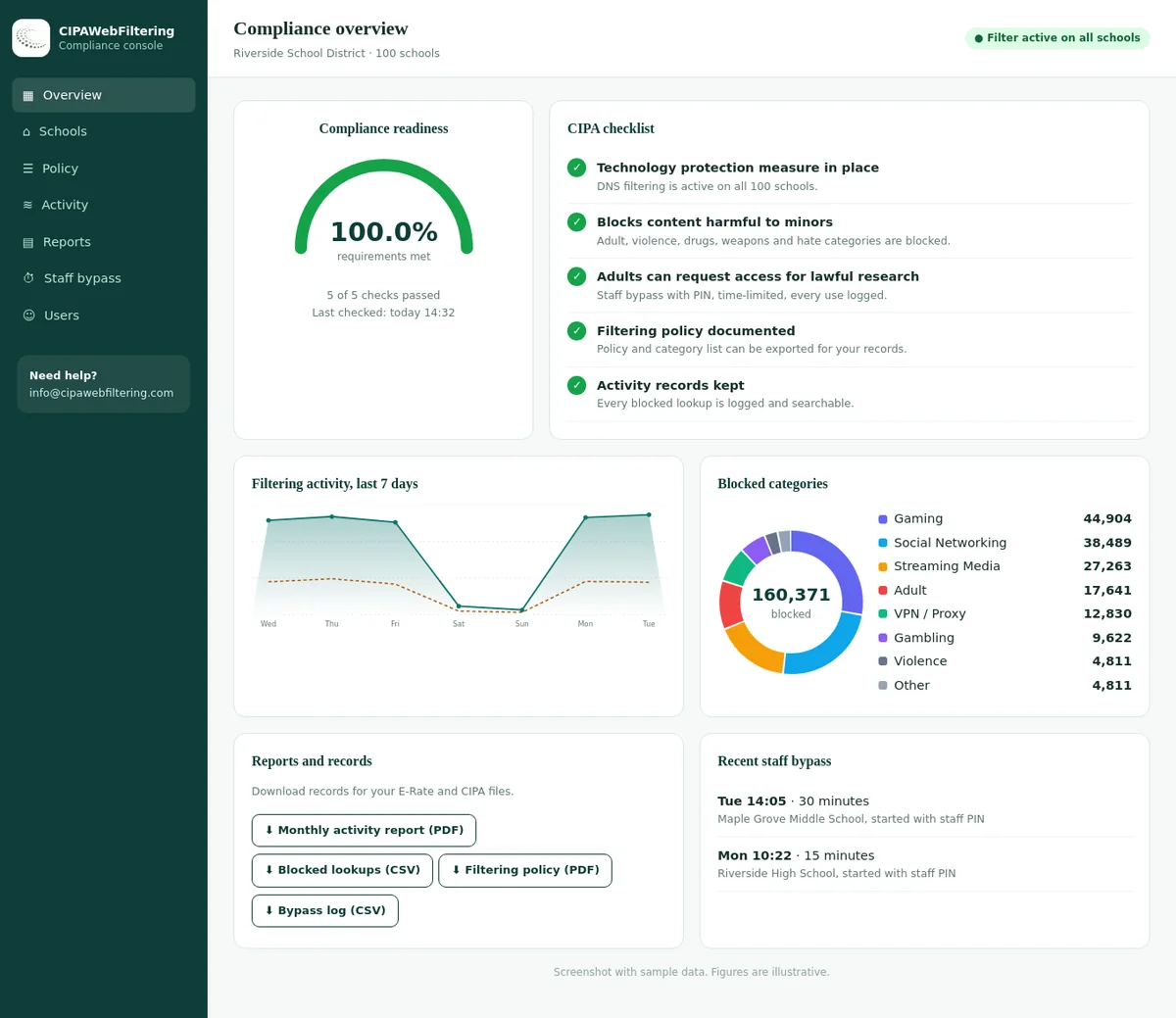
Included capabilities

More than a block page

The same cloud service that stops harmful categories carries several capabilities schools end up leaning on weekly.

On

SafeSearch, enforced

Safe modes on major search engines are turned on at the network level, so image and video results stay classroom-appropriate even when a student never touches a settings page.

Logging

Audit-ready reporting

Category-level reports show what was blocked, for whom and why — the evidence trail your annual E-Rate certification and your school board both want to see.

Updated

AI tools, governed

A bundled blocklist tracking 16,000+ AI-tool domains — essay writers, homework solvers, deepfake and companion-chat apps — lets you permit AI where it teaches and pause it where it cheats, updated daily.

Decrypting

Encrypted traffic handled

Most of the web is HTTPS now. Requests to encrypted sites are still matched to their categories, so protection does not evaporate the moment a padlock appears in the address bar.

Ready

Exceptions in seconds

When a teacher needs one blocked site for one unit, an administrator can scope an allowance to a group and a timeframe from the console — no ticket queue, no appliance login.

Segmented

Policy by building or band

Elementary, middle and high school carry different rules under one roof of reporting, so age-appropriate does not mean administratively painful.

A sane migration checklist

  • Export your current allow and block exceptions before anything else
  • Run cloud filtering in one pilot building alongside the old appliance
  • Compare a week of block reports against your existing filter’s logs
  • Brief teachers on the new block page so nothing feels mysterious
  • Cut over building by building, then retire the appliance on your schedule

Switching from an appliance without a scary weekend

Most schools adopting cloud filtering are not starting from zero — they are leaving a box that is aging out, over capacity, or blind to take-home devices. The good news is that migration is not a cliff-edge cutover.

Because the cloud service needs no hardware, it can run in parallel with your existing filter during evaluation. A pilot building points at the cloud while the rest of the district stays on the appliance, and you compare results side by side with real traffic from real students.

The exceptions list is usually the only asset worth carrying over. Category policies do not transfer one-to-one between products — and honestly should not, since starting from a clean K-12 baseline and adding your genuine exceptions produces a tighter policy than importing years of accumulated workarounds.

How to evaluate a cloud filter before you commit

Demos all look clean. The evaluation that actually predicts your experience uses your traffic, your edge cases and your people. Take the ten sites your teachers complained about under the old filter and check how each is categorized; a multi-category database should handle the mixed-content platforms — video, forums, developer sites — without forcing all-or-nothing decisions.

Then test the off-campus story concretely. Take a managed Chromebook home, join it to a phone hotspot, and confirm the policy holds and the activity appears in the next report. If a vendor’s answer to off-campus filtering involves extra licensing or a VPN concentrator, you are looking at an appliance product wearing a cloud costume.

Finally, sit a non-specialist in front of the console. The person managing school filtering day to day is often a media specialist or a part-time technician, not a network engineer. If they cannot find why a site was blocked and grant a scoped exception in under five minutes, the product will generate tickets forever regardless of how good its category data is.

Questions

What IT directors ask about cloud filtering

Do we need any hardware at all?
No. There is no appliance, server or virtual machine to deploy for the filtering itself. Traffic is directed to the cloud service through a DNS change or a lightweight agent on managed devices, and everything else — classification, policy matching, logging — happens on infrastructure we run. Your existing firewall and network gear stay exactly as they are.
How fast can a school realistically be filtered?
A single school piloting on DNS can be enforcing a baseline K-12 policy the same afternoon it starts. District-wide rollouts take longer only because of change management — communicating with staff, tuning grade-band policies, enrolling take-home devices — not because of any technical bottleneck. Most districts phase in over days, not months.
Does filtering really work when students take devices home?
Yes, and this is the model’s signature strength. Enforcement is bound to the managed device, so a school Chromebook on home Wi-Fi, a hotspot or a relative’s network follows the same policy it does on campus. Parents install nothing, and students cannot opt out by switching networks. Personal family devices on the home network are not touched.
What happens if the cloud service itself has a problem?
The service runs on redundant, continuously monitored infrastructure precisely so that no single failure interrupts protection. That said, honest architecture talk matters: any cloud service depends on internet reachability. Districts with strict requirements for local continuity sometimes pair cloud coverage for take-home devices with an on-premise deployment for campus traffic — a hybrid we fully support.
Is cloud filtering enough for CIPA compliance?
It provides the technology protection measure — blocking obscene material, child sexual abuse material and content harmful to minors — plus the monitoring and reporting that support your E-Rate certification. CIPA also expects an adopted internet safety policy and education for students on appropriate online behavior, which remain your district’s responsibility; the filter gives you the enforcement and the evidence.
Can different schools in one district run different policies?
Yes. Policy attaches to groups you define — grade bands, buildings, staff versus students — under one console and one reporting view. An elementary campus can run a tight policy while the high school opens more categories for research, and the district still produces a single consolidated report at certification time.
How is pricing structured for cloud deployment?
Cloud filtering is priced as a subscription rather than a capital purchase, which most districts find easier to budget and to defend: no hardware line item, no refresh cycle, and costs that track enrollment. Current tiers and what each includes are laid out on our pricing page, and we are happy to map them to your student count.

Be filtering by Friday

Start a no-hardware pilot with one building, see your own traffic categorized in the reports, and decide with real data. If cloud is not the fit, we will tell you — and show you the on-premise path instead.