Compliance Guide

What Is CIPA?

CIPA — the Children's Internet Protection Act — is the federal law that ties E-Rate funding for schools and libraries to a simple bargain: if your institution takes discounted internet access, it must filter that access for minors, adopt an internet safety policy, and keep an eye on how students use the web. This guide explains what the law actually requires, what it does not, and how to meet it without disrupting teaching.

3Core requirements
E-RateHow it is enforced
K-12 + LibrariesWho it covers
AnnualCertification cadence
CIPA Compliance
Federal Law Guide
E-Rate Linked
K-12 & Libraries
Annual Certification
Guide Overview

A plain-language reading of the Children's Internet Protection Act (Pub. L. 106-554), prepared as a compliance reference for K-12 schools, districts and public libraries.

Editor's note: this guide is written for compliance and IT staff, not attorneys. Confirm specifics with your E-Rate consultant or counsel.
1

What CIPA Is

A United States federal law aimed at protecting minors from harmful online content on networks the public helps pay for — with a narrow, specific scope tied to E-Rate funding.

2

Who Must Comply

CIPA obligations follow the money: K-12 schools, public libraries, and consortia receiving E-Rate discounts on internet access must put defined safeguards in place.

3

The Three Requirements

Filter, policy, and monitoring plus education — verified each year through an E-Rate certification. Meet all three, keep evidence, and certification becomes routine.

4

From Law to Practice

How category filtering, group policies, off-campus coverage, and audit-ready records turn the statutory text into a working program for every school day.

Deep Dive

Understanding every aspect of CIPA

1
Definition

The Children's Internet Protection Act in plain English

Narrow, specific scope

The Children's Internet Protection Act is a United States federal law aimed at protecting minors from harmful online content on networks the public helps pay for. It does not regulate the internet at large and does not tell private households what to do. Its reach is specific: schools and libraries that receive E-Rate discounts on internet access must put defined safeguards in place before they can certify for that funding.

Three working parts

When someone asks "what is CIPA?", the honest short answer is: a funding condition with three working parts — filter, policy, and monitoring plus education — verified each year through an E-Rate certification. Alongside the filter, institutions must adopt and enforce an internet safety policy and monitor the online activities of minors.

Technology Protection Measure

"In everyday language, a web filter." Covered institutions must use a filter that blocks access to visual depictions that are obscene, that constitute child sexual abuse material, or that are harmful to minors.

Protecting Children in the 21st Century Act

A later amendment added an educational duty: schools must teach students about appropriate online behavior, including how to interact safely on social networking sites and in chat rooms, and how to recognize and respond to cyberbullying.

2
Scope

Who has to comply with CIPA — and who doesn't

Scope overview

CIPA obligations follow the money. If your institution certifies for E-Rate discounts on internet access, the law applies. If it doesn't, CIPA is optional — though most schools filter anyway.

K-12 schools & districts

Public and private elementary and secondary schools that receive E-Rate discounts for internet access must comply. In practice, the district usually certifies once on behalf of every building it serves.

Public libraries

Libraries taking E-Rate discounts for internet access face the same core duties: a filter on computers that minors can use, an internet safety policy, and a public process for adopting it.

Consortia & ESAs

Educational service agencies and consortium arrangements that pass E-Rate-funded connectivity to member schools need every benefiting site to be covered by a compliant policy and filter.

Not covered: telecom-only

Institutions that receive E-Rate support only for telecommunications services, and none for internet access, are generally outside CIPA's filtering mandate — a narrow and increasingly rare situation.

Not covered: home networks

CIPA does not regulate what families do on their own connections. But when a school-managed device goes home, most districts extend filtering anyway, because their duty of care travels with the device.

Voluntary compliers

Schools that skip E-Rate are not legally bound by CIPA, yet many follow it as a baseline: parents, boards and insurers increasingly expect filtering whether or not federal discounts are involved.

3
Core Law

The three requirements of the Children's Internet Protection Act

Key principle: Every CIPA obligation folds into one of three duties. Meet all three, keep evidence that you meet them, and the annual certification becomes routine.
I
Article

A technology protection measure — the filter

Institutions must operate a filter that blocks visual depictions that are obscene, child sexual abuse material, or harmful to minors on computers used by minors. For adults, the first two categories must still be blocked. The law leaves the choice of filtering technology to the school, which is why category-based filtering with strong coverage of adult and exploitative content has become the standard way to satisfy this duty.

II
Article

An internet safety policy, adopted publicly

The institution must adopt and enforce a written internet safety policy addressing minors' access to inappropriate material, their safety when using email and chat, unauthorized access such as hacking, unlawful disclosure of minors' personal information, and measures restricting access to harmful content. Adoption requires reasonable public notice and at least one public hearing or meeting, so the community has a chance to weigh in. Our guide to the CIPA internet safety policy covers what to put in the document.

III
Article

Monitoring plus student education

Schools must monitor the online activities of minors — not surveil every keystroke, but maintain reasonable oversight of student internet use. Under the Protecting Children in the 21st Century Act amendment, schools must also educate students about appropriate online behavior, including safe interaction on social networking sites and awareness of cyberbullying. Filtering alone, without the human and instructional layer, does not complete compliance.

4
Filtering

What the filter must actually block

Three defined categories

CIPA names three categories of visual depictions that a compliant filter has to stop. They are deliberately narrow. The law targets the clearly harmful edge of the web, not controversial ideas, news coverage, or health information that a student might legitimately need for coursework.

User distinctions matter

The distinction between users matters too. For minors, all three categories below must be blocked. For adult staff and library patrons, the "harmful to minors" category can be relaxed, and an authorized administrator may disable the filter for an adult engaged in bona fide research or other lawful purposes. Building those distinctions into policy is far easier when your filter can apply different rules to different user groups.

  • Obscene material — blocked for everyone on the network
  • Child sexual abuse material — blocked for everyone, without exception
  • Material harmful to minors — blocked wherever minors can browse
  • Adult unblocking permitted for lawful purposes at the institution's discretion

How categories map to the mandate

Adult / pornography Child exploitation Explicit imagery Harmful to minors

In practice

A category-based filter satisfies the mandate by blocking the content categories that contain obscene and exploitative material across the whole web — including brand-new domains — rather than relying on a hand-built list of known URLs. With 120M+ domains classified into 57+ categories and updated daily, coverage does not depend on someone reporting a site first.

Common misconceptions
What CIPA does not require

Over-blocking is usually the product of misunderstanding the law, not obeying it. CIPA is narrower than many district policies assume.

Myth vs. reality

QuestionRequired?Common myth
Block social media entirely?No"CIPA makes us block Facebook and YouTube"
Block all text on sensitive topics?No"Health and news sites must be filtered"
Track every student individually?No"We need spyware on every device"
Use a government-approved filter?No"Only certified vendors count"
Filter adults the same as students?No"Nobody can ever be unblocked"

The real boundaries

  • CIPA does not mandate a blanket social media ban — whether to restrict social media beyond the three required categories is a local policy decision
  • The mandate targets visual depictions in three defined categories, not all text content on sensitive topics
  • Reasonable monitoring is required, not per-keystroke surveillance
  • The institution chooses its own technology protection measure — no government-approved vendor list exists
  • Adults may be unblocked for lawful use at the institution's discretion
Practical takeaway: a district can comply with CIPA while still allowing supervised social media use in class, keeping health and current-events resources open for research, and granting teachers broader access than students. The law sets a floor for safety, not a ceiling on instruction. Districts that treat it as a mandate to lock everything down tend to generate teacher frustration and workaround behavior — and none of that extra restriction earns any additional compliance credit.
Follow the funding

CIPA and E-Rate: how the law is enforced

CertifyCompliance attested each funding year
DiscountE-Rate reduces internet costs
AuditRecords can be reviewed later
RepayFalse certification risks funding

How E-Rate works

E-Rate gives schools and libraries substantial discounts on internet access and related services, with the deepest discounts going to the highest-poverty communities. As part of each application cycle, the institution certifies that it is CIPA-compliant — that the filter is in place, the internet safety policy has been adopted after public notice and a hearing, and monitoring and student education are happening. There is no CIPA inspector who shows up at the school gate. Enforcement happens through the E-Rate program's certification and audit process.

What happens if it's not accurate

That certification is a legal statement. If an audit later finds it was not accurate — the filter was disabled, the policy was never adopted, records don't exist — the institution can be required to repay discounts and can jeopardize future funding. For a full walkthrough of the money side, see our guide to E-Rate and CIPA funding.

Snapshot

CIPA compliance at a glance

Filter

Block visual depictions that are obscene, child sexual abuse material, or harmful to minors across all devices.

Policy

Adopt an internet safety policy through public notice and hearing, addressing all five required topics.

Monitor + Educate

Maintain reasonable oversight of student internet use and educate minors about appropriate online behavior.

From law to practice

How districts turn CIPA into a working program

Compliance is not a single purchase. It is a small system of technology, policy and habit that runs quietly in the background of every school day.

Technology & policy

Category filtering as the technology measure

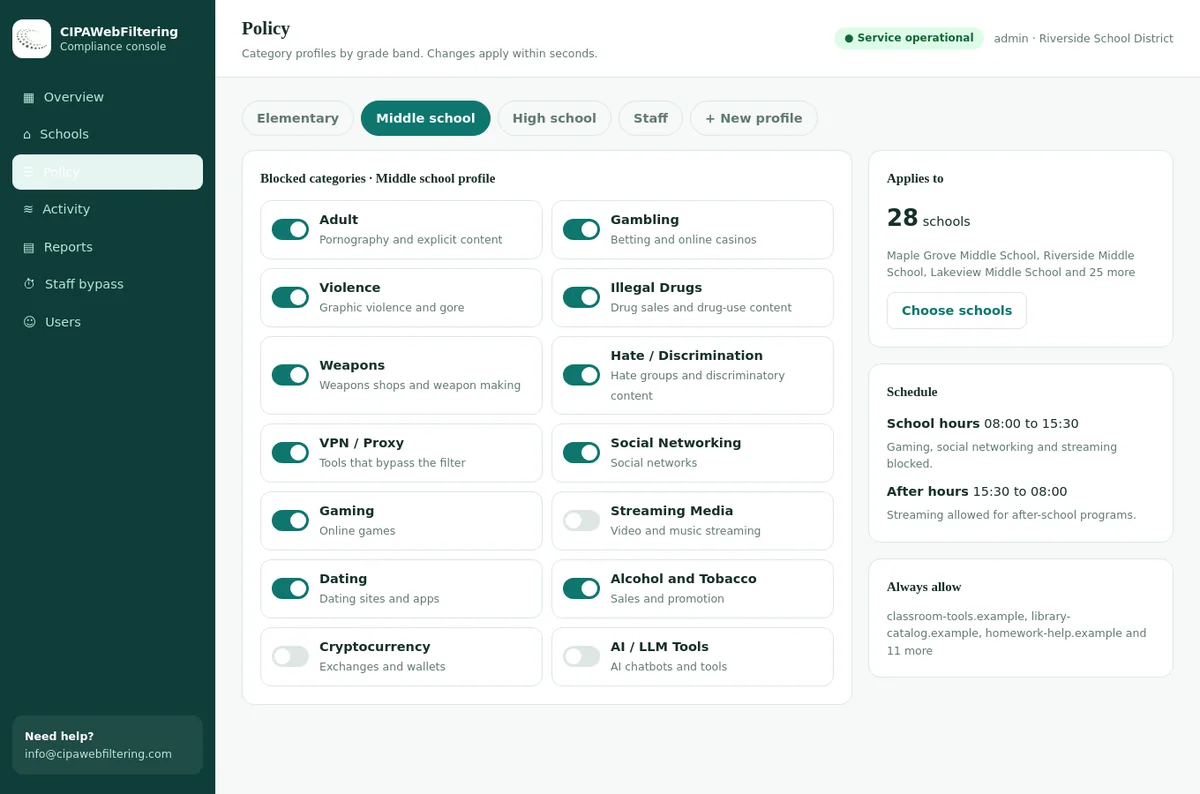
Districts deploy a filter that classifies the web into content categories and blocks the ones containing obscene, exploitative and harmful-to-minors material. Because a single domain can carry multiple category labels — a video platform can be both "Video" and "Adult" depending on the content — the filter can block the harmful slice without shutting down the useful one. SafeSearch enforcement on major search engines closes the image-search gap.

Policies by grade band and group

A kindergarten lab and a high school journalism class should not share one policy. Applying different category rules to elementary, middle and high school — and separate rules for staff — keeps the filter age-appropriate, which is exactly the "harmful to minors" logic CIPA is built on. Group-level policy also makes the adult-unblocking provision easy to honor.

Coverage & evidence

Coverage that follows the device

Take-home Chromebook programs mean the school network is no longer the only place students browse under school responsibility. Filtering that travels with managed devices off-campus — and that handles HTTPS traffic rather than going blind on encrypted sites — keeps the program consistent with what the district certified.

Records that survive an audit

The quiet half of compliance is evidence: the adopted policy, the public-hearing notice and minutes, filter configuration showing the required categories blocked, and category-level reports of what the filter is doing. Districts that keep these in one folder answer audit questions in an afternoon instead of a month.

5
New Pressures

CIPA in the age of AI tools and 1:1 devices

AI tools need their own category

The law's text predates generative AI, but its logic applies cleanly. AI image generators, deepfake tools, and "companion" chatbots can produce exactly the kinds of content CIPA exists to keep away from minors — and they appear far faster than any manual blocklist can track. Districts increasingly treat ungoverned AI tools as a filtering category of their own.

Scale of 1:1 ownership

When every student carries a district device, "monitoring minors' online activity" is no longer a matter of walking a computer lab. Reasonable monitoring now means category-level reporting across thousands of devices, alerting on the categories that matter, and a review habit — not reading every student's screen, which CIPA has never required.

AI Tools Blocklist

Filtering bundles an AI tools blocklist covering more than 16,000 AI-tool domains across categories such as essay writers, homework solvers, image generators, deepfake tools and AI companion chat, updated daily as new domains appear. That lets a district permit approved AI for instruction while holding back the tools that create academic-integrity, safety or audit exposure.

Where to go next

Start with the practical CIPA compliance checklist, then draft or update your internet safety policy, and read how E-Rate and CIPA funding fit together. When you are ready to evaluate technology, our CIPA-compliant web filter page shows how category coverage, off-campus enforcement and audit reporting come together, and pricing is published openly.

Key Takeaways

What every IT leader should remember about CIPA

CIPA sets a floor, not a ceiling

The law sets a floor for safety, not a ceiling on instruction. A district can comply while still allowing supervised social media use in class, keeping health and current-events resources open for research, and granting teachers broader access than students. Over-blocking is usually the product of misunderstanding the law, not obeying it.

Evidence matters as much as the filter

Compliance is not a single purchase. It is a small system of technology, policy and habit that runs quietly in the background of every school day. The adopted policy, public-hearing records, filter configuration, and category-level reports form the evidence trail that makes annual certification routine and audit responses painless.

The law adapts through its logic

CIPA's text predates AI tools and 1:1 device programs, but its logic — filter harmful visual content, maintain a safety policy, monitor and educate — applies cleanly to generative AI, off-campus Chromebooks, and every new challenge. Building those distinctions into policy is far easier when your filter can apply different rules to different user groups.

Continue Reading

Related CIPA & compliance resources

CIPA Compliance Checklist

Step-by-step walkthrough of every requirement with actionable verification steps.

Read the checklist

Internet Safety Policy

What to include in your written internet safety policy and how to adopt it properly.

Build your policy

E-Rate & CIPA Funding

How E-Rate discounts connect to CIPA certification and what auditors look for.

Understand funding

CIPA-Compliant Web Filter

How category coverage, off-campus enforcement and audit reporting come together.

See the solution
Questions

What Is CIPA — frequently asked questions

CIPA stands for the Children's Internet Protection Act, a U.S. federal law that requires schools and libraries receiving E-Rate discounts on internet access to filter harmful online content for minors, adopt an internet safety policy, monitor minors' internet use, and educate students on appropriate online behavior. It is enforced through the E-Rate certification process rather than by direct inspection.
No. CIPA applies to schools and libraries that receive E-Rate discounts on internet access or internal connections. A school that takes no E-Rate support for those services is not legally bound by CIPA, though most still filter as a matter of duty of care, board policy and community expectation.
No. CIPA does not require blocking social media platforms outright. The required blocking targets visual depictions that are obscene, child sexual abuse material, or harmful to minors. Whether to restrict social media beyond that is a local policy decision — many districts allow supervised, age-appropriate access while blocking the genuinely harmful categories.
Any technology that blocks or filters internet access to the prohibited categories of visual depictions. The law does not name products or maintain an approved-vendor list. In practice, schools use category-based web filters because they can demonstrate that the required categories are blocked network-wide and produce reports that back up the annual certification.
For adults, yes, within limits: an authorized person may disable the filter for an adult conducting bona fide research or other lawful use. For minors, the required categories must stay blocked. Good practice is a documented unblocking procedure — who can approve it, for whom, and for how long — so an audit can see the provision was used properly.
It is the amendment that broadened CIPA's education component. Beyond filtering and monitoring, schools must educate minors about appropriate online behavior, including interacting with others on social networking sites and in chat rooms, and cyberbullying awareness and response. Districts typically meet it with a digital citizenship curriculum delivered at each grade band and documented for certification.
The certification is made to the E-Rate program, and an inaccurate one carries real consequences: the institution can be required to repay the discounts it received and can put future funding at risk. That is why auditors focus on evidence — the adopted policy, hearing records, and filter reports — and why keeping those documents current matters as much as the filter itself.

Make CIPA compliance the easy part

See how category-based filtering across 120M+ domains, off-campus policy enforcement, and audit-ready reporting turn the Children's Internet Protection Act from a worry into a checkbox.