Give every student a safe path to the internet and keep your E-Rate funding protected. Our filtering classifies more than 120 million domains into clear content categories, so your team blocks what harms learning and allows what supports it — on campus, at home, and on every device.
A district network carries thousands of young users at once, spread across shared labs, take-home Chromebooks, staff laptops and guest phones. The traffic is enormous, the stakes are personal, and the rules leave little room for error.
A district network is not a business network. It serves students who are minors, on devices the school owns, under legal obligations no corporate IT team faces. The filter has to protect without getting in the way of learning.
From CIPA compliance to a parent's expectations, the rules governing school internet access leave little room for error. When a filter misses something harmful, a child is exposed and the school is answerable.
When a filter blocks a legitimate research resource, teachers lose instructional time. The question is never "how do we block the whole internet?" — it is "how do we allow the web that helps students learn while keeping out what does not belong?"
Hand-maintained lists of "bad sites" cannot keep pace with a web that adds hundreds of thousands of new domains every day. Categorizing the whole internet lets a small team set one policy that covers millions of sites at once.
Allow or block by category — adult content, gambling, weapons, self-harm, malware — and every matching domain is covered automatically, including sites nobody has seen before.
Freshly registered sites are classified as they appear, so the gap that blocklists leave between "site goes live" and "someone reports it" shrinks dramatically.
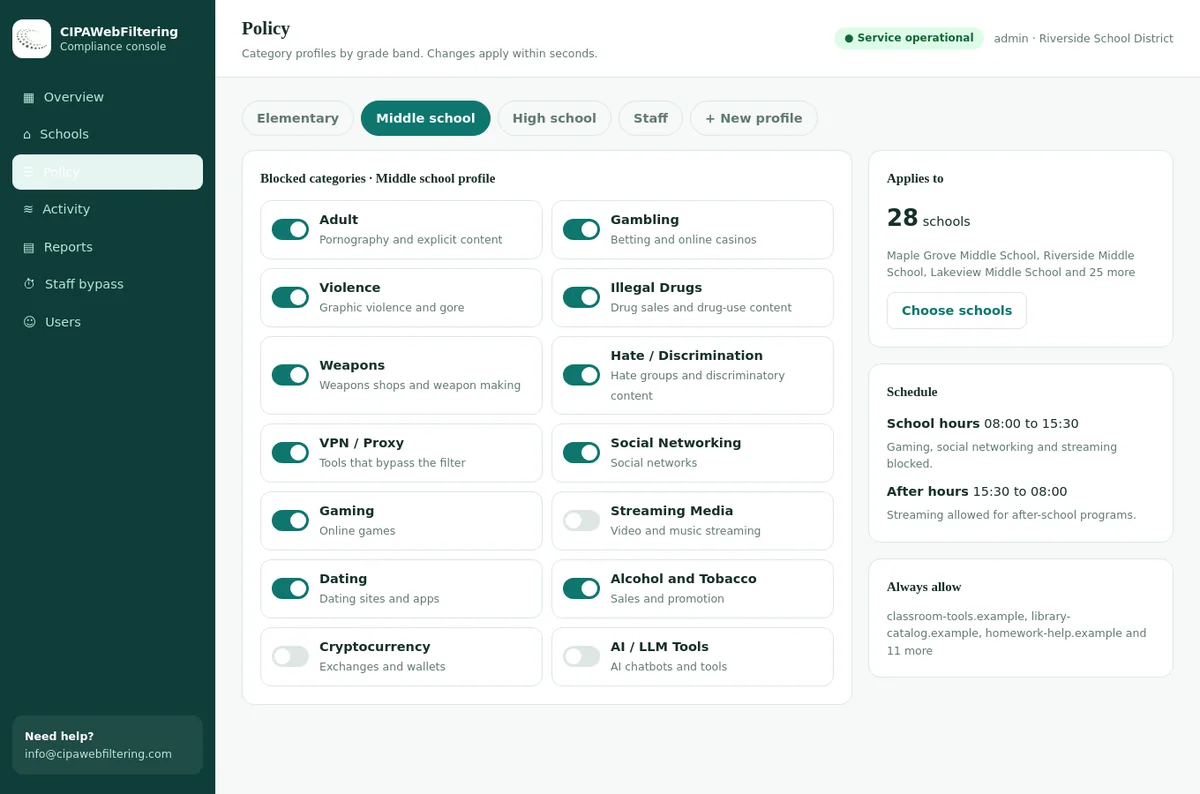
Elementary, middle and high school rarely need the same policy. Apply age-appropriate categories to each grade band, building or user group without maintaining separate systems.
Education, reference and research categories stay open by default, so a category filter protects instruction rather than getting in its way.
Instead of chasing individual URLs, your team manages a short set of category and exception rules — a workload one part-time administrator can own.
Every block maps to a named category and reason, which makes it far easier to answer a parent, a teacher or an auditor asking why a page was stopped.
When a student opens a page, the request is checked against a categorized view of the domain in milliseconds. The filter looks up which content categories the site belongs to, compares them to the policy for that user or grade band, and either allows the page, blocks it with a friendly notice, or flags it for review.
Because a single site can serve very different content — a video platform hosts both math lessons and material that is clearly off-limits — domains carry multiple category labels rather than one. That lets the filter make nuanced calls instead of the all-or-nothing choices that frustrate teachers.
A filter is only as good as the data behind it. Ours is built on a continuously refreshed map of the web, classifying new domains as they appear so nothing slips through the gap.
Cloud-based web filtering for schools can be live in an afternoon. A phased rollout keeps teachers informed and avoids surprise blocks.
Point a single site or lab at the filter, apply a starter policy, and confirm that everyday classroom resources pass cleanly before you scale.
Set stricter policies for elementary and progressively open more for high school, then add the handful of allow and block exceptions your staff request.
Push the policy to managed Chromebooks and laptops so filtering follows the student home — the requirement most districts underestimate.
Use category-level reporting to show your board and E-Rate auditors what is being filtered, and revisit policy each term as needs change.
Generative AI arrived in classrooms faster than any policy could keep up. Essay writers and homework solvers raise academic-integrity questions, while image, voice and companion tools introduce safety and privacy risks that did not exist a few years ago. A modern school web filter treats AI tools as their own manageable category rather than an afterthought.
The second pressure is location. Learning no longer stops at the school gate, and neither does the district's responsibility for what happens on a school-issued device. Filtering that only works behind the campus firewall leaves the take-home hours — often the highest-risk hours — completely uncovered. Policy has to travel with the device.
Both have a place, but for a district-scale problem the difference in day-to-day effort is dramatic.
| What you care about | Category-based filtering | Manual blocklist only |
|---|---|---|
| New / unseen sites | Covered automatically by category | Unblocked until someone reports it |
| Ongoing staff effort | A short set of policy rules | Endless URL-by-URL maintenance |
| Different rules per grade | Built in | Separate lists to manage |
| Explaining a block | Named category and reason | "It was on the list" |
| AI tools & emerging risks | Grouped and updated daily | Always behind |
The people who depend on school filtering rarely sit in the same room, and each of them measures it differently. Good filtering software gives every one of them what they need.
Need coverage they can prove, policy they can push everywhere at once, and reporting that turns the annual audit into a formality instead of a fire drill.
Want fewer tickets. A filter that classifies new sites on its own and lets a teacher's exception be granted in seconds is a filter that stops generating help-desk noise.
Care that the lesson resource loads and the distracting one does not. Category accuracy keeps filtering invisible during class instead of a daily obstacle.
Answer to parents and boards. They need confidence that harmful content is blocked district-wide and a clear record to show it if anyone asks.
Trust the school with a device that goes home. Filtering that follows that device is the difference between a promise and a protection.
Rely on monitoring signals — searches around self-harm or violence — reaching the right person quickly, so filtering becomes an early-warning tool, not just a wall.
Neither is glamorous, and neither shows up in a feature checklist as loudly as a headline blocklist number. But these are exactly where a school filter is tested in practice.
Almost the entire web now travels over HTTPS. A filter that cannot see past the padlock ends up making crude, domain-level guesses — blocking a whole platform because one corner of it is off-limits, or letting everything through because the domain looks harmless. Effective filtering software handles encrypted traffic gracefully, classifying by domain intelligence and, where a district chooses, inspecting selected categories so the decision matches the actual content rather than the certificate.
Reporting quietly decides how painful compliance feels each year. When every block is tied to a named category and a timestamp, an administrator can answer three very different audiences from the same data: a parent who wants to know why a page was stopped, a teacher who wants a resource opened, and an auditor who wants proof that the required categories are enforced. Category-level reporting hands that story over ready-made.
Encrypted-traffic handling is tested when a clever student probes for gaps. Reporting is tested when the district has to demonstrate that its internet filtering software is doing what it claims. A filter that handles both well protects students and protects your compliance record at the same time.
For most public schools and libraries, filtering is not optional. To receive E-Rate discounts, an institution has to certify that it enforces a technology protection measure alongside an internet safety policy and student education on appropriate online behavior.
Auditors look for evidence: a policy that is actually enforced, records that show the required categories are blocked, and a process for handling exceptions. Category-level reporting makes that straightforward to demonstrate. Rather than producing a pile of individual URLs, an administrator can show that adult content, obscenity and harmful categories are blocked district-wide, with logs to back it up.
A district that lets each school choose its own approach ends up with inconsistent protection and a reporting nightmare. Standardizing on a single categorized dataset means one policy language, one set of reports, and one place to grant the exception a chemistry teacher needs without opening a hole everywhere else. It also makes the annual E-Rate certification a review rather than a scramble.
Smaller and independent schools benefit from the same model for the opposite reason: they rarely have a dedicated network team, so a filter that runs itself — classifying new sites automatically and surfacing only the decisions that need a human — is the only realistic way to stay both safe and compliant without dedicated staff.
Budget conversations around school filtering tend to fixate on the license price and miss the number that actually matters: total cost of ownership. A cheap or free tool that needs constant list maintenance, leaves take-home devices uncovered, and cannot produce audit-ready reports is rarely cheap once you count the staff hours and the risk. A well-chosen filter is priced against how much administrative work it removes, not just the software itself.
The practical way to evaluate any option is to run it against your own traffic for a week or two. Point one building at it, confirm that the sites your teachers use every day pass cleanly, check that the categories you care about are genuinely blocked, and look at what the reporting gives you. That short pilot tells you far more than any datasheet — and because a cloud deployment needs no hardware, there is very little standing between an evaluation and a decision.
Get a walkthrough of category coverage for the sites your students actually visit, plus the AI-tools blocklist and off-campus enforcement in action.