Web Filtering for Libraries
Libraries carry a harder filtering brief than any school: satisfy CIPA to keep E-Rate and LSTA funding, protect the children at the homework tables, honor adult patrons' right to lawful information — including the provision that lets staff disable the filter for adults — and do it all on public terminals and open guest Wi-Fi that serve strangers by design.
Libraries carry harder obligations than any school
Most writing about CIPA talks to schools, but the law names libraries too. What makes the library case genuinely different is the patron base — and the provision that lets adults request the filter be disabled.
Same obligations as schools
Public libraries that accept E-Rate discounts for internet access, or certain LSTA funds used for connectivity, take on the same core obligations schools do: a technology protection measure blocking obscene material, CSAM, and content harmful to minors, plus an internet safety policy adopted after public notice and hearing.
A fundamentally different audience
A school filters a known population of minors organized into grades. A library serves a retiree, a teenager and an eight-year-old — simultaneously, within sight of one another, on machines the library owns and a wireless network it merely hosts. One policy cannot fit all of them, and CIPA doesn't ask it to.
What this page covers
How library filtering actually gets configured: the funding obligations, the zones and audiences a policy should recognize, the disable-for-adults workflow, guest Wi-Fi, and the intellectual-freedom balance that library boards rightly insist on.
One CIPA filter for every branch on your system
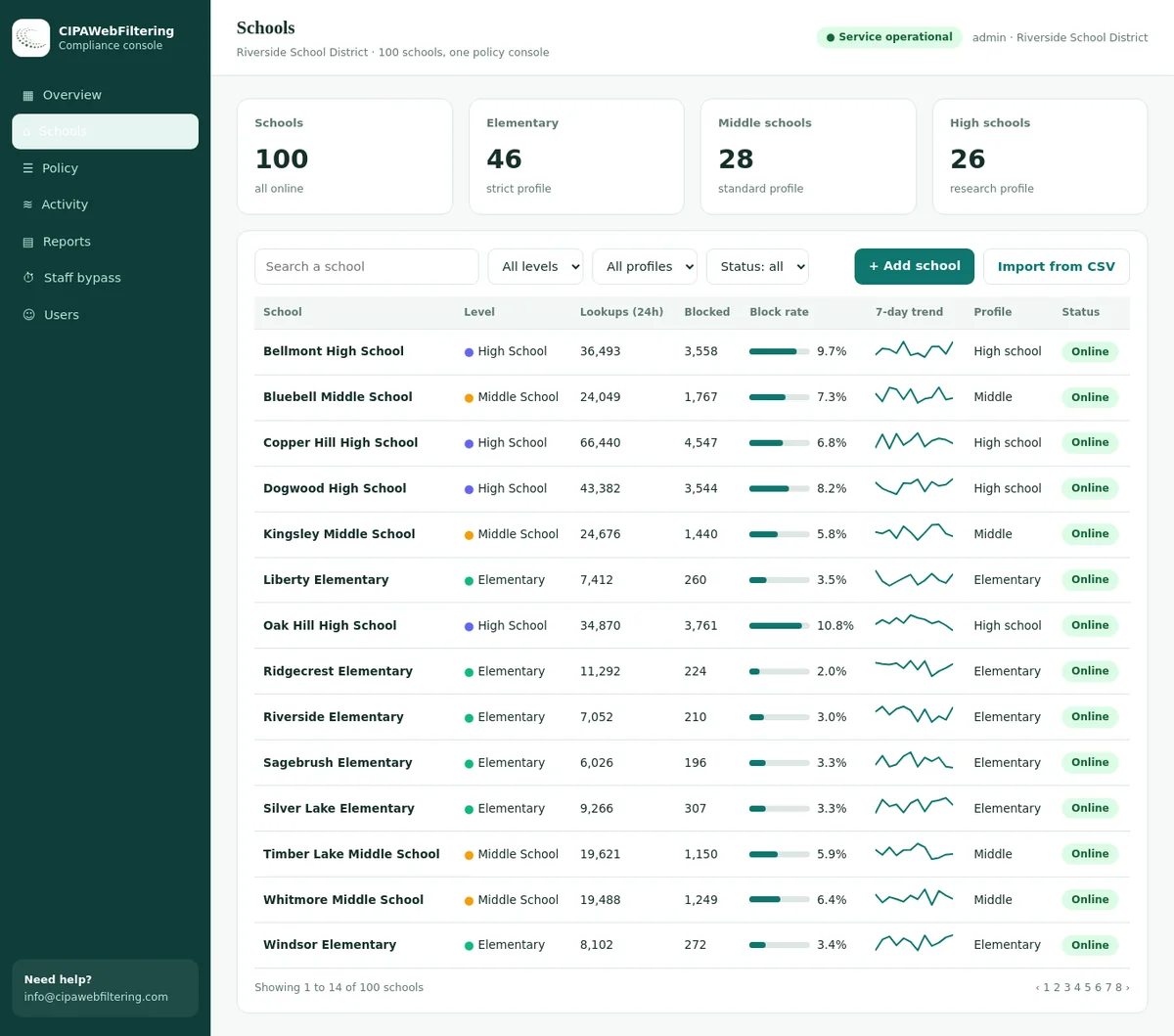
The hosted CIPA filter treats each library or branch like a school: its own category settings inside one console. We run it, and you point your router or firewall at a single DNS address.
- Adult and VPN/Proxy/Anonymizers are switched on by the CIPA preset
- Each branch can keep different always-allow and always-block lists
- Public computers need nothing installed on them
Who has to comply — and what compliance means
The trigger is funding, not library type. Accept E-Rate discounts on internet access or internal connections, or apply certain LSTA technology funds to connectivity, and CIPA's conditions attach. A library funded purely by local taxes with no federal connectivity support can choose its own filtering posture; the moment discounted internet enters the budget, certification follows.
Compliance has a technical half and a policy half. The technical half is the filter itself, blocking the three statutory content classes on computers with internet access — including staff machines, not just the public floor. The policy half is an internet safety policy addressing minors' access, safety and security in direct communications, unauthorized access, unlawful disclosure of minors' personal information, and measures to restrict the harmful content, adopted with public notice and a hearing or meeting.
- E-Rate internet discounts → CIPA certification required
- LSTA funds used for connectivity → filtering conditions apply
- Filter covers public and staff computers alike
- Policy adopted after public notice — keep the minutes in your file
What your compliance file should hold
Category-level filter reports slot directly into items 2 and 3 — evidence an auditor can absorb in one sitting.
The five surfaces a library filter has to cover differently
A library is not one audience on one network. Effective policy starts by naming the distinct surfaces and letting each carry its own rules from the same category data.
Adult public terminals
The baseline CIPA categories are blocked; nearly everything else lawful stays open, from medical research to dating sites that a school would never permit. This is where the disable-for-adults provision operates, and where over-blocking causes the most legitimate complaints.
Children's area terminals
Machines in the children's room run a materially stricter profile — closer to an elementary-school policy — with SafeSearch enforced and harmful-to-minors categories interpreted broadly, because the audience is defined by the furniture, not a login.
Guest Wi-Fi
The open network serves whoever walks in, on their own devices, with no account to distinguish twelve from forty. Most libraries run a single filtered profile here that satisfies CIPA's floor without attempting age tiers the network cannot verify.
Staff workstations
Frequently forgotten and explicitly in scope: CIPA's filter requirement reaches library computers generally, staff included. Staff profiles are typically lighter than public ones but still block the statutory categories.
Catalog kiosks & loaner devices
OPAC stations locked to the catalog need almost no policy; loaner tablets and take-home hotspots need the full public policy riding with them — the same device-borne enforcement logic school 1:1 programs use.
Shared-space sightlines
Filtering is also a physical problem: an adult terminal's screen may face the teen section. Zoned policy plus sensible floor layout — privacy screens, terminal placement — does what neither can do alone.
A disable request, handled well
Desk: confirms adult status, no purpose interrogation beyond lawful use
Action: filter disabled for that session on that terminal, or the specific site unblocked
Record: logged with date and terminal — not the patron's reading list
Session-scoped, promptly honored, minimally recorded: the workflow that satisfies both the statute and the intellectual-freedom policy on the same afternoon.
The disable-for-adults provision, taken seriously
CIPA contains a clause schools never use but libraries must operationalize: an authorized person may disable the technology protection measure for an adult to enable bona fide research or other lawful purposes. Following the Supreme Court decision that upheld CIPA for libraries, the working understanding is that adult patrons should be able to have the filter disabled or a lawful site unblocked without undue delay or burdensome justification.
That legal nuance has practical teeth. A filter suited to libraries needs session-level disable that staff can trigger in seconds, scoped to one adult's session on one machine — not a building-wide switch nobody dares touch. It needs per-site unblocking as the lighter-weight alternative when the whole filter need not come off. And it needs logging that records that the mechanism works without recording what the patron read, because patron-privacy principles reach filtering records too.
Libraries that get this wrong in either direction pay for it: refuse or stall adult requests and you invite legal and reputational challenge; make disabling so informal it bleeds into minors' sessions and your certification weakens. A crisp, documented, session-scoped procedure is the whole answer.
What CIPA expects for minors vs. adult patrons
The same law draws different lines for different patrons. Your filter configuration should mirror the distinction instead of flattening it.
| Question | Minors | Adult patrons |
|---|---|---|
| Obscene material & CSAM blocked | Yes, always | Yes, always |
| "Harmful to minors" category blocked | Yes — the defining extra layer | Not required for adults |
| Filter may be disabled on request | No — specific sites may be reviewed & unblocked | Yes, for lawful use by an authorized person |
| Activity monitoring expected | Yes, per the internet safety policy | Reading privacy prevails |
| Typical terminal profile | Children's/teen zone, SafeSearch enforced | Statutory floor only, broad lawful access |
Time-limited access for an authorised person
The filter offers a staff PIN for adult research that lasts 15, 30 or 60 minutes, then switches back and is logged. VPN/Proxy stays blocked even when the PIN is used.
Precision is what makes the balance possible
Every hard library case — the health site that mentions anatomy, the art archive, the LGBTQ teen resource — is a classification problem before it is a policy fight. Better data means fewer fights.
How library staples and health resources are labelled
Precision means these catalogue, lending and health sites are not mistaken for something else. The rows below are real entries.
| Site | Category |
|---|---|
| archive.org | Education/Reference |
| worldcat.org | Education/Reference |
| overdrive.com | Education/Reference, Arts & Entertainment |
| hoopladigital.com | Arts & Entertainment |
| plannedparenthood.org | Health & Medicine |
Standing up compliant library filtering in five steps
A single branch can complete this in days; a county system, in a few weeks. None of it requires new hardware if you choose cloud deployment.
Confirm your funding triggers
Establish exactly which E-Rate discounts and LSTA funds the library receives and therefore which certifications apply. This determines scope — and tells purely locally funded branches in your consortium what is optional for them.
Zone the building and the network
Inventory terminals and networks into audiences: adult floor, children's and teen areas, guest Wi-Fi, staff, kiosks, loaners. Each zone becomes a policy target; VLANs or terminal groups you already have usually map cleanly.
Set category policy per zone
Apply the statutory floor everywhere, add harmful-to-minors and SafeSearch layers in children's and teen zones and on guest Wi-Fi, and leave adult zones otherwise open. Category-based rules across 57+ categories make each zone a short, legible list rather than a thousand-line blocklist.
Wire up the human workflows
Configure session-scoped disable for adult requests, a quick per-site unblock path, and a review queue for miscategorization reports. Train desk staff on all three — the front desk, not the server room, is where compliance meets patrons.
Adopt, publish, file
Take the internet safety policy through public notice and a board hearing, post it beside the terminals and on the website, and file the adoption record with your certification paperwork. Category reports then keep the file current year over year.
The library situations that test a filtering setup
Every library has a few scenarios the vendor demo never mentioned. These four come up constantly in our conversations with directors, and each has a clean answer under zoned, category-based policy.
Bookmobiles and lent hotspots
Connectivity that leaves the building — a bookmobile's satellite link, a checked-out hotspot, a loaner tablet — still represents library-provided internet access. Device- or hotspot-level enforcement carries the appropriate zone profile along, so the children's-program bookmobile runs children's rules in a grocery-store parking lot, and a hotspot lent to a family enforces the guest-network policy in their kitchen.
The after-school surge
At 3:15 the adult reading floor fills with unaccompanied middle schoolers using whatever terminal is free. Libraries handle this with teen-profile terminals in the areas students actually occupy, time-based tightening of specific terminals during after-school hours, or library-card logins that carry an age profile to any machine — the card approach being the most precise where the ILS supports it.
Digital-literacy classes
Staff teaching seniors to spot scams, or teens to evaluate sources, sometimes need to display the very content the filter blocks. A time-boxed instructor exception for a training room — scoped like a school's teacher allow-list — lets the lesson proceed without loosening a single public terminal.
AI tools at public terminals
Patrons increasingly arrive to use AI chatbots and generators — sometimes legitimately, sometimes in ways that raise safeguarding flags on shared machines used by minors. Our AI Tools database classifies more than 11,800 such domains in categorized groups — delivered via REST API, CSV, DNS/RPZ or any other supported format — so a library can allow mainstream assistants on adult terminals while holding back companion-chat and deepfake tools in teen and children's zones.
Filtering and intellectual freedom can coexist
The tension is real but narrower than the loudest versions of the debate suggest. CIPA obliges a library to block three specific classes — not to curate taste, not to shield adults from controversy.
The real problem was crude tools
The damage to intellectual freedom historically came less from the mandate than from crude filters: blocking breast-cancer resources with pornography, sex-education with obscenity, art museums with adult content. The remedy is classification that is both precise and multi-dimensional — a health site is recognized as health even when its subject matter is anatomical.
Practices that keep the balance visible
Publish the list of blocked categories so patrons can see how narrow it is. Make the miscategorization-report path obvious. Honor adult disable requests without interrogation. Report annually to the board — aggregate numbers, never reading histories. Libraries that adopt these habits find the filtering controversy largely evaporates.
Related resources
Two resources pair well with this page: our plain-English explainer on what CIPA is and requires, and the template-driven guide to writing an internet safety policy, both applicable to libraries as well as schools. Districts whose school libraries share the building's network will also want web filtering database for schools.
Running filtering across a library system, task by task
The questions below come up when a director compares options.
| Task | Separate filter per branch | Hosted CIPA filter |
|---|---|---|
| Setting up a new location | Configure another box | Add it to the console and point its DNS at the filter |
| Different rules for children's areas | Hard to keep consistent | Separate settings per branch |
| Lifting a block for one adult request | Turn the filter off | Logged PIN for 15, 30 or 60 minutes, then it reverts |
| Evidence for the E-Rate file | Collect from each location | Activity reports, policy record and log export |
| Patrons using a VPN | Often succeeds | VPN/Proxy blocked, even with a PIN |
Questions library directors ask us
It applies to both. Public libraries that receive E-Rate discounts for internet access, or that use certain LSTA funds for connectivity, must certify CIPA compliance: a technology protection measure blocking obscene material, child sexual abuse material and content harmful to minors, plus an internet safety policy adopted after public notice and a hearing. Libraries with no such federal connectivity funding are not bound by CIPA and filter, or not, by local choice.
CIPA permits an authorized person to disable the filter for adults engaged in bona fide research or other lawful purposes, and the prevailing post-litigation practice is to honor adult requests promptly and without demanding justification. Build it as a session-scoped action staff can perform at the desk, log that it happened without logging what was read, and reserve refusal for clearly unlawful use.
Run a single profile on the open network that blocks the statutory categories plus a harmful-to-minors layer — the conservative choice given that children demonstrably use it. Some libraries add a second SSID or a librarian-provided access code for adults who need broader access on personal devices, mirroring the terminal-side disable workflow.
Yes — CIPA's filtering requirement covers the library's internet-connected computers generally, staff machines included. Staff profiles are usually configured with only the statutory floor, and the disable provision remains available for legitimate staff needs such as collection development or investigating a patron report.
Two paths, both fast: an adult can have the filter disabled for their session, and anyone can flag the site for review. Because domains carry multiple category labels and updates ship daily, a genuine miscategorization is corrected once and stays corrected — and precision classification makes such cases rare to begin with. The block page should advertise both paths.
It should not. Zoned policy is the design CIPA's own minor/adult distinction invites: children's-area terminals run a strict profile with SafeSearch enforced, teen zones something intermediate, and adult terminals the statutory floor only. All zones draw on the same category data, so the configuration burden is a handful of profiles, not parallel systems.
Light, by design. Cloud deployment means no on-site appliance; zone profiles are set once and rarely touched; new and reclassified domains update daily without maintenance; and the day-to-day human tasks — a disable here, an unblock review there — live at the circulation desk. Systems that prefer local control can run the same filtering on-premise. See pricing for small-library tiers.
Pricing depends on the number of branches and devices, and a quote comes within one business day. A pilot at one branch shows the blocks and reports so your board can see them first.
Compliant for the auditors. Defensible to your board. Fair to every patron.
Walk through zoned policies, the adult disable workflow and the certification paperwork with us — we'll show you exactly how a library your size runs it.