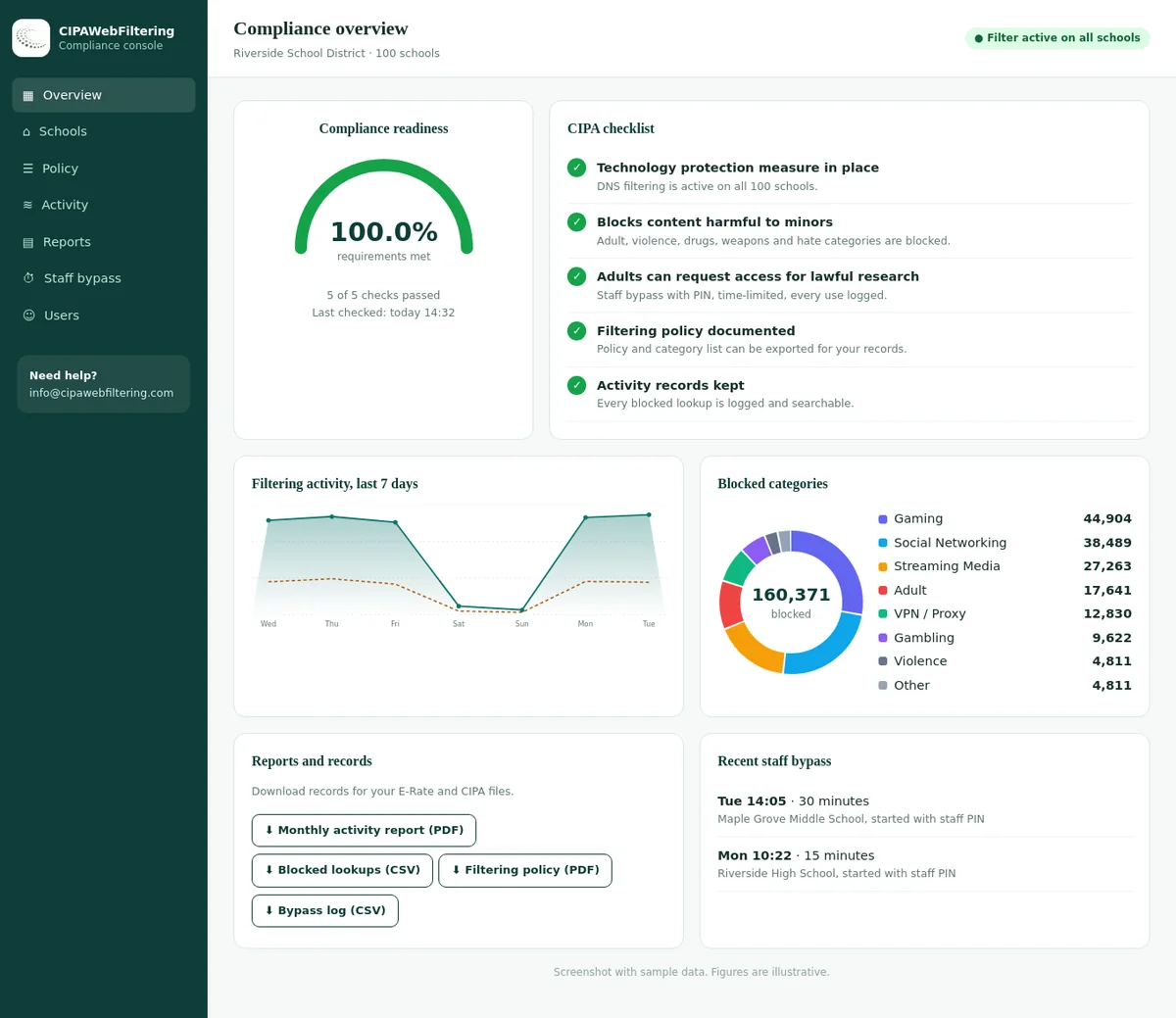
Block what the law requires. Keep what classrooms need. Follow every device home. Hand auditors the evidence—not a story.
Minors on your network will not reach obscene material, child sexual abuse material, or content harmful to them. Keeping that promise across thousands of students and a web that adds hundreds of thousands of domains daily is what a CIPA web filter does—and all we build.
Policy decisions happen by category rather than by chasing individual URLs. A technology director sets one rule—block adult content for students, everywhere, always—and every matching site is covered automatically, including ones registered this morning.
The same engine that powers category filtering also enforces SafeSearch on major platforms, applies grade-band policies from kindergarten to senior year, and follows 1:1 devices home.
Good filtering does not wall off the internet until teaching becomes impossible, force a librarian to defend a block she cannot explain, or treat every student as the same user. Category-based policy by grade band keeps the law and your community requirements while leaving the rest open for learning.
Below is a quick tour of what the platform does, who it serves, and how a rollout actually goes. When you are ready to see it against your own traffic, a demo takes about thirty minutes.
Six capabilities, one categorized database underneath. Start with the piece most urgent for you—they all work together.
Category-based filtering tuned for classrooms: harmful content blocked by default, education and reference left open, exceptions granted in seconds.
The technology protection measure your E-Rate certification depends on, plus category-level records that show auditors exactly what is enforced.
16,328+ AI-tool domains—essay writers, homework solvers, deepfake and companion apps—organized so you allow instruction and block the rest.
One policy language across every building, delegated admin for site techs, and consolidated reporting the central office can actually use.
Policy that travels with managed Chromebooks and laptops, so the take-home hours are filtered the same way third period is.
Lightweight, appliance-free enforcement at the DNS layer—a fast path to compliant filtering for smaller schools and libraries.
Blocking decisions are data decisions. Ours rest on one of the largest continuously refreshed domain classification datasets anywhere—see the full breakdown on our coverage page.
Different chairs, same accountability. The platform gives each role the piece they need without making anyone a full-time filter administrator.
You get one policy console for the whole district, audit-ready category reports, and a vendor whose entire product is the thing you are certifying.
Cloud or on-premise deployment, no per-school appliances required, HTTPS traffic handled, and exceptions that take seconds instead of a change-request cycle.
Category-based decisions are explainable to a parent or a board member, research resources stay reachable, and CIPA-required blocking never turns into blanket censorship.
The Children’s Internet Protection Act ties E-Rate discounts to three commitments: a technology protection measure, an adopted internet safety policy, and monitoring plus education. The filter is the technical half—and the half you prove with data.
Our CIPA web filtering maps the required content directly onto named categories blocked by default for minors and logged continuously. When certification season arrives, you export category-level evidence instead of reconstructing a year of decisions from memory.
We supply the first line outright and the evidence trail for the rest. Full details →
18 categories and 165+ subcategories, updated daily from a screen of roughly 300,000 newly registered domains. Delivered as CSV, DNS/RPZ blocklist, PAC or hosts files, firewall EDL, or API.
New AI tools launch every week, and most legacy filters file them under a vague “technology” category or miss them entirely. Meanwhile teachers are grading AI-written essays, counselors are handling deepfake incidents, and students are pasting personal information into chatbots nobody has vetted.
Our bundled AI tools blocklist treats this as its own discipline: every tool categorized by what it actually does, so you can permit the AI your instruction plan calls for while holding back essay mills, companion chat, and face-swap apps.
Cloud deployments have gone live in an afternoon. Most districts take a deliberate two to four weeks so staff are never surprised by a block page.
Choose cloud—no appliance, enforced by DNS or a lightweight agent—or on-premise if policy requires filtering to stay inside your network.
Start from a CIPA-aligned baseline, then tighten for elementary and open up for high school. Policies attach to user groups and buildings.
Push the same policy to managed Chromebooks and laptops so filtering follows students home—the gap that sinks more compliance stories than any other.
Category-level reporting shows the board what is blocked and why, feeds your E-Rate paperwork, and surfaces the decisions that genuinely need a human.
The best filter is one nobody notices. When a student opens a page, the request is checked against a categorized view of that domain in milliseconds—the filter reads which content categories the site belongs to, compares them against the policy for that user, grade band and time of day, and either serves the page, shows a friendly block notice, or lets it through with SafeSearch enforced.
Because one site can be several things at once, domains carry multiple category labels rather than a single verdict. A streaming platform can be Video, User-Generated and Adult all at the same time, and your policy weighs all three.
Change the user to a third grader and the same lookup returns a block—same database, same domain, a different defensible answer.
Every tier is cloud-first with no per-appliance fees, built to fit E-Rate-funded environments. Quotes are sized to your enrollment, not a one-size rate card.
Core category filtering, SafeSearch enforcement and baseline reporting for one building.
Multi-school policy, delegated admin, off-campus 1:1 coverage and full CIPA reporting.
Everything in District plus the 16,328+ AI-tools blocklist in every delivery format.
Custom deployment, on-premise option and SLA for consortia and state programs.
Guides written for the questions we hear from technology directors every week—no registration walls, no sales gate.
The law in plain English: what it requires, what it does not, and who it applies to.
A step-by-step worksheet for getting your certification story in order.
How the discount program and the filtering requirement fit together.
The numbers behind the filter: 120M+ domains, 57+ categories, daily updates.
Filtering carries baggage from a decade ago, when filters were blunt, slow and famous for blocking the wrong things. Here is where the reality now sits.
Most districts we talk to are not buying their first filter—they are escaping one. The stories rhyme: an appliance approaching end-of-life with a five-figure refresh quote, a legacy category list that has not learned a new site since the contract started, take-home Chromebooks falling off the filter the moment they leave the parking lot.
Because our cloud tiers need no hardware, a pilot runs alongside your current filter—same users, same sites, two verdicts. Districts typically discover legitimate classroom sites their old filter had been silently blocking for years, and a long tail of new domains their old database had simply never met.
Filtering built for enterprises treats schools as small businesses with louder stakeholders. Filtering built for CIPA starts from the certification you sign, the grade bands you teach, and the board meeting where you may have to explain a single blocked page. That second thing is what we build—and all we build.
Bring your top student-visited sites to a 30-minute demo and watch how category policy, the AI blocklist and off-campus enforcement would handle them—then get a quote sized to your enrollment.