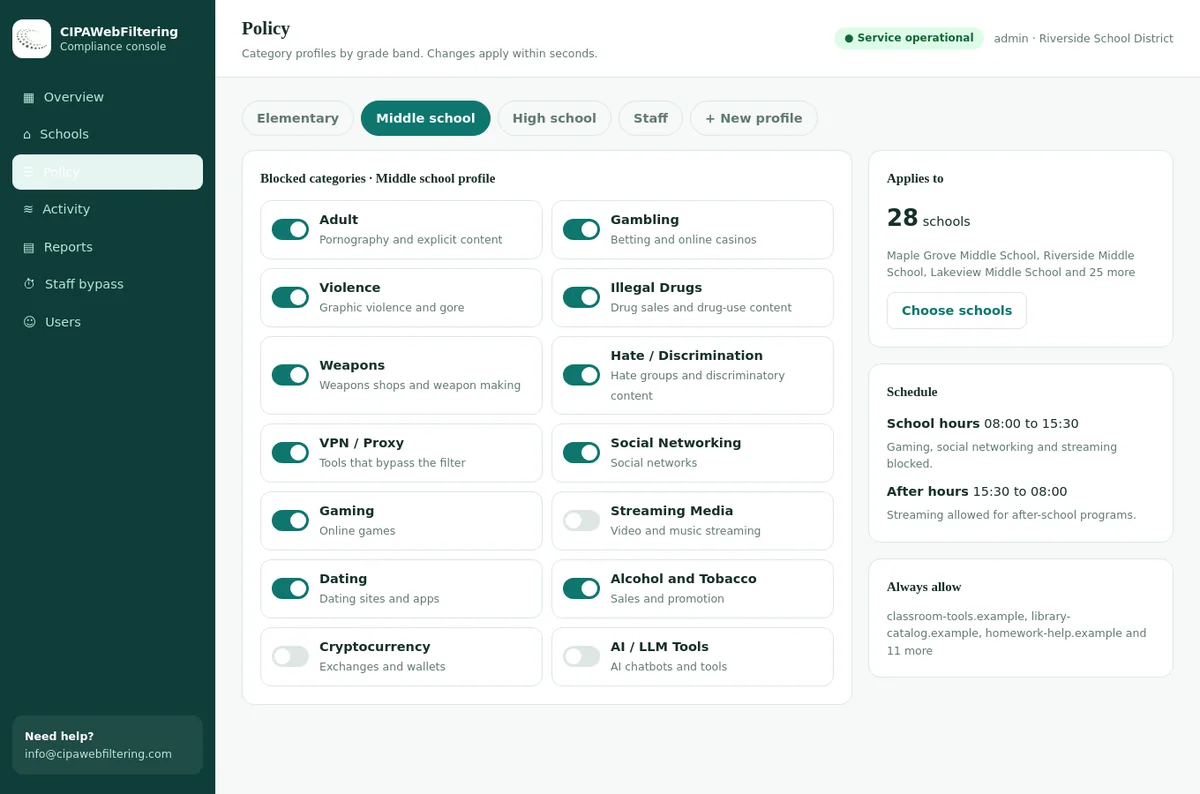
Category-Driven Protection

Content Filtering Software for Schools

A school filter earns its keep in the small moments: the search a fourth grader runs at 9:15, the video a substitute teacher queues up after lunch, the site a sophomore tries on a take-home Chromebook at night. This page explains what the software actually does in those moments — how categories are assigned, how mixed sites are judged, and how the record of it all becomes your audit evidence.

57+
Content CategoriesCovering the full spectrum of web content
120M
Domains ClassifiedContinuously updated threat intelligence
24h
Daily Category RefreshNew domains classified as they appear
3
Grade-Band PoliciesElementary, middle & high school rules

CIPA Compliant
120M+ Domains
57+ Categories
Daily Updates
Cloud & On-Premise
Take-Home Ready
Fit

Sized for a one-person tech office or a whole district

The same filtering model scales down and up, because categories do the heavy lifting instead of headcount.

Independent & Charter Schools

Often one administrator wears every technology hat. A filter that classifies new sites automatically and only escalates genuine judgment calls keeps compliance achievable without a network team.

Compliance-Ready

Districts

Central policy, building-level flexibility, one reporting surface. Standardizing across schools ends the patchwork where each campus filters differently and nobody can produce a district-wide answer at audit time.

Scalable

Libraries

Public and school libraries under E-Rate face the same certification with a more varied patron base. Category policy distinguishes minors' sessions from adult research without turning librarians into referees.

E-Rate Eligible

E-Rate Certification

Schools and libraries taking E-Rate discounts certify that a technology protection measure is enforced. Category reports show, in plain language, that obscene material and content harmful to minors are blocked district-wide — the evidence a reviewer wants to see.

Counselors & Safety Staff

Repeated attempts to reach self-harm or weapons content are a signal, not just a statistic. Because CIPA also expects schools to monitor minors' online activity, category visibility doubles as an early-warning channel for student wellbeing.

Board & Parents

A superintendent presenting to the board does not need packet logs; they need "here are the categories we block for each age group, and here is how often the filter intervened." Reporting by named category turns a technical system into a governance story parents can follow.

Foundation

Why categories are the unit of school filtering

Imagine writing a rule for every website a student might visit this year. Even a modest district would need millions of individual decisions, refreshed constantly, because the web adds new domains every single day. No technology office has that kind of time, and no manually curated list survives contact with a bored teenager and a search engine.

Categories collapse that impossible task into a manageable one. When 120 million domains are already sorted into 57+ content categories — from adult material and gambling to games, streaming video, weapons, and self-harm — a policy becomes a short document a curriculum director can actually read. "Block these fourteen categories for elementary students" is a sentence a school board can debate; a spreadsheet of URLs is not.

Why it works

The practical test: when a teacher asks "why was this site blocked?", a category-based filter answers with a reason — "it is classified as Gambling" — not a shrug. Explainability is what separates workable web content filtering for schools from a black box that erodes staff trust.
Always ahead: Just as important, categorization keeps working on sites nobody in your district has ever visited. New domains are classified as they appear, so a page registered this week already carries labels by the time a student finds it. The filter's knowledge grows ahead of your users, which is the only direction that keeps children safe.

One platform, three verdicts

Elementary: Streaming Media blocked→ page stopped
Middle school: allowed, SafeSearch on→ restricted
High school: Video allowed for coursework→ page loads

Same domain, same category labels — three age-appropriate outcomes, because policy is set per grade band rather than per site.

Precision

Mixed-content sites: where single-label filters fail

The hardest sites to filter are not the obviously bad ones — they are the enormous platforms that host everything at once. A video service carries physics lectures and content no ten-year-old should see. A forum hosts a homework-help community three clicks from something else entirely.

That is why every domain in our database can hold multiple category labels at the same time. A single site might be classified as Video and Streaming Media and User-Generated Content, and your policy reads all of those labels together before deciding.

The result is precision instead of the two bad options schools historically faced: blocking an entire platform teachers depend on, or opening it completely and hoping. Multi-category classification, combined with SafeSearch enforcement on search engines and video platforms, lets the same site be usable in a high school classroom and invisible to a first grader.

  • One domain, several labels — policy weighs them all
  • SafeSearch enforced so open platforms stay classroom-safe
  • HTTPS and encrypted sites still resolve to their categories
  • Per-site exceptions layer on top when a lesson needs one
AI Coverage

A note on AI tools

Any current evaluation of school filtering has to ask about generative AI, so here is the short version. Alongside the main category database, the filter bundles a dedicated blocklist of more than 16,000 AI-tool domains — essay writers and paraphrasers, homework and code solvers, image generators, deepfake and face-swap tools, voice cloning services, and AI companion chatbots — organized into its own categories and updated daily.

That granularity means "AI" is not one switch. A district can permit approved tools for instruction while blocking the ones that undermine academic integrity or invite students to paste personal information into ungoverned services. It is one section of the policy, managed the same way as every other category, which is exactly how it should feel.

AI tool categories

BlockedEssay Writers
BlockedDeepfake Tools
RestrictedCode Solvers
RestrictedImage Generators
ApprovedClassroom AI
ApprovedResearch Assistants

16,000+ AI-tool domains organized by function, updated daily.

The life of a block, well handled

1

Student hits a block page

The page names the category and offers a polite explanation instead of a cryptic error, so the moment teaches rather than frustrates.

2

Teacher requests a review

A link on the block page routes the request to the right administrator with the site and category already attached.

3

Scoped exception granted

The site is opened for one class, one grade band, or one building — not for the whole district — and the change is logged.

Workflow

Good filtering fails gracefully

No classification of 120 million domains will match every lesson plan on every campus, so the honest measure of web content filtering for schools is what happens after a disagreement. A teacher preparing a unit on public health may genuinely need a page the policy stops; a filter that makes fixing that painful trains staff to route around it.

The exception workflow is therefore part of the product, not an afterthought. Block pages explain themselves, review requests carry context, and approvals apply exactly as narrowly as you choose. Because every exception is recorded next to the category data, your audit trail stays complete even as the policy flexes around real teaching.

Districts that run this loop well report an unexpected benefit: trust. When staff see that blocks are explainable and reversible within a class period, the filter stops being "the thing IT uses to say no" and becomes shared infrastructure — which is what keeps a policy enforced in spirit, not just in packets.

  • Block pages that state the category and the appeal path
  • Exceptions scoped to a class, group, or building
  • Every change logged alongside category reporting

Freshness

A filter is only as current as its data

Yesterday's classification of yesterday's internet protects nobody. The database behind the filter is rebuilt around a daily rhythm.

120M+Domains under classification
57+Categories, multiple per site
24hUpdate cadence
Day 1New domains covered at launch
Cloud deployment On-premise option Encrypted-traffic aware Follows take-home devices

The job to be done

What the software does during one school day

Strip away the vendor language and content filtering software for schools performs the same cycle thousands of times an hour. Here is that cycle, from the first bell to the evening homework session.

1

A request leaves a student device

A browser asks for a page. Before anything loads, the filter intercepts the request — on the school network or, for a managed take-home device, wherever that device happens to be connected.

2

The domain is looked up in a categorized map of the web

The site is matched against a database of more than 120 million classified domains. The answer is not "good" or "bad" — it is a set of named categories, because most of the web resists a single label.

3

Categories meet the policy for that student

An elementary policy, a middle school policy, and a high school policy can all read the same lookup differently. The rules for the user's grade band, group, or building decide whether the page opens, opens with SafeSearch enforced, or stops at a block page.

4

The decision is written down

Every allow and every block lands in category-level reporting. Months later, that quiet logging is what lets you answer a parent's question or an E-Rate reviewer's request in minutes instead of days.

Coverage

What 57+ categories look like in practice

Categories cluster into a handful of policy conversations. These are the groups school technology directors actually configure, and the questions each one answers.

Always blocked

Core CIPA content

Adult content, obscene material, and content harmful to minors — the core of what CIPA requires a school's technology protection measure to stop, for every age group, without exceptions.

Judgment calls

Grade-band dependent

Games, streaming video, social platforms, shopping. Legal everywhere, disruptive in a classroom, sometimes useful in one. These categories carry different rules per grade band.

Safety-sensitive

Early-warning signal

Self-harm, weapons, drugs, hate content. Blocking is only half the value — visibility into attempted visits gives counselors an early signal that a student may need help.

Open for learning

On by default

Education, reference, news, and research categories stay available by default, so protecting students never means shrinking the library they learn from.

Reporting

The report is the product

Blocking happens silently; reporting is where the filter becomes visible to the adults responsible for students. Category-level reports serve four different audiences, each with a different question.

For the E-Rate certification

Schools and libraries taking E-Rate discounts certify that a technology protection measure is enforced. Category reports show, in plain language, that obscene material and content harmful to minors are blocked district-wide — the evidence a reviewer wants to see. Our guide to what CIPA requires covers the certification in detail.

For the board and parents

A superintendent presenting to the board does not need packet logs; they need "here are the categories we block for each age group, and here is how often the filter intervened." Reporting by named category turns a technical system into a governance story parents can follow.

For counselors and safety staff

Repeated attempts to reach self-harm or weapons content are a signal, not just a statistic. Because CIPA also expects schools to monitor minors' online activity, category visibility doubles as an early-warning channel for student wellbeing.

For the IT team

Which categories generate the most blocks? Which teacher requests keep recurring? Reports tell your team where policy is too tight, too loose, or exactly right — so tuning is driven by evidence rather than by whoever emailed last.

Evaluation

School-grade filtering vs. a generic business filter

Plenty of districts inherit a filter designed for offices. It technically blocks websites — and misses almost everything that makes filtering work in a school.

Age-differentiated policy

Separate rules per grade band and building, not one policy for every user.

School filter Business filter

CIPA-aligned categories

Obscenity and harmful-to-minors content mapped to named categories, not just a productivity focus.

School filter Business filter

Mixed-content platforms

Multi-category labels enable nuanced verdicts instead of allow-or-block the whole domain.

School filter Business filter

Take-home 1:1 devices

Policy travels with managed devices off campus instead of ending at the office door.

School filter Business filter

Audit-ready reporting

Category-level evidence for E-Rate review, not raw logs assembled by hand.

School filter Business filter

AI tools in class

Dedicated, daily-updated AI blocklist instead of untracked or lumped into "technology."

School filter Business filter
Selection

How to judge the best content filter for schools

Rankings and award badges tell you very little, because the best content filter for schools is the one that fits how your district actually runs. The good news is that fit can be tested with a handful of concrete questions during a pilot, before any contract is signed.

Test with real traffic

Start with coverage: pull the fifty sites your teachers used last week and the fifty you most need blocked, and check how each is categorized. Depth matters more than a demo — a database spanning 120 million domains with daily updates behaves very differently from a thin list once real students start browsing. Then test the awkward cases: mixed-content platforms, brand-new domains, encrypted sites.

Evaluate policy expressiveness

Next, look at policy expressiveness. Can you write different rules for an elementary building and a high school without running two systems? Can a librarian get an exception approved without a support ticket to a vendor? Web content filtering software for schools succeeds or fails on these workflows, because they are what your staff will touch every week.

Choose your deployment

Finally, decide how you want to run it. The same categorized dataset can be delivered as cloud-based filtering with nothing to install, or on-premise for districts that want filtering decisions kept inside their own network. Deployment is a preference; the data underneath is what does the protecting.

See the full picture

For a broader look at the whole product, see our overview of web filtering software for schools. It covers every layer — from database depth to deployment options — so you can compare with the full context of what school-grade filtering means in practice.

FAQ

Questions we hear while districts evaluate

Whatever your policy says, expressed in categories. Every school blocks the CIPA core — obscene material, child sexual abuse material, and content harmful to minors — and then makes local choices about categories like games, streaming, social platforms, and AI tools, usually varying by grade band. The software supplies the classification of 120 million+ domains; your district supplies the judgment.
Through multi-category classification. A domain can carry several labels at once — for example Video, Streaming Media, and User-Generated Content — and the policy evaluates all of them, together with SafeSearch enforcement, before deciding. That lets a platform be available to seniors for coursework while remaining blocked for younger students, instead of forcing an all-or-nothing call.
It satisfies the technology protection measure, which is the technical requirement. CIPA also expects an internet safety policy, monitoring of minors' online activity, and educating students about appropriate online behavior and cyberbullying. The filter supports the monitoring piece through its reporting, but the policy and education pieces are commitments your school makes alongside it.
New domains are classified as they appear, and the category database refreshes daily. In practice that means a site registered this week already resolves to categories by the time students discover it — closing the window that manual blocklists always leave open between a site going live and someone reporting it.
Over-blocking is a policy problem more than a software problem, and categories are the cure. Education, reference, and news categories default to open, mixed platforms get nuanced treatment rather than blanket bans, and per-site exceptions take moments to grant. Districts typically see teacher complaints fall after moving from a crude filter to a categorized one, because blocks become rarer and every block comes with a stated reason.
Encrypted sites still resolve to their categories, so HTTPS is not a bypass. And on managed take-home devices, the policy travels with the device — the same rules apply on a home network or public Wi-Fi as in the classroom. Determined circumvention attempts also show up in reporting, which gives staff a conversation to have rather than a blind spot.
Pricing scales with the size of your deployment — see current pricing for tiers. Most schools start with a short pilot: point one building or lab at the filter, load a starter policy per grade band, and spend a week confirming that everyday classroom sites pass cleanly before rolling out district-wide.

Put your school's real traffic through it

Bring the sites your students visit and the ones that worry you. We will show you exactly how each is categorized, what your grade-band policies would do, and what the resulting reports look like.