North Carolina School Internet Safety Laws After HB 959
In 2025 North Carolina wrote social media blocking, classroom phone limits and social media literacy into state law. Here is how HB 959 sits on top of CIPA and what it changes in your filter.
What CIPA requires in North Carolina schools
Every North Carolina school or library taking E-Rate discounts for internet access or internal connections must meet CIPA first. HB 959 builds on that. Background: what is CIPA.
Technology protection measure
A filter that blocks visual depictions that are obscene, child pornography or harmful to minors on computers minors use. Obscene material and child pornography are blocked for adults too.
Internet safety policy
Covers minors' access to inappropriate material, safety in email and chat, hacking, disclosure of minors' personal information and filtering. Adopted after public notice and a hearing or meeting.
Monitoring and education
Monitoring of minors' online activity and teaching appropriate online behavior, including social networking and cyberbullying awareness.
Certification
Schools and libraries certify on FCC Form 486, consortium members on Form 479. See E-Rate and CIPA funding for how audits work.
Make the HB 959 social media block real on school Wi-Fi and school devices
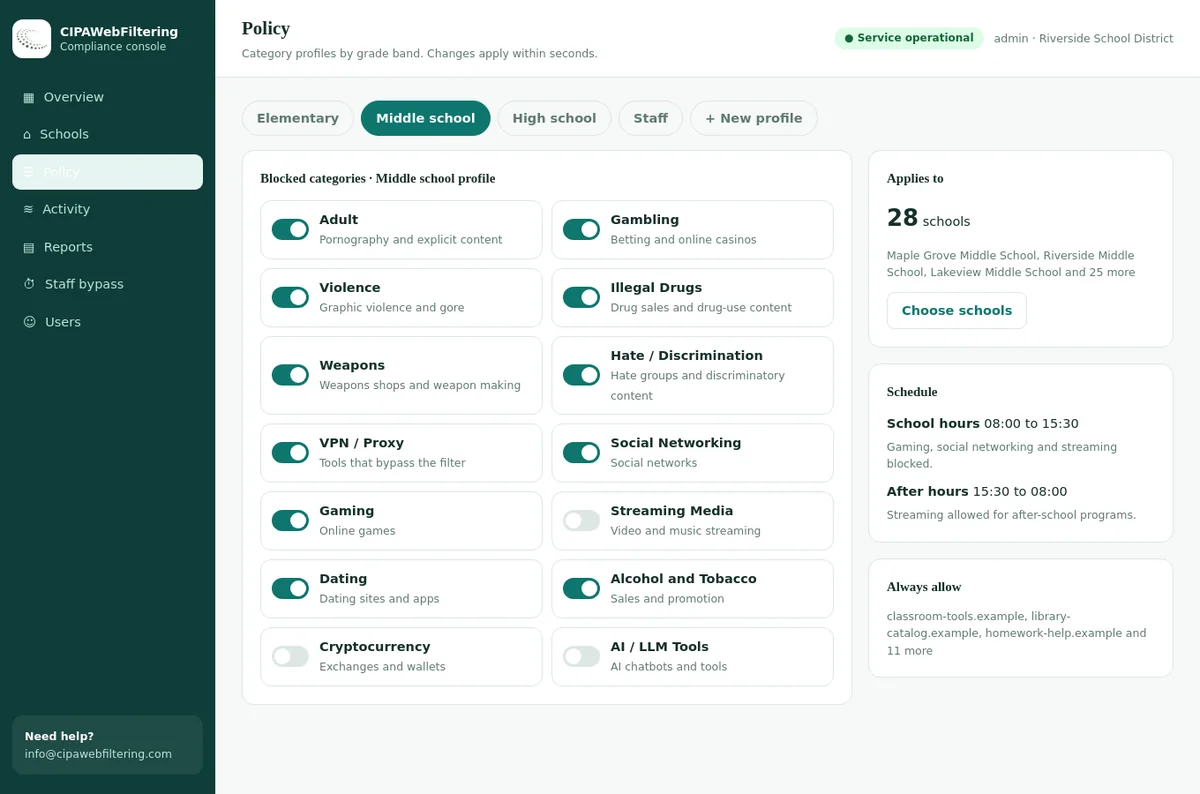
North Carolina boards must prohibit and prevent student access to social media on school-provided devices and internet, and a written rule alone will not do that. Our hosted CIPA filter blocks by category, so the Social Networking switch sits next to the CIPA preset in one console.
- Student and guest Wi-Fi can follow the same social media rule as school laptops
- VPN/Proxy/Anonymizers stays blocked, so the rule is hard to route around
- A private encrypted link keeps the rule on a take-home laptop at night
HB 959 (2025): what North Carolina adds to CIPA
HB 959 passed the House unanimously and the Senate with one vote against, and was signed on 1 July 2025 as Session Law 2025-38. Its school technology provisions are summarised here in our own words.
Student internet access policies
Local boards must adopt policies for student access to the internet on devices or internet services the school unit provides.
This turns your filtering rules into a board-level, state-required policy.
Prohibit and prevent social media access
One required element is to prohibit and prevent student access to social media platforms on those devices and services.
The exception: use a teacher expressly directs solely for educational purposes.
Wireless devices off in class
Boards must adopt policies that bar students from using, displaying or having wireless communication devices turned on during instructional time.
The definition is broad and reaches beyond phones to other personal devices.
Social media literacy
Students receive instruction on social media, covering topics such as mental health, addiction, misinformation, cyberbullying and online safety.
Reported to begin in 2026-27 at elementary, middle and high school levels.
Board policy timing
Reports give 1 January 2026 as the deadline for local board policies under the new section.
If your board has not adopted them yet, treat it as urgent and check NC DPI guidance.
State compliance reporting
The Department of Public Instruction reports to the General Assembly on implementation.
Expect requests from DPI for information about your adopted policies.
North Carolina classroom phone rules and your network
Unlike some states with bell-to-bell bans, the North Carolina rule targets instructional time. That leaves gaps in the day when personal devices may be on.
North Carolina student online privacy and filter data
Filtering and monitoring tools generate data about named students. North Carolina has a specific student online privacy statute that applies to operators.
| Rule | Who it binds | Core idea | What to do with your filter |
|---|---|---|---|
| G.S. 115C-401.2 S.L. 2016-11 (HB 632) | Operators of K-12 online services | Limits on operator use of covered student information, including targeted advertising based on student activity over time. | Check filtering and monitoring vendor terms against it, and keep the agreement on file. |
| FERPA | Schools receiving federal funds | Protects education records and controls disclosure. | Decide when logs tied to named students become records; set access rules. |
| CIPA policy topic | E-Rate schools | The policy must address unauthorized disclosure of minors' personal information. | Say in the policy how filter data is protected. |
| Local board policy | The school unit | Retention, access and parent requests. | Write a retention period for browsing logs and alerts. |
What HB 959 means for web filtering and monitoring
The key words are "prohibit and prevent". A written rule is not enough; the filter has to stop social media access on school devices and school-provided internet.
Adult
Blocked for all users on every network.
Lingerie / Swimsuits / Intimate Apparel
Blocked as harmful to minors for students.
Social Networking
Blocked for students on school devices and school internet, with a teacher-directed exception.
Community Sites
Many have social features; review against how your policy defines social media.
Forums / Message Boards
Decide case by case and document the decision.
Streaming Media
Short-video apps with feeds and comments often count as social media.
VPN / Proxy / Anonymizers
Without this, the social media rule is easy to route around.
URL Shorteners
Hide the real destination of links shared in class.
AI / LLM Tools
Allow approved tools by grade; review companion chat apps.
Build the teacher-directed path
Let teachers request time-limited access for one platform and one class, with a stated educational purpose. Approve, schedule and log it.
Follow the device home
The rule covers school-provided devices wherever they are. Use an agent, managed browser policy or DNS profile that works on home networks. See off-campus device filtering.
Report on attempts
Review blocked Social Networking attempts per school on a schedule. Spikes often point to a new app or a bypass route.
Keep up with new apps
About 300,000 newly registered domains are categorized every day, so new social apps are covered without manual lists. Test any domain with the domain checker.
Platforms with more than one category in our data
HB 959 does not define social media, so these examples show why category mapping matters. Each row is a real result from our database.
| Domain | Categories in our data | Question for your board policy |
|---|---|---|
| youtube.com | Streaming Media, Social Networking | Video platform with comments and channels, in or out? |
| reddit.com | Social Networking, Forums / Message Boards, Community Sites | Three labels, and a clear social feature |
| tumblr.com | Blogs/Personal Sites, Social Networking | Blog hosting that works like a feed |
| wattpad.com | Community Sites | Writing community that is not labelled Social Networking |
| pinterest.com | Social Networking | Image boards, a plain social label |
Defining "social media platform" in your board policy
We did not find a definition of "social media platforms" in the HB 959 text we reviewed. Your policy should say what you mean, so staff, students and auditors read it the same way.
Profile and feed networks
Services built around user profiles, follower connections and public or semi-public feeds. These map to the Social Networking category.
Short-video and photo sharing apps
Apps where users post, comment and follow others, even if they present as entertainment. Many sit in Streaming Media or Community Sites as well.
Forums, chat communities and gaming chat
Discussion boards and chat servers have social features. Decide which count and record the reasoning in your policy notes.
Learning platforms with comments
District-approved learning systems with class discussion features are normally treated as instructional tools, not social media. Say so explicitly.
School email and messaging
District-managed email and messaging fall under your acceptable use policy and the CIPA email and chat topic, rather than the social media rule.
New and renamed apps
New platforms appear all the time. Review your definition and category mapping once a year and after any major new app trend.
Opening one platform for one school without loosening the rest
Always-allow and always-block lists work per school, and changes take effect in seconds. A teacher request can therefore be approved for one site, and removed again when the media unit ends.
North Carolina school internet safety dates
Dates as reported for HB 959 and related rules. Check NC DPI guidance for administrative deadlines.
Student online privacy statute
Session Law 2016-11 adds G.S. 115C-401.2, setting rules for operators of K-12 online services.
HB 959 signed on 1 July
Becomes Session Law 2025-38, adding the student internet policy section, phone rules and social media literacy.
Board policies due
Reports give 1 January 2026 as the deadline for local board policies under G.S. 115C-102.10.
Social media literacy lessons begin
Instruction reported to start in the 2026-27 school year across school levels.
Who owns which HB 959 duty
Splitting the work by role avoids gaps between the board policy, the filter and the classroom.
| Role | Owns | Evidence |
|---|---|---|
| Local board | Adopting the student internet, phone and CIPA policies | Minutes and adopted text |
| Technology director | Filter categories, device coverage, bypass controls | Configuration exports and block tests |
| Principals | Phone rule enforcement and teacher exceptions | Exception log and building procedures |
| Curriculum staff | Social media literacy and CIPA online safety lessons | Lesson schedules by grade |
| Privacy or records lead | Vendor terms, retention, parent requests | Agreements and retention schedule |
| E-Rate coordinator | Form 486 or Form 479 certification | Filed forms |
North Carolina scenarios: applying HB 959
Short worked examples of situations school technology teams in North Carolina meet.
A teacher wants a social site for a media unit
Use the teacher-directed exception. Limit it to that class and period, record the purpose, and switch it off when the unit ends.
Students use phones on Wi-Fi at lunch
School Wi-Fi is school-provided internet. Apply the social media block to it, or keep students off guest Wi-Fi.
A take-home laptop reaches social media at night
The device is still school-provided. Make sure the filter applies on home networks and check reports for gaps.
Students install a proxy extension
Block extension installs on managed browsers and keep VPN and proxy categories blocked.
A parent asks what the filter records
Explain the categories, who sees reports and how long logs are kept. Point to the board policy.
DPI asks for your policy
Send the adopted student internet policy, adoption minutes and a short note on how the filter enforces it.
North Carolina school internet safety compliance checklist
Use this with the federal CIPA compliance checklist.
Adopt the student internet policy
Board-adopted under G.S. 115C-102.10, covering school devices and internet services.
Block social media for students
On every school device and school network, including guest Wi-Fi students can join.
Write the exception process
Teacher-directed, educational purpose only, logged.
Adopt the phone policy
Devices off during instructional time, with the listed exceptions.
Plan social media literacy
Lessons at each school level from 2026-27, with records kept.
Update the CIPA policy
Reflect HB 959 and re-adopt with public notice if it changes.
Block bypass routes
VPN, proxy, anonymizer and URL shortener categories, plus extension controls.
Check vendor terms
Filtering and monitoring vendors against G.S. 115C-401.2.
Test each term
Sign in as a test student on campus and at home and confirm blocks.
Set log retention
Written period for browsing logs and alerts.
Prepare for DPI requests
Policy, minutes and enforcement summary ready to send.
File E-Rate forms
Form 486 or Form 479 on time.
Evidence to keep for HB 959 and E-Rate
A folder per school year answers DPI, E-Rate auditors and parents without a scramble.
Enforcing HB 959: hosted filter or a written policy plus manual blocks
Rows are drawn from the scenarios and checklist earlier on the page.
| HB 959 scenario | Hosted CIPA filter | Policy with manual blocks |
|---|---|---|
| Block social media on school devices and Wi-Fi | Social Networking switched off per school in one console | Individual platforms added to a block list |
| New or renamed apps | Domains carry categories already, 120M+ of them | Someone must notice each new app |
| A teacher needs a platform for a unit | Always-allow entry for that school, removed afterwards | A one-off exception edit |
| Take-home laptop at night | Private encrypted link keeps the same rules | Blocks stop at the school network |
| Proxy or VPN to get round the block | VPN/Proxy blocked, even with the staff PIN | Relies on the list covering every tool |
| A DPI request for evidence | Policy record, activity reports and log export | Policy text plus screenshots |
North Carolina school internet safety FAQ
Does North Carolina require schools to block social media?
Yes. G.S. 115C-102.10, added by HB 959, requires board policies that prohibit and prevent student social media access on school-provided devices and internet services, unless a teacher expressly directs it solely for educational purposes.
Are phones banned in North Carolina classrooms?
During instructional time, yes, subject to exceptions for teacher-authorized educational use, emergencies, IEPs, Section 504 plans and medical needs. Non-instructional time is left to local policy.
Did North Carolina ban TikTok in schools?
An earlier draft had a TikTok provision; the enacted version we reviewed does not. The general social media rule still covers it.
When does social media literacy instruction start?
Reported to begin in 2026-27, at elementary, middle and high school levels. Check NC DPI guidance for the exact requirements.
Does HB 959 apply to charter schools?
The provisions are written for local boards of education. How they apply to charter schools depends on North Carolina charter law and the charter agreement, so check with counsel.
Does HB 959 replace CIPA?
No. CIPA still applies to E-Rate schools and libraries. HB 959 adds social media, phone and instruction duties on top.
Does the social media rule cover staff?
The HB 959 social media provision is written about students. Staff use of social media on school devices is a local acceptable use decision, though CIPA's obscenity and child pornography blocks still apply to adults.
Do we need a separate filter policy for each school level?
The law does not require it, but grade-band policies make sense. Elementary students usually get tighter rules on streaming, games and AI tools, while high school classes may use more teacher-directed exceptions for media and journalism work.
What if a student uses a personal hotspot?
A personal hotspot is not school-provided internet, but a school device tethered to it still carries the school's filter if it runs on the device. That is a strong reason to filter on the device, not only at the network edge.
Is this page legal advice?
No. Confirm details with board counsel, NC DPI guidance and your E-Rate consultant.
Other state pages and guides
See how other states handle social media and phones on our school internet safety laws by state page.
Related guides
- What Is CIPA? Children's Internet Protection Act Requirements
- CIPA Internet Safety Policy: What It Must Contain and How to Write One
- Presenting Web Filtering to the School Board: Budget, Risk, Metrics
- Tennessee School Internet Safety Laws: TCA 49-1-221 and CIPA
- South Carolina School Internet Safety Laws: CIPA and 10-1-205
The price depends on how many North Carolina schools and devices you cover, and our quote follows within one business day. A pilot on one school lets you watch the social media block and its reports before the whole unit moves.
Talk to us about your North Carolina district
See how category data blocks social media on school devices and Wi-Fi, supports teacher exceptions and covers CIPA categories on and off campus.
Not legal advice. This page summarises North Carolina and federal law as we understand it in October 2026. Statutes, DPI guidance and deadlines change; confirm with counsel and current official sources before acting.
TikTok is a trademark of its owner. It is named here only to identify the platform discussed. CIPA Web Filtering is not affiliated with, sponsored or endorsed by that owner.