Arizona School Internet Safety Laws
Arizona goes further than most states. A.R.S. 34-502 makes internet filtering a state duty for public schools, with state aid at stake, and a 2025 law adds required policies on social media over school internet and on phones during the school day.
Here is how those rules stack on top of CIPA, and what they mean for your filter, monitoring and paperwork.
What CIPA requires of Arizona schools
CIPA applies to schools and libraries that take E-Rate discounts for internet access or internal connections. It is certified each funding year on FCC Form 486, or through a consortium lead on Form 479.
Technology protection measure
A filter that blocks visual depictions that are obscene, child pornography or harmful to minors on computers minors use.
Internet safety policy
A policy covering minors' access to inappropriate material, safety in email and chat, hacking and disclosure of minors' data, adopted after public notice and a hearing or meeting.
Monitoring and education
Monitoring of minors' online activities, plus teaching about online behavior, social networking safety and cyberbullying.
Read the plain-language overview of what CIPA is and who must comply, and how it connects to E-Rate funding.
Answer A.R.S. 34-502 and the social media policy with one set of categories
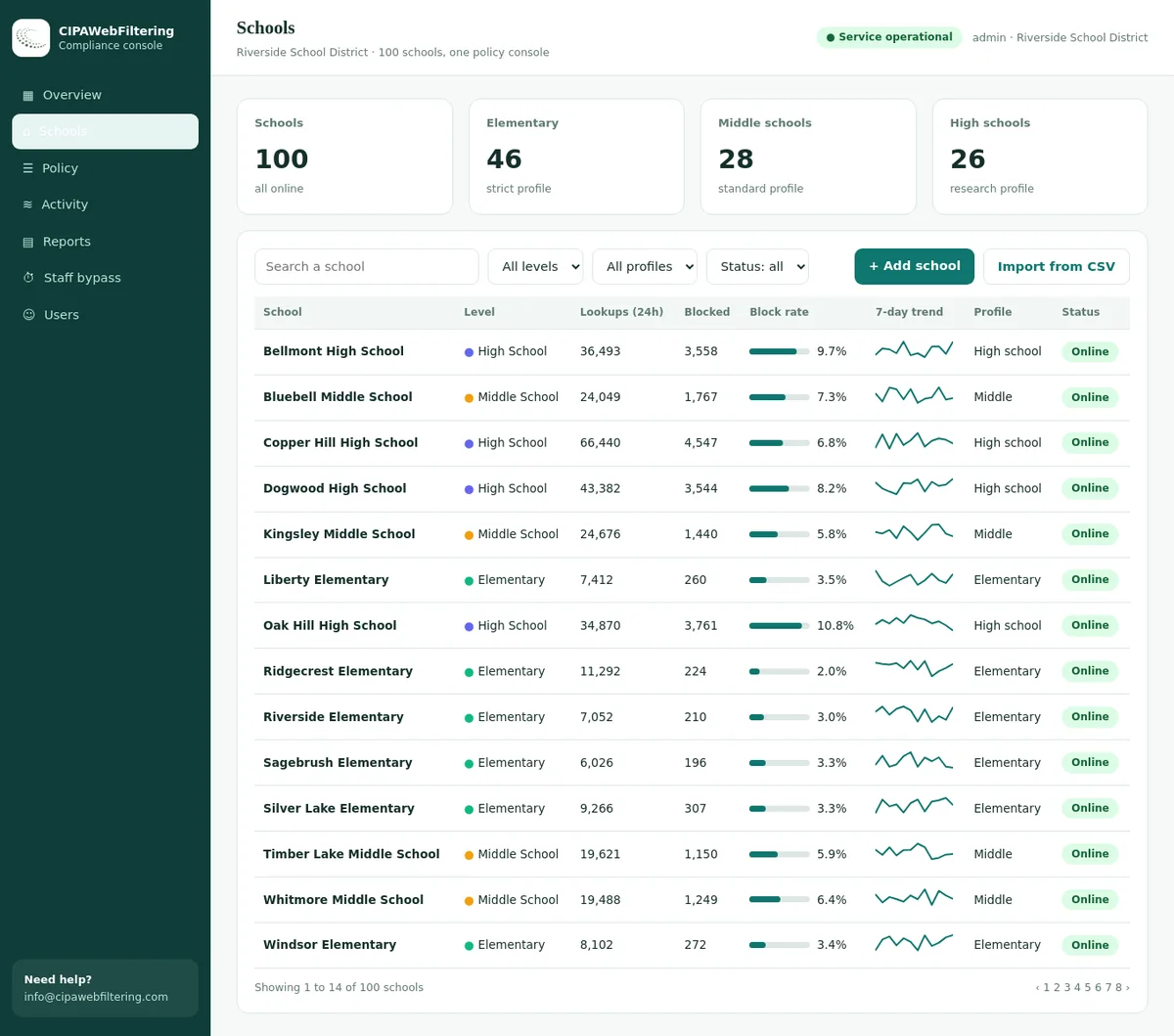
In Arizona the filter is a state duty as well as a federal one, so the settings need to be both correct and easy to show. Our hosted CIPA filter keeps its settings, reports and policy record in one console that a district can open when asked.
- Adult and VPN/Proxy/Anonymizers are on in the CIPA preset
- Social Networking can be restricted on school internet for each school
- Reports and a log export help when a state notice starts the clock
A.R.S. 34-502: Arizona's own filter mandate
This statute covers both public schools and public libraries. Unlike CIPA, it does not depend on E-Rate: it is a state rule, enforced through state aid. Here is what each subsection does, in our own summary.
Public schools
A school providing a public access computer deploys and enforces a filter keeping minors from child pornography, harmful to minors and obscene depictions. The board sets rules and makes them public.
Public libraries
Libraries filter the same three categories for minors, and child pornography and obscenity for everyone.
Adult disabling
Library staff may disable the filter only for an adult patron, and only for research or other lawful purposes.
State library rules
The state library director adopts enforcement rules, and libraries post the rules and their policies for patrons.
Library policy
A library's governing body adopts its policy at an open meeting and reviews it at least every three years.
Liability shield
A complying school or library is not criminally liable, or liable for damages, when a minor reaches prohibited material on its computers.
School enforcement
After notice and 60 days without compliance, up to 10 percent of monthly state aid may be withheld until the school complies.
Library enforcement
A similar 60-day notice and up to 10 percent withholding of monthly public monies applies to libraries.
What is at stake for a school
- The State Board of Education or the Superintendent of Public Instruction finds a violation of subsection A.
- The district or charter school receives notice.
- If it does not comply within 60 days, withholding of up to 10 percent of the monthly apportionment may be directed.
- The full amount is restored once the school is found in compliance.
A.R.S. 15-120.05: social media and phone policies (HB 2484)
HB 2484 became Chapter 53 of the 2025 session when it was signed on April 14, 2025. It requires district and charter governing bodies to adopt and enforce two linked policies.
Covers student access to the internet the school provides.
- Must include restrictions on student access to social media platforms.
- Must let teachers give students access to social media to the extent needed for educational purposes.
- A social media platform is a site, app or digital platform used for social networking and creating or exchanging content.
Limits student use of wireless communication devices during the school day.
- The school day includes meals, passing periods and recess.
- Devices include personal ones and those the school provides.
- Use must be allowed for teacher-directed learning, emergencies and medical needs.
- Procedures must let parents and students contact each other during the day.
A.R.S. 15-1046: student data privacy for school operators
Added by SB 1314 in 2017, this section governs operators of sites, services and apps that know they are used primarily for school purposes and were designed and marketed for them.
No targeted advertising
Operators may not knowingly target ads using information acquired through school-purpose use, on their own service or elsewhere.
No outside profiles
Operators may not build student profiles except for school purposes.
No selling student data
Operators may not sell or rent student information, with narrow exceptions such as acquisitions. Check the current text for security and deletion duties.
Filtering and monitoring products often receive usernames tied to browsing records. Our guide to student data privacy and filtering covers the federal side of the same question.
What Arizona law means for filtering and monitoring
Arizona is unusual because its laws reach directly into filter settings. The state filter mandate mirrors CIPA's three harms, and the 2025 law asks for social media restrictions on school internet.
| Requirement | Source | Filter setting | Monitoring or process |
|---|---|---|---|
| Block child pornography, obscene and harmful to minors depictions | CIPA, A.R.S. 34-502(A) | Adult and related categories blocked for all student groups | Board-adopted enforcement rules, made public |
| Restrict social media on school-provided internet | A.R.S. 15-120.05 | Social Networking restricted for students by default | Teacher-requested access for lessons, recorded |
| Teacher access to social media for learning | A.R.S. 15-120.05 | Scoped allow rules for a class, group or time window | Simple request route for teachers |
| Limit device use during the school day | A.R.S. 15-120.05 | Student Wi-Fi under the student policy at lunch and recess | Classroom rules, exceptions, parent contact procedure |
| Monitor minors' online activity | CIPA | Category-level reporting | Named reviewers and a review schedule |
| Limit vendor use of student data | A.R.S. 15-1046 | Keep identifiers to the minimum needed | Contract terms and retention periods |
Required for students under CIPA and A.R.S. 34-502
AdultLingerie/Swimsuits/Intimate ApparelDatingVPN / Proxy / AnonymizersProxy blocking is not named in the law, but it keeps students from routing around the required block.
Restricted under A.R.S. 15-120.05
Social NetworkingCommunity SitesForums / Message BoardsCheck how your policy defines social media. Some messaging and video sites also carry social features.
Common local choices
GamblingIllegal DrugsWeaponsViolenceHate/DiscriminationAlcoholTobaccoStreaming MediaGamingAI / LLM ToolsUsually kept open for learning
Education/ReferenceNews/MediaScienceGovernment & LegalHealth & MedicineWebinars/E-learningWhich social networks sit under one category switch
The 2025 law asks boards to restrict social media over school internet. These lookups show the labels on the networks students name, and where one site carries more than a single category.
| Network | Categories in our data |
|---|---|
| facebook.com | Social Networking |
| x.com | Social Networking |
| threads.net | Social Networking |
| tumblr.com | Blogs/Personal Sites, Social Networking |
| reddit.com | Social Networking, Forums / Message Boards, Community Sites |
Phones, school devices and the school day
The Arizona device policy covers personal and school-provided devices. That makes the line between "device time" and "learning time" a policy question that IT settings should support.
Teacher-directed use
School devices used for lessons are allowed under the educational exception. They stay under the CIPA and A.R.S. 34-502 filter on and off campus.
Lunch and recess
The school day includes meals, passing periods and recess. If students reach Wi-Fi then, the student policy still applies to that traffic.
Cellular data
A personal phone on its own data plan bypasses the school network. Classroom rules and storage are the control for that traffic.
For take-home programs, see how to enforce CIPA on off-campus student devices.
Which devices does A.R.S. 34-502 reach?
The school subsection speaks of a public access computer that a public school provides. Districts with 1:1 programs, labs and library terminals should decide, with counsel, how that phrase maps onto each device type.
- Computer lab and classroom machines students share
- School library and media center terminals
- Student Wi-Fi networks that any student device can join
- Take-home devices assigned to one student
- Staff devices that students may borrow
- After-hours community use of school labs
Every public access computer under the same rules
Because 34-502 speaks of computers a public school provides, labs, library terminals and take-home laptops all matter. A private encrypted link keeps the school's rules on laptops away from the network, and separate settings apply per school or branch.
School and public library partnerships
Some Arizona communities run joint-use libraries on school campuses. A.R.S. 34-502 sets different duties for schools and for public libraries, so shared spaces need a clear plan.
Know which rules apply
Schools follow subsection A. Public libraries follow subsections B to E, including an open-meeting policy reviewed at least every three years.
Separate user groups
Give students, adult patrons and staff their own filter policies. Adults may then have the filter disabled for research or other lawful purposes.
Post the rules
Libraries post the state rules and their own policy where patrons can see them. Schools make their enforcement rules public too.
More on patron policies in web filtering for libraries.
Common myths about Arizona school internet rules
Arizona's rules are stricter than many states, which leads some staff to assume they are stricter still. These are the points we hear confused most often.
"Social media must be fully blocked"
The law asks for restrictions, and it requires teacher access for educational purposes. A full block with no exceptions would miss that second part.
"Only E-Rate schools must filter"
CIPA is tied to E-Rate, but A.R.S. 34-502 is a state rule for public schools whether or not they take E-Rate.
"Phones are banned outright"
The law limits use during the school day and requires exceptions for learning, emergencies and medical needs. Possession rules are a local choice.
"Monitoring means watching screens"
CIPA asks for monitoring of minors' online activity. Category reports and alert review usually meet that need.
"A filter covers phones on data"
Cellular traffic does not pass the school network. The device policy handles those phones.
"A list of blocked sites is enough"
New domains appear daily. Our database categorizes about 300,000 newly registered domains every day, which a hand-built list cannot match.
Arizona school compliance checklist
Combine the federal and state steps in one yearly pass. Our general CIPA compliance checklist covers the federal items in more depth.
Required categories blocked
Child pornography, obscene and harmful to minors content blocked for every student group.
CIPA, 34-502Enforcement rules public
Board-adopted filtering policies, standards and rules posted where the public can see them.
34-502(A)Social media restricted
Student access to social media on school internet restricted by policy and filter.
15-120.05Teacher access route
A simple way for teachers to open social media for a lesson, with a record.
15-120.05Device policy adopted
Limits for the school day, with educational, emergency and medical exceptions.
15-120.05Parent contact procedure
Steps for parents and students to reach each other during the day.
15-120.05Annual notice sent
Policies shared with parents, teachers and students at the start of the year, with any changes.
15-120.05Internet safety policy current
Five CIPA topics covered, with public notice and hearing on file.
CIPAMonitoring defined
Who reviews reports, how often, and how alerts are escalated.
CIPAOnline safety lessons
Social networking safety and cyberbullying taught across grade bands.
CIPAVendor data terms
No targeted ads, no outside profiles, no sale of student data.
15-1046E-Rate certification
Form 486, or Form 479 through a consortium, filed on time.
CIPAEvidence to keep for CIPA and Arizona rules
With state aid tied to A.R.S. 34-502, being able to show compliance quickly matters. A notice gives you 60 days, and good records make that period calm.
| Record | Shows | Owner | Refresh |
|---|---|---|---|
| Board-adopted filtering policies, standards and rules, and where they are posted | A.R.S. 34-502(A) | Board office | When revised |
| Filter configuration export showing blocked categories by group | CIPA and 34-502 filter duty | IT | Each term |
| Off-campus filter tests on sample school devices | Coverage of school-provided devices | Device team | Each semester |
| Social media and device policies under 15-120.05 | 2025 policy duties | Board office | Each school year |
| Copy of the annual notice and how it was sent | 15-120.05 notice duty | Communications | Each school year |
| Teacher social media access log | Educational access exception in use | IT, principals | Ongoing |
| Internet safety policy, public notice and hearing minutes | CIPA policy duty | Board clerk | When revised |
| Monitoring report samples and reviewer list | CIPA monitoring | Administrators | Monthly or termly |
| Vendor contracts and data terms | A.R.S. 15-1046 alignment | Procurement | At renewal |
| Filed Form 486 or Form 479 | E-Rate certification | E-Rate lead | Each funding year |
Writing the policy itself? Our CIPA internet safety policy guide lists each required topic.
Showing Arizona compliance fast: by hand or from the console
A state notice gives 60 days, and these rows compare how much effort the evidence takes.
| Arizona task | Assembled by hand | Hosted CIPA filter |
|---|---|---|
| Proving that harmful content is blocked | Screenshots from each device | Policy record and category settings per school |
| Restricting social media over school internet | Typing each network into a list | Social Networking switch per school |
| Handling a teacher exception | Edit the list, then undo it | Always-allow entry for the school, changed in seconds |
| Library terminals on campus | Possibly a separate product | Same console with its own settings for that branch |
| Laptops that go home | Varies by device set-up | Private encrypted link keeps the rules |
| Bypass through a VPN | Keep a list of proxy sites | VPN / Proxy / Anonymizers blocked as a category |
Arizona school internet safety FAQ
Does Arizona have its own school internet filtering law?
Yes. A.R.S. 34-502 requires a public school that provides a public access computer to deploy and enforce a filter keeping minors from child pornography, harmful to minors and obscene depictions, with board rules made public.
What happens if a school does not comply?
After a finding and notice, a school has 60 days. If it still does not comply, up to 10 percent of its monthly state aid may be withheld until it does.
What does HB 2484 require?
It added A.R.S. 15-120.05: policies on student access to school internet, including social media restrictions, and limits on student device use during the school day, plus an annual notice.
Can teachers still use social media in class?
Yes. The policy must let teachers give students access to social media platforms to the extent needed for educational purposes.
Does the phone law cover school-issued devices?
Yes, the definition includes devices the school provides. Use for teacher-directed learning, emergencies and medical needs must be allowed.
Does A.R.S. 34-502 apply to charter schools?
The enforcement subsection names school districts and charter schools, so charter schools should treat the filter duty as applying to them and confirm details with counsel.
Compare other state school internet laws
See all state guides on our school internet safety laws by state page.
Not legal advice. This page summarizes federal and Arizona rules in our own words for general information. Laws and guidance change, so details here may be out of date. Check the current Arizona Revised Statutes and confirm your obligations with district counsel.
Related guides
- CIPA Internet Safety Policy: What It Must Contain and How to Write One
- What Is CIPA? Children's Internet Protection Act Requirements
- CIPA Compliance Checklist for Schools and Districts (8 Steps)
- Presenting Web Filtering to the School Board: Budget, Risk, Metrics
- California School Internet Safety Laws: CIPA, SOPIPA, Phones
Cost follows the number of schools and devices, and a quote arrives within one business day. A pilot at one Arizona school lets your team see the blocks and reports well before a state notice could ever land.
Talk to us about your Arizona district
Tell us how you handle social media and devices today. We will show how our CIPA category coverage and the hosted CIPA filter pilot support both A.R.S. 34-502 and the 2025 policy rules.