Missouri School Internet Safety Laws: RSMo 182.827, the Phone Law and CIPA
Missouri has had its own school and library filtering statute for more than twenty years. RSMo 182.827 gives schools a choice of software, a policy, or both, while federal CIPA asks E-Rate schools for a real filter.
This guide shows how the two fit, what the 2025 phone law adds, and what Missouri districts should keep on file.
Schools on E-Rate also need CIPA's technology protection measure, so in practice most districts do both.
Take the filter route of RSMo 182.827 and meet CIPA with the same setup
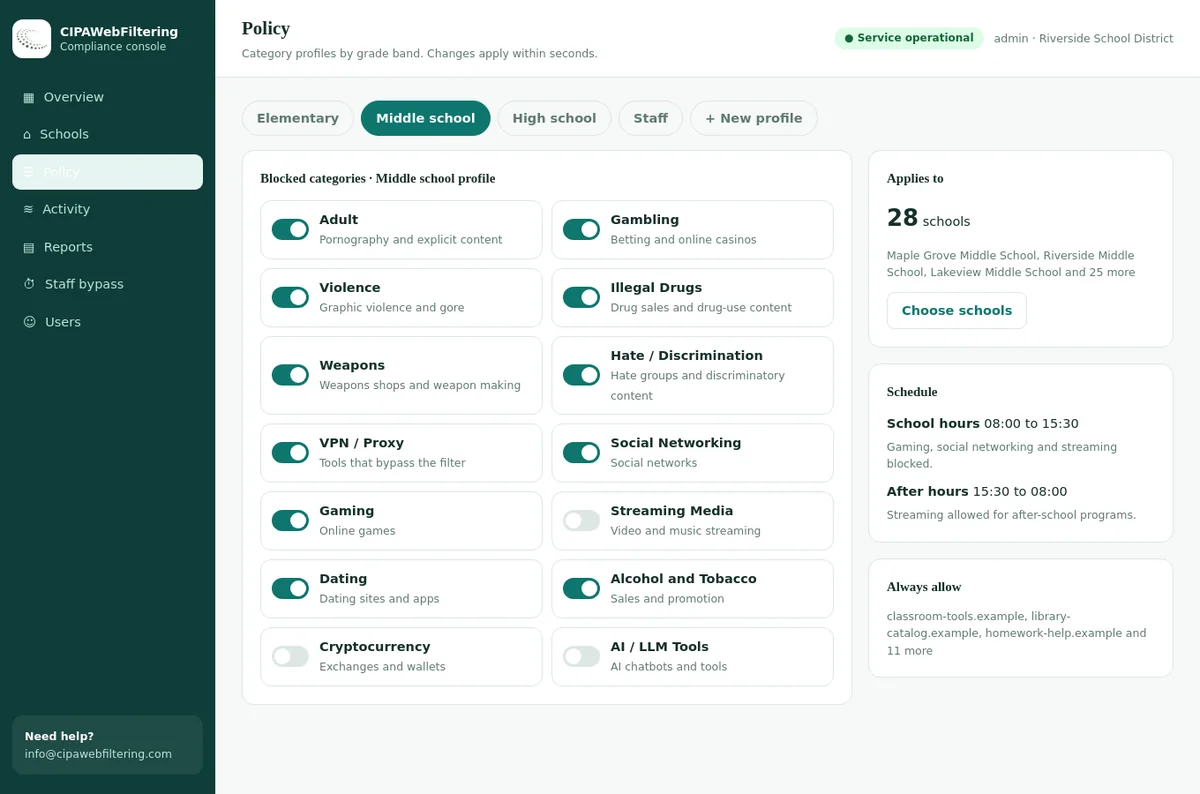
Missouri lets a school choose software, a policy or both, but a school on E-Rate needs a real filter anyway. Our hosted CIPA filter is a DNS filter that we run for you, so one set of rules answers the state route and the federal one.
- The CIPA preset starts with Adult and VPN/Proxy/Anonymizers switched on
- Gambling, Weapons and Lingerie are optional, which fits categories your board picks under community standards
- Charter schools in the district get their own settings inside the same console
What CIPA requires of Missouri schools
The Children's Internet Protection Act applies to schools and libraries that take E-Rate discounts for internet access or internal connections. For those schools, it sets the technical standard.
Technology protection measure
Blocks or filters visual depictions that are obscene, child pornography or harmful to minors on computers minors use.
Internet safety policy
Covers inappropriate matter, messaging safety, hacking and disclosure of minors' personal information.
Public notice and meeting
At least one public hearing or meeting on the policy after reasonable notice.
Monitoring
Policies include monitoring minors' online activity. CIPA does not require tracking named users' internet use.
Education
Lessons on appropriate online behavior, including social networking and cyberbullying.
Certification
FCC Form 486, or Form 479 for consortium members, each funding year.
New to the federal rules? Start with what CIPA is and who must comply, then see how certification ties to funding in E-Rate and CIPA funding.
What Missouri adds: RSMo 182.827 clause by clause
This is our summary of the statute in our own words, with what each part means for a district. Check the current text with the Missouri Revisor of Statutes before you cite it.
The state rule: 5 CSR 20-100.220
The Department of Elementary and Secondary Education rule puts the statute into practice for public school districts and public charter schools that offer public access computers.
What the rule asks
Districts and charters that offer public access computers implement software, develop a policy, or both, to restrict minors' access to pornographic material.
It also notes that districts receiving E-Rate discounts certify compliance with CIPA.
How to read it with CIPA
The state allows a policy-only route, but CIPA does not. If you take E-Rate, you need a technology protection measure as well.
One combined policy that names the filter can meet the statute, the rule and CIPA together.
Charter schools are named in the rule, so the same duties apply to them. For the policy wording itself, see our guide to the CIPA internet safety policy.
The 2025 phone law: SB 68 and the school day
Senate Bill 68, signed by Governor Kehoe in July 2025, requires districts and charter schools to adopt written policies restricting student cell phone use for the whole school day, starting in 2025-26.
Phones away
The restriction starts at the beginning of the school day, not at the first class.
School devices only
Learning online happens on school devices and networks you filter.
Still covered
Reporting describes mealtimes and passing periods as part of the restricted day.
Safety and needs
Emergencies, disabilities, and specific learning or medical purposes.
Rule ends
Districts set consequences for violations in their own policies.
The phone law does not mention web filtering. Its effect is that personal phones on cellular data, which no school filter reaches, are out of use for the day. That moves nearly all student internet use onto equipment covered by your RSMo 182.827 and CIPA measures.
Where students go when SB 68 puts phones away
With phones set aside, the sites below are the ones that tend to be tried on school devices instead. The categories shown are the ones in our database.
| Domain | Categories in our data | Choice for the board |
|---|---|---|
| instagram.com | Social Networking | Social category, often blocked by grade band |
| twitch.tv | Streaming Media, Gaming | Two categories, so the Gaming and Streaming switches both matter |
| poki.com | Gaming | Browser games that need no install |
| now.gg | Gaming | Cloud gaming in a browser tab |
| hidemyass.com | VPN / Proxy / Anonymizers | The kind of bypass a proxy block exists for |
What it means for filtering and monitoring
Missouri leaves category choices to local boards under its community standards wording. Use that freedom deliberately, and write down the reason for each choice.
Block the shared core
Adult content meets both the state's pornographic for minors target and CIPA's three types. Add Lingerie/Swimsuits/Intimate Apparel for minors.
Close bypass routes
Block VPN / Proxy / Anonymizers. With phones put away, students who want to get around the filter turn to proxy sites on school devices.
Set local categories
Gambling, Weapons, Illegal Drugs, Alcohol, Tobacco, Dating, Violence and Hate/Discrimination are common board choices under community standards.
Follow the device home
Take-home laptops need device-level or cloud filtering. Our guide to enforcing CIPA on off-campus devices covers the setup.
Coordinate with libraries
Libraries follow the same statute under separate rules. See web filtering for libraries for adult disable and patron questions.
Monitor in proportion
CIPA asks for monitoring of minors, not tracking every user. Keep class supervision central and limit automated alerts to real safety needs.
| Category | Why Missouri schools block it | Typical scope |
|---|---|---|
| Adult | RSMo 182.827 target and CIPA core | All users, all devices |
| Lingerie/Swimsuits/Intimate Apparel | Harmful to minors standard | Students |
| VPN / Proxy / Anonymizers | Keeps the filter effective | Students, most staff |
| Gambling | Age-restricted, community standards | Students |
| Illegal Drugs, Weapons | Student safety, community standards | Students |
| Social Networking, Gaming | Fits the purpose of the SB 68 school day | By grade band |
| Malware / Phishing / Suspicious | Protects accounts and devices | All users |
You can see how any site is classed with the domain category checker, and browse all options in the web filtering categories taxonomy.
What the hosted filter gives your Missouri policy file
The filter keeps a policy record and a log export for CIPA files, plus activity reports by school. Each school or branch has its own settings, so the export shows which categories were on where.
One policy for three sets of rules
Missouri districts answer to RSMo 182.827, the DESE rule and CIPA, plus the SB 68 phone policy. A single internet safety policy with a clear structure keeps them from drifting apart.
Scope
Every computer and network minors use, school-issued devices at home, and guest networks.
Technology measure
Name the filter and the core categories. This meets the statute's technology route and CIPA.
Local standards
List local categories and the community standards reasoning, as the policy route expects.
Safety topics
The CIPA topics: messaging safety, hacking, personal information, monitoring and education.
Devices
A short pointer to the SB 68 phone policy, so both documents agree on the school day.
Our guide to the acceptable use policy for schools covers the student and staff rules that usually sit alongside this policy.
Common Missouri situations
These cases come up in most districts within the first months of a school year. Each answer points to the rule that settles it.
A teacher needs a blocked site
CIPA lets an authorized person disable the filter for an adult doing bona fide research. For a class, use a reviewed unblock of the specific site with a time limit.
A parent questions a block
Point to the local categories in the policy and the community standards reasoning. That is exactly the judgment the statute leaves to your board.
A student has a medical phone exception
SB 68 allows it. If the phone joins school Wi-Fi it is filtered; on cellular data it is not, so the exception plan should define use.
Students use AI chat tools
Neither state law nor CIPA requires a block. If your board restricts them, see the AI tools blocklist for schools.
A community event uses school Wi-Fi
If minors can join, filter it to the core standard. The statute speaks of computers minors use, and guest networks are an easy gap to close.
Social media during the day
With phones put away, school devices are the only route. See social media filtering in schools for grade band options.
Student data in filtering and monitoring tools
Filters and monitoring tools create records about named students. Federal FERPA and COPPA rules apply, and contracts carry most of the detail.
Collect what you need
Blocking by site category needs very little personal data. Tools that read messages or screens collect far more, so justify each one in writing.
Keep logs tied to named students only as long as safety and discipline require.
Put it in the contract
Sign a data agreement with each filtering and monitoring vendor that limits use, sets deletion and bans advertising use of student data.
We did not confirm a separate Missouri statute that sets duties for filter vendors, so check current state guidance.
For the federal side, see our guide to student data privacy, FERPA and filtering.
Missouri compliance checklist by role
Open each role to see its items. For the full federal list, use our CIPA compliance checklist.
Board of education
- Adopt an internet safety policy that meets RSMo 182.827, 5 CSR 20-100.220 and CIPA in one document
- Hold a public hearing or meeting after reasonable notice, as CIPA requires
- Record the community standards reasoning for local categories
- Adopt the SB 68 cell phone policy and set consequences
- Set a yearly review date for both policies
Technology director
- Run filtering technology on every computer and network minors use
- Block CIPA categories and VPN, proxy and anonymizer services
- Filter take-home devices off campus
- Export the filter configuration each term and file it
- Run an unblock request process with named reviewers
Principals
- Put the SB 68 phone policy into daily practice, including lunch and passing periods
- Handle exceptions for disabilities, medical needs and emergencies
- Make sure classroom supervision of internet use happens
Curriculum and library staff
- Teach online safety by grade band, including cyberbullying
- Agree on rules with any public library sharing space or network
- Collect teacher requests for sites needed in lessons
E-Rate coordinator
- File Form 486 on time, or collect Form 479 from consortium members
- Keep certification records for each funding year
- Confirm the policy and filter were in place before certifying
Evidence to keep
The RSMo 182.827 penalty for willful neglect and its liability shield both turn on whether you did the work. E-Rate rules also require records to be kept for at least 10 years after the last date of service.
| Record | What it proves | Law it supports |
|---|---|---|
| Adopted internet safety policy | The policy route and CIPA policy are in place | RSMo 182.827, CIPA |
| Public meeting notice and minutes | The CIPA public process happened | CIPA |
| Filter configuration exports | The technology route was active, with which categories | RSMo 182.827, CIPA |
| Device coverage report | Every computer minors use is filtered, including take-home | RSMo 182.827, CIPA |
| Community standards notes | Why local categories were chosen | RSMo 182.827 |
| SB 68 phone policy and family notice | The school day device rule is adopted and shared | SB 68 |
| Online safety lesson records | The education element is delivered | CIPA |
| Form 486 or 479 | Certification for each funding year | CIPA |
Licence holders of our category data receive validation reports with the measured accuracy of the CIPA categories. Many districts file them with configuration exports as part of the same record.
Policy on paper or filter in place: what each gives a Missouri district
The statute allows either route, so this shows where a running filter adds something a document cannot.
| Missouri need | Hosted CIPA filter | Policy document alone |
|---|---|---|
| RSMo 182.827 technology route | Meets it with a category filter on the network | Allowed by the state, but nothing blocks a site |
| CIPA technology protection measure | Adult and VPN/Proxy/Anonymizers blocked by the preset | Not enough for E-Rate schools |
| Local community standards | Optional categories switched on or off per school | Reasoning written down, no enforcement |
| Take-home laptops | A private encrypted link keeps the rules off campus | Rules apply only where staff can see |
| Proxy use on the school day | VPN/Proxy blocked, including with the staff PIN | Left to supervision |
| Files for a review | Policy record and log export | The document itself |
Missouri school internet safety FAQ
Does Missouri require school internet filters?
RSMo 182.827 requires public schools with public access computers to use filtering technology, a restricting policy, or both. E-Rate schools also need CIPA's technology protection measure.
Is a policy alone enough?
Under the state statute it can be, since it allows either route. CIPA requires a filter for E-Rate schools, so most districts need one in practice.
What is 5 CSR 20-100.220?
The state rule that applies RSMo 182.827 to public school districts and charter schools, and notes the CIPA certification duty for E-Rate districts.
What is the Missouri phone law?
SB 68, signed in July 2025, requires written policies restricting student cell phone use for the whole school day from 2025-26, with set exceptions. Districts decide consequences.
Are there penalties?
Board members, officers and employees who willfully neglect a duty under the section face penalties under section 162.091. Schools that comply are protected from liability.
Do public libraries follow the same law?
Yes. RSMo 182.827 also covers public libraries with public access computers, with rules from the Secretary of State.
Can staff unblock a site for research?
CIPA allows an authorized person to disable the filter for adults doing bona fide research. For students, use reviewed, time-limited unblocks of specific sites.
Do charter schools have the same duties?
The DESE rule names public charter schools that offer public access computers, and SB 68 covers charters too. CIPA applies to any charter that takes the covered E-Rate discounts.
Does the phone law change what we block?
Not directly. SB 68 is a device rule. It does move more student internet use onto school devices, so many districts review social media, gaming and proxy categories when they adopt it.
What does "community standards" mean for us?
The statute's policy route lets your board reflect local views when choosing what to restrict. Record the discussion and the reasons, so the choices can be explained to families later.
How long should we keep records?
At least 10 years after the last date of service for E-Rate records. Keep the policy, meeting records, filter exports and Form 486 copies.
Compare other state school internet laws
Compare Missouri with every other state we cover on our school internet safety laws by state page.
Related guides
- What Is CIPA? Children's Internet Protection Act Requirements
- CIPA Internet Safety Policy: What It Must Contain and How to Write One
- Presenting Web Filtering to the School Board: Budget, Risk, Metrics
- Arkansas School Internet Safety Laws: 6-21-107 and Bell to Bell
- Illinois School Internet Safety Laws: SOPPA, Phones, CIPA
We quote on the number of schools and devices in your Missouri district and answer within one business day. A pilot on a single school is a way to see the blocks and reports before deciding.
Talk to us about your district
We can show how our CIPA category data and the hosted CIPA filter pilot cover RSMo 182.827 and CIPA on every school device, with records you can file.