Wisconsin School Internet Safety Laws
A practical guide for Wisconsin district technology directors, library media staff and principals. It covers what federal CIPA requires, what Wisconsin law adds, and what both mean for the way you filter and monitor student internet use.
Written for compliance work, not as a legal opinion. Check current law with your counsel or E-Rate consultant.
The short answer
Wisconsin does not have a state statute that sets its own web filtering standard for K-12 schools. The filtering rules Wisconsin districts follow come from federal CIPA, through E-Rate.
- A 2023 bill to add state filtering rules (AB 15 and SB 10) failed in April 2024.
- A 2025 law requires boards to ban phone use during instructional time, with policies due by July 1, 2026.
- Pupil records rules in s. 118.125 shape how you treat filter and monitoring data.
What CIPA requires of every Wisconsin school that takes E-Rate
The Children's Internet Protection Act is a federal funding condition. If your district, private school or library receives E-Rate discounts for internet access or internal connections, three duties apply. Our guide what is CIPA covers the full background.
A technology protection measure
A filter on every computer with internet access that blocks visual depictions that are obscene or child pornography, and, for computers used by minors, material harmful to minors.
An internet safety policy
A written policy that covers minors' access to inappropriate material, safety in email and chat, hacking, unauthorized disclosure of minors' personal data and the filter itself, adopted after public notice and a hearing or meeting.
Monitoring and education
Schools must monitor minors' online activities and teach appropriate online behavior, including social networking safety, chat room safety and cyberbullying awareness and response.
No state filter law means your own setup is the whole story
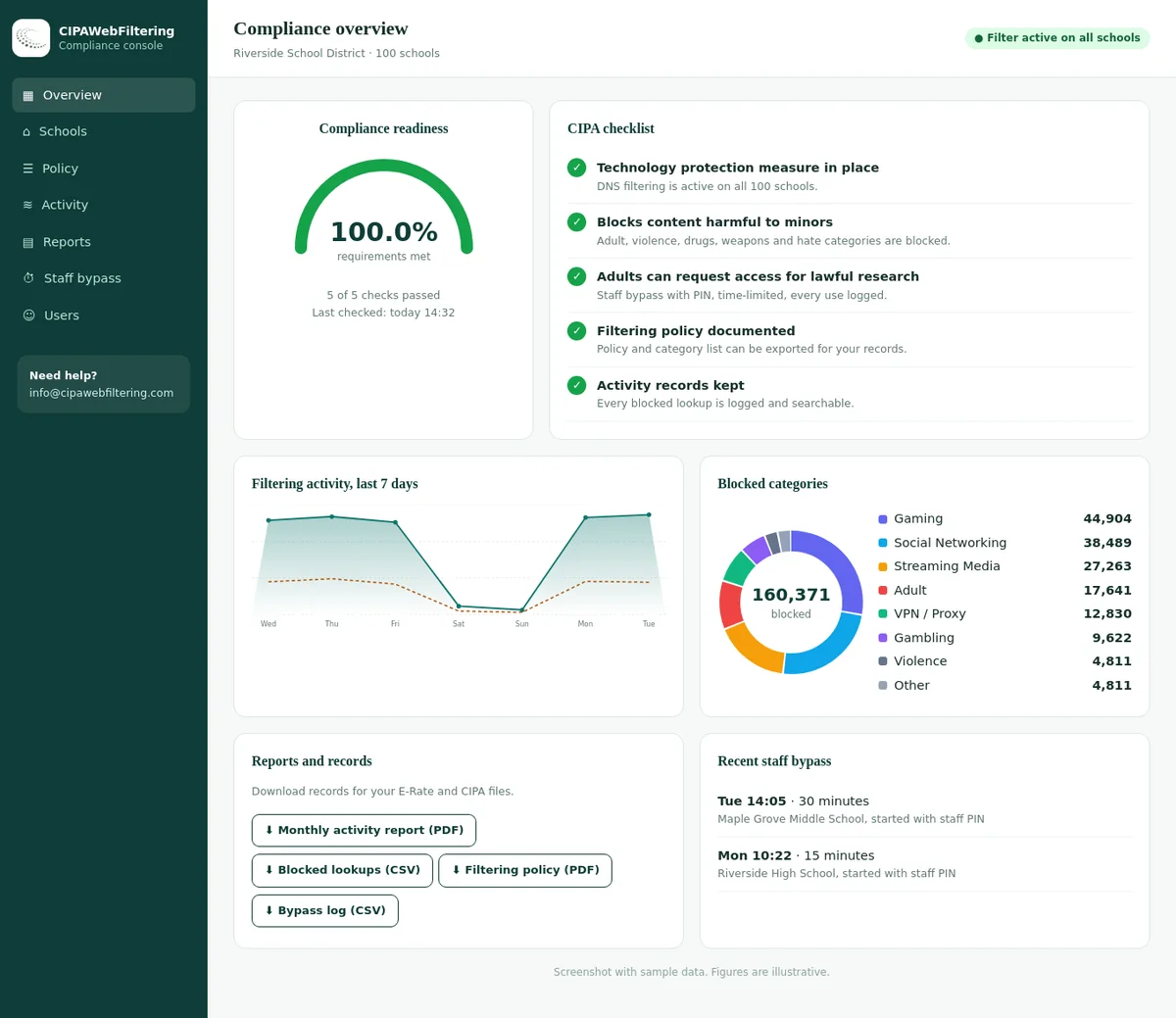
Wisconsin's 2023 filtering bill died in April 2024, so CIPA and your board's choices are what an E-Rate reviewer reads. Our hosted CIPA filter is a DNS filter that we run for you, which turns those choices into category switches you can print and file.
- Start from the CIPA preset, then set grade bands by school without touching other buildings
- Guest and student Wi-Fi can share the same DNS setting, so a phone that joins the network meets the same rules
- Spot-checks with the category checker fit into the same evidence folder as exports from the console
What Wisconsin adds on top of CIPA
Wisconsin is one of the states where the honest answer is "very little on filtering itself". The state's additions sit around the filter: phones in class, pupil records and the policy work boards already do.
| Rule | Level | Status | What it touches |
|---|---|---|---|
| Children's Internet Protection Act | Federal | Applies with E-Rate | Filter, internet safety policy, monitoring, online safety education |
| AB 15 and SB 10 (2023 session): harmful material on school and library computers | State bill | Failed April 15, 2024 | Would have created s. 43.75 for public libraries and s. 118.073 for schools |
| School cell phone law (signed fall 2025) | State law | Policy due July 1, 2026 | Student phone use during instructional time |
| Pupil records, s. 118.125 | State law | In force | Confidentiality and handling of records about pupils |
| FERPA and COPPA | Federal | In force | Education records and data from children under 13 collected by online services |
| Future filtering or age proposals | State bills | Watch each session | Bills on minors and online content are introduced often; check status each session |
The Wisconsin filtering bill that did not pass
Districts sometimes hear that Wisconsin "passed a filter law". It did not. Here is what the 2023 proposal would have done and what happened to it.
AB 15 introduced, with SB 10 as companion
Referred to the Assembly education committee. The bill focused on "harmful material" as defined in the existing criminal code, s. 948.11.
New s. 43.75
Public libraries with public access computers would have had to keep minors from harmful material through software, a filtered internet service or a written policy, with parental consent as an exception.
New s. 118.073
A parallel section would have applied to school boards and charter school operators, limiting pupil access to harmful material on school computers.
Failed to pass
Both bills died at the end of the session under the joint resolution that closes out pending bills. Neither section exists in the statutes today.
Why it still matters to your district
- Similar ideas are often reintroduced in later sessions, so put a short legislative check into your annual review.
- Board members and parents may have read about the bill. A one-page note on what applies today avoids confusion.
- If a future bill passes, the work is mostly policy wording. A category filter that already blocks adult content for minors covers the core of what this proposal described.
What the bill would not have changed
- Your CIPA duties, which stay the same with or without a state law.
- Your E-Rate certification on Form 486 or Form 479.
- The need for monitoring and online safety lessons.
Wisconsin's school cell phone law and your filter
In fall 2025 Wisconsin required public school boards to adopt a policy that prohibits student cell phone use during instructional time. Policies must be in place by July 1, 2026, so the 2026 to 2027 school year is the first full year under the rule.
What the law asks of boards
- Adopt a written policy that bans phone use during instructional time.
- Build in exceptions; reporting on the bill lists emergencies, student health needs, IEP and 504 plans, and educational use a teacher directs.
- Boards may allow staff to hold a device for the rest of the school day.
- Most districts already had some restriction. The law sets a statewide floor.
What it means for filtering
- The phone policy does not create a new filtering duty. It governs the device, not the network.
- A phone on its own cellular plan never touches your filter. The policy is the control for that path.
- A phone on school Wi-Fi does pass through your network, so your guest or student network should apply the same category rules.
- Less phone use in class tends to move more browsing to school devices, where your filter already applies.
| Where the student is browsing | Who controls it | Practical step |
|---|---|---|
| School-owned device on school network | District filter and policy | Grade-band category rules, SafeSearch, HTTPS-aware filtering |
| School-owned device at home | District filter, if it travels with the device | Agent or DNS filtering that follows the device off campus |
| Personal phone on school Wi-Fi | District network filter | Separate SSID with the student rule set, VPN and proxy category blocked |
| Personal phone on cellular data | Phone policy, not the filter | Enforce the instructional-time rule; teach online safety |
What it means for filtering and monitoring in Wisconsin
Because Wisconsin leaves the filtering details to districts, a well-documented CIPA setup is the whole job. These are the decisions that make a difference in practice.
Start from a CIPA category set
Block Adult for every user. For minors, also block categories such as Gambling, Illegal Drugs, Weapons, Violence, Hate/Discrimination, Dating and VPN / Proxy / Anonymizers.
Use grade bands
An elementary rule set and a high school rule set can differ. Health, news and research sites matter more for older students, and CIPA does not require blocking them.
Cover take-home devices
If devices go home, decide whether filtering travels with them. Our guide to filtering student devices off campus walks through the options.
Decide on AI tools
No Wisconsin law requires blocking AI chat tools. A dedicated AI tools blocklist for schools lets you allow approved tools and hold back the rest.
Keep monitoring proportionate
CIPA asks for monitoring, not keystroke capture. Category reports, alerts on high-risk categories and staff supervision usually satisfy the duty with less data collected.
Treat logs as possible pupil records
Logs tied to a named pupil can fall under s. 118.125 and FERPA. Our page on student data privacy and filtering covers retention and access.
Catch new domains
New sites appear every day. A category database that classifies newly registered domains daily keeps the block current without hand-built lists.
Test what you certify
Spot-check categories with the domain category checker and record the result. A tested filter is easier to defend than a configured one.
Health, news and research names next to the sites you do want closed
The grade-band advice says older students need health, news and research sites. Here is how our database labels a few of those, plus two student-facing names a high school may still close.
| Domain | Categories in our data | Grade-band thought |
|---|---|---|
| mayoclinic.org | Health & Medicine | Open for health classes in high school |
| kidshealth.org | Health & Medicine, Education/Reference | Open for all grade bands, via two categories |
| cnn.com | News/Media | Open for current-events research in older grades |
| jstor.org | Education/Reference, Science | Open, and easy to keep through the research categories |
| omegle.com | Social Networking | Closed with the Social Networking switch |
| wine.com | Alcohol | Closed for students by the Alcohol category |
Wisconsin compliance checklist
Run through this list once a year, ideally before the E-Rate window. The full CIPA compliance checklist goes deeper on each item.
Policy
- Internet safety policy covers all CIPA topics
- Public notice and hearing or meeting documented
- Acceptable use policy matches the filter settings
- Phone policy adopted by July 1, 2026 with exceptions
- Adult disable process written down
Technology
- Filter on every internet-capable computer
- Adult content blocked for all users
- Harmful-to-minors categories blocked for students
- Student Wi-Fi uses the student rule set
- VPN and proxy category blocked for minors
- Off-campus coverage decided and documented
People and records
- Monitoring approach described in the policy
- Online safety lessons scheduled by grade
- Log retention set in the records schedule
- Vendor contracts reviewed for data handling
- Form 486 or 479 filed and saved
Reports built around schools and categories
Because logs tied to a named pupil can fall under s. 118.125, it helps that our activity reports are organised by school and category, with a log export for the CIPA file. The filter decides by domain rather than by page, and it is not a monitoring or classroom screen tool.
Common Wisconsin misreadings, and what is actually true
Most over-blocking and most compliance gaps start with a misunderstanding of what the law asks. These are the ones we hear from Wisconsin staff most often.
| What people say | What applies |
|---|---|
| "Wisconsin passed a school filter law in 2024." | The 2023 bill failed in April 2024. Federal CIPA is the filtering rule. |
| "The phone ban means we must filter phones." | The law is about phone use in class. Filtering applies to traffic on your network and your devices. |
| "CIPA makes us block social media and video." | CIPA targets obscene, child sexual abuse and harmful-to-minors imagery. Blocking social or video sites is a local choice. |
| "We need to record every keystroke to monitor." | Monitoring can be supervision plus category-level reporting. Collecting less data also lowers your pupil records exposure. |
| "Teachers can never be unblocked." | An authorized person may disable the filter for an adult doing bona fide research or other lawful work. |
| "Private schools are exempt from CIPA." | Any school that takes E-Rate for internet access or internal connections must comply, public or private. |
A first-year plan for a Wisconsin district
New technology directors often inherit a filter with little paperwork. This sequence gets a district to a defensible position within one school year.
Find the documents
Locate the adopted internet safety policy, the hearing or meeting record, the acceptable use policy and the last filed Form 486 or 479.
Export the filter settings
Save each rule set, note which categories are blocked for students and staff, and compare them with the policy text.
Test the gaps
Check student Wi-Fi, take-home devices and VPN or proxy sites. Record what passed and what you fixed.
Align the phone policy
Make sure the July 1, 2026 phone policy and the internet safety policy point to each other and use the same exceptions language.
Confirm teaching and monitoring
Collect online safety lesson records by grade and write a short monitoring procedure that staff can follow.
Close the folder
File the evidence, update the policy review date and certify. Next year the same folder becomes your starting point.
Evidence to keep for an E-Rate review
An audit asks you to show, not tell. Keep these items in one folder per funding year, owned by a named person.
| Evidence | Shows | Typical owner |
|---|---|---|
| Adopted internet safety policy with board minutes | The policy exists and was adopted | Superintendent's office |
| Public notice and hearing or meeting record | The community had a chance to comment | Board secretary |
| Filter configuration export or screenshots by rule set | The required categories are blocked | Technology director |
| Category test results for sample sites | The filter works as configured | Network administrator |
| Online safety lesson plans and delivery records | The education duty is met | Curriculum or library media lead |
| Monitoring procedure and sample category reports | Minors' activity is monitored | Technology director |
| Adopted phone policy and posting record | The state phone rule is met | Board secretary |
| Filed Forms 486 or 479 and confirmations | Certification was made on time | E-Rate coordinator |
Building the policy pieces
Wisconsin boards write their own policies, so the quality of the documents decides how smooth compliance feels. These resources help with each piece.
Internet safety policy
The core CIPA document. See how to write a CIPA internet safety policy that covers each required topic.
Acceptable use policy
What students and staff agree to. Our acceptable use policy guide for schools shows how to keep it consistent with the filter.
E-Rate link
How certification and funding fit together is covered in E-Rate and CIPA funding.
Phone policy
Keep the phone policy and the internet safety policy cross-referenced, so staff know which rule covers which device.
Compare other state school internet safety laws
Neighbouring and peer states take different routes. Some add filtering statutes, others focus on privacy or phones.
Annual Wisconsin checklist items, handled by hand or by the hosted filter
Each row is an item from the checklist above, compared across two ways of working.
| Checklist item | Handled in-house | Hosted CIPA filter |
|---|---|---|
| Adult blocked for all users | Block lists on every device or firewall | Adult is on in the CIPA preset |
| Harmful-to-minors categories for students | Rules edited school by school | Category switches per school; Lingerie, Gambling and Weapons optional |
| Student Wi-Fi on student rules | A separate SSID with its own settings | Same DNS setting and categories on that network |
| VPN and proxy blocked for minors | New proxy sites added when someone notices | VPN/Proxy/Anonymizers blocked as a category |
| Adult disable process written down | Informal, and easy to forget to reverse | Staff PIN for 15, 30 or 60 minutes, logged, switches back |
| Off-campus coverage decided | Agent installs or account policies per device | Private encrypted link keeps the rules on laptops and phones off the network |
Wisconsin school internet safety FAQ
Does Wisconsin have its own school web filtering law?
We are not aware of one. The filtering duty Wisconsin districts work to is federal CIPA, tied to E-Rate. The 2023 bill that would have added state rules for schools and libraries, AB 15 and SB 10, failed to pass in April 2024.
What did Wisconsin's 2025 cell phone law require?
Public school boards must adopt a policy that prohibits student phone use during instructional time, in place by July 1, 2026. Reported exceptions include emergencies, health needs, IEP and 504 plans and teacher-directed use. It covers personal phones, not network filtering.
Do filter logs count as pupil records in Wisconsin?
It depends on what the log holds and how you use it. Logs tied to a named pupil, or used in discipline, can fall under s. 118.125 and FERPA. Ask counsel how your logs are classified and set a retention period.
Does CIPA apply to Wisconsin private and choice schools?
CIPA follows E-Rate. Any school that receives E-Rate discounts for internet access or internal connections must certify compliance. A school without that support is not bound by CIPA, although most still filter.
Do Wisconsin public libraries have a state filtering rule?
The 2023 bill would have created one in s. 43.75, but it did not pass. Libraries that take E-Rate for internet access, or certain federal library funds, follow CIPA. Others set policy through their library board.
Should Wisconsin schools block AI chat tools?
No Wisconsin statute we know of requires it. Districts decide by grade and purpose. A separate AI tools category lets you allow approved tools, block the rest and adjust by grade band.
How often should we review all of this?
Once a year before the E-Rate filing window, plus whenever the filter contract renews, a new device program starts or the phone policy changes how students get online.
Related guides
- CIPA Internet Safety Policy: What It Must Contain and How to Write One
- CIPA Compliance Checklist for Schools and Districts (8 Steps)
- Presenting Web Filtering to the School Board: Budget, Risk, Metrics
- Illinois School Internet Safety Laws: SOPPA, Phones, CIPA
- Minnesota School Internet Safety Laws: 125B.15 and 13.32
The price follows how many Wisconsin schools and devices are involved, and our quote comes back within one business day. Piloting one school gives your director blocks and reports to review before the next E-Rate window.
See all state guides on our school internet safety laws by state page.
Talk to us about your district
Tell us how your Wisconsin district filters today, and we will show how CIPA category coverage, grade-band rules and audit-ready reports can fit your setup.
Talk to us about your district