Alabama School Internet Safety Laws
Alabama has no stand-alone filter statute, but the 2025 FOCUS Act changed that picture. It bans student phone use during the instructional day, and it orders every local board to adopt an Internet safety policy for board-owned devices.
This guide sets the Alabama rules next to CIPA and turns them into filter settings, a checklist and an evidence file.
What CIPA requires of Alabama schools
The Children's Internet Protection Act applies to Alabama schools and libraries that receive E-Rate discounts for internet access or internal connections. Compliance is certified every funding year on FCC Form 486, or on Form 479 for consortium members.
Technology protection measure
A filter on computers minors use that blocks visual depictions that are obscene, child pornography or harmful to minors.
Internet safety policy
A policy on minors' access to inappropriate material, safety in email and chat, hacking, unauthorized disclosure of minors' data and restricting harmful materials.
Public notice and meeting
The policy is adopted after reasonable public notice and at least one public hearing or meeting.
Monitoring and education
Monitoring of minors' online activities, and teaching students about appropriate online behavior, social networking safety and cyberbullying.
New to the federal rules? Start with what CIPA is and who must comply, then see how certification ties into E-Rate and CIPA funding.
Meet the board Internet safety policy with a filter you can switch by category
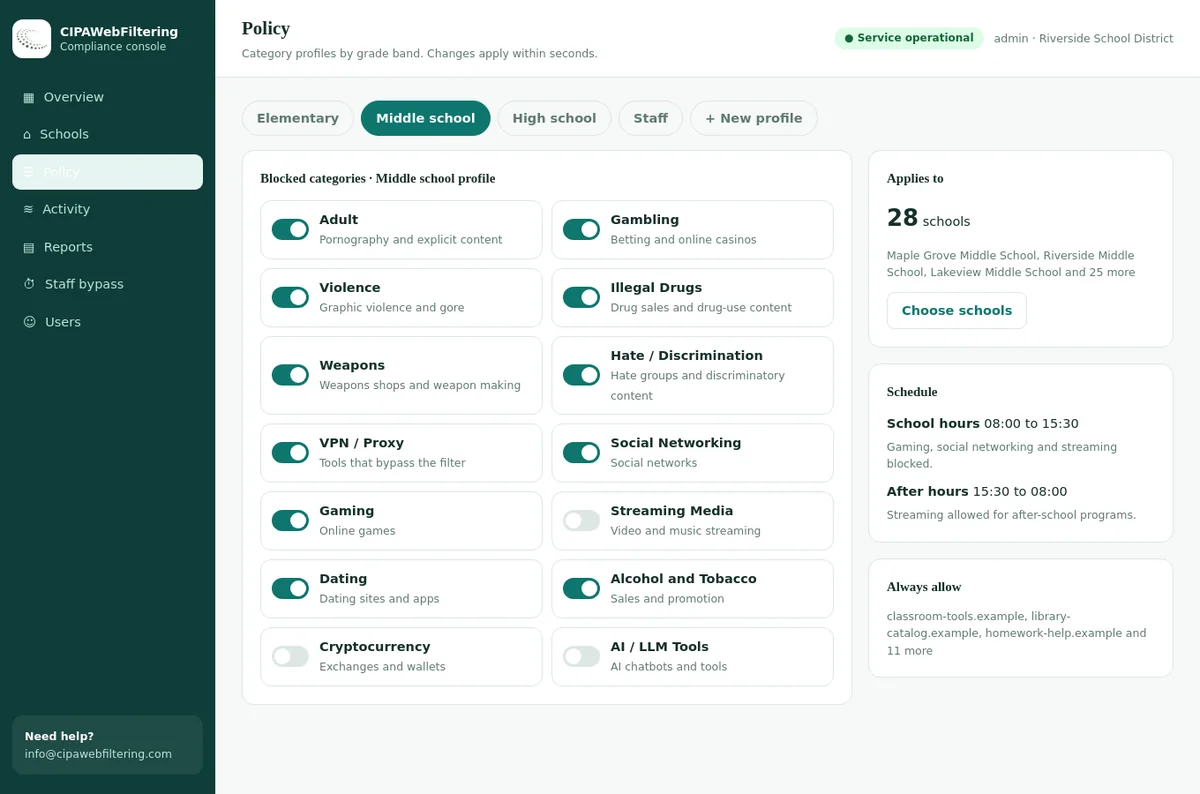
The FOCUS Act asks each Alabama board to keep students off social media on board-owned devices unless a teacher directs it. Our hosted CIPA filter makes that a category setting, with exceptions you add yourself.
- Social Networking can be switched on or off for each school in the district
- Adult and VPN/Proxy/Anonymizers are on in the CIPA preset for the federal duty
- Nothing is installed on the board-owned computers and Chromebooks
The FOCUS Act: how HB 166 reached Alabama classrooms
FOCUS stands for Freeing our Classrooms of Unnecessary Screens for Safety. Governor Kay Ivey signed HB 166 on May 14, 2025, and the legislature records it as Act 2025-386.
Local choice on phones
Section 16-1-27 let local boards decide whether students could carry or use pagers, phones and similar devices on school property. The FOCUS Act repealed that section.
HB 166 signed
The act set statewide rules for phones, required a board Internet safety policy and added a social media safety course to the Code of Alabama.
Two board policies due
Each local board adopts a wireless communication device policy with consequences for violations, and an Internet safety policy for student access on board-owned devices.
State course ready
The State Department of Education develops an online, self-paced course on the risks of social media and how to use it safely.
Phone rule in force
Students may not use wireless devices during the instructional day, and devices on campus must be off and stored away from the student.
Alabama's phone rule in detail
The phone rule is broader than many people assume. Both the definition of a device and the definition of the instructional day are wide, which affects how IT teams think about laptops and tablets too.
Wireless communication device
- Cell phones, tablets, laptops, pagers and gaming devices
- Any other portable device named in the local policy
- The test: it can exchange voice, messages or other data with another device
Instructional day
- The time a school is in session to meet required instructional days or hours
- Includes class transitions and lunch
- Includes non-instructional times and any time the local policy adds
Plan-based use
Use written into a student's IEP, Section 504 plan, individualized accommodation plan or individualized health plan.
Supervised learning
Use for educational or learning purposes under the supervision of school staff. This is where school-issued devices usually sit.
Emergencies
Use during an emergency that threatens the life or safety of the student or another person.
The five required parts of an Alabama Internet safety policy
Section 4 of the act is the part closest to web filtering. Each local board must adopt an Internet safety policy covering student access on devices the board owns. In our own words, the policy must do five things.
Age-appropriate access
Limit student internet access to subject matter and materials the policy treats as age-appropriate.
Safe communication
Protect students when they use email, chat rooms and other direct electronic communication.
No hacking
Prohibit access to unlawfully obtained data and other unlawful online activity, including hacking.
Personal data
Prohibit sites, web apps or software that expose students to disclosure or misuse of their personal information.
Social media
Prohibit student access to social media platforms, except when a teacher expressly directs it for educational purposes only.
Several of these points overlap with the federal policy topics. Our CIPA internet safety policy guide shows how to write one document that covers both, and the acceptable use policy guide for schools covers the student-facing rules.
What the Alabama rules mean for filtering and monitoring
Alabama now has a state rule that speaks directly about social media on school devices. Turning that into filter policy is mostly about categories, user groups and a clean teacher exception.
| Requirement | Source | Filter setting | Process to pair with it |
|---|---|---|---|
| Block obscene, child pornography and harmful to minors depictions | CIPA | Adult and related categories blocked for every student group | Policy adopted after public notice and a meeting |
| Age-appropriate access only | FOCUS Act, Section 4 | Different category sets for elementary, middle and high school groups | Board-approved list of what each grade band may reach |
| No social media unless a teacher directs it | FOCUS Act, Section 4 | Social Networking blocked by default for students | Time-limited class allow rules on teacher request |
| Safe email and chat | CIPA, FOCUS Act | Email and Messaging limited to school accounts where possible | Reporting route for unsafe contact |
| No hacking or unlawful activity | CIPA, FOCUS Act | VPN / Proxy / Anonymizers and Remote Access Tools blocked | Discipline steps in the code of conduct |
| Protect students' personal information | CIPA, FOCUS Act | Malware / Phishing / Suspicious blocked, unknown apps reviewed | Vendor review before new tools go live |
| Monitor minors' online activity | CIPA | Category-level reports by school and grade | Named reviewers and a review schedule |
Blocked for students under CIPA
AdultLingerie/Swimsuits/Intimate ApparelDatingVPN / Proxy / AnonymizersProhibited by default under the FOCUS Act
Social NetworkingCommunity SitesForums / Message BoardsTypical age-appropriate limits
GamblingIllegal DrugsWeaponsViolenceHate/DiscriminationAlcoholTobaccoFile Sharing/P2PSocial media sites and the categories they carry
Alabama prohibits student access to social media platforms except when a teacher directs it for education. Several of the best-known platforms carry more than one category, which matters when you decide what to switch off.
| Platform | Categories in our data |
|---|---|
| instagram.com | Social Networking |
| snapchat.com | Social Networking |
| tiktok.com | Social Networking, Streaming Media |
| discord.com | Email and Messaging, Social Networking, Gaming |
| youtube.com | Streaming Media, Social Networking |
Making the "teacher directed" social media exception work
The act allows social media only when a teacher expressly directs it, solely for educational purposes. A filter that is either fully open or fully closed cannot show that difference, so plan the exception up front.
Request
- Teacher names the platform, class and lesson
- Request goes through a simple form or ticket
- Principal or delegate approves where local policy asks
Scope
- Allow rule for one class group, not the whole school
- Set to expire after the lesson or unit
- Only the platform needed, not the whole category
Record
- Log who asked, what was opened and for how long
- Keep it with the policy evidence
- Review patterns each term
An exception you can add and take away
Each school in the console has its own always-allow and always-block lists, and a change applies in seconds. Entries are yours to remove when the unit ends, which keeps the district default intact.
The social media safety course before eighth grade
New Section 16-40-13 asks the State Department of Education for an online, self-paced course, and each local board must deliver it to every student before eighth grade. Students who transfer in during grades eight to 12 without it must be offered it too.
Benefits
- Career and resume building
- Sharing with family and friends
- Connecting safely around shared interests
Risks
- Effects on mental health, including addiction
- Misinformation and manipulation of behavior
- Permanence of what is shared online
Safe practices
- Reporting suspicious behavior
- Spotting cyberbullying, phishing, scams, predators and trafficking
- Personal security and not oversharing
Student data privacy in Alabama
Alabama has no dedicated statute for edtech operators of the kind found in several other states. Bills were proposed in 2014 and 2016 but did not pass. Student records sit under FERPA, the State Board's data use and governance policy and each district's own records policy.
FERPA
Federal rules on access to and disclosure of education records apply to every Alabama district receiving federal education funds.
State governance policy
The State Board's data use and governance policy sets how state-held data is shared, and expects every district to have a locally adopted records policy.
Contracts
Without a vendor statute, contract terms carry the load: limits on use, retention, deletion and resale of student data.
Web filters and monitoring tools often store usernames next to browsing history. Read our guide to student data privacy, FERPA and filtering before you sign or renew.
Board-owned devices on and off campus
The FOCUS Act Internet safety policy covers student access on devices owned by the local board. It does not limit that to the school building, so take-home devices need the same rules at home.
On the school network
Network or DNS filtering covers every device on student Wi-Fi. Pair it with device-level policy so the rules follow the device.
At home
A device agent or cloud filter keeps the same category rules active on home Wi-Fi and hotspots. See how to enforce CIPA on off-campus student devices.
Personal phones
Phones on cellular data never touch school filters. The FOCUS Act storage rule, not the filter, is the control during the day.
Managed Chromebooks
Admin console settings help, but category data does the heavy lifting. See category filtering on managed Chromebooks.
Alabama school internet safety checklist
Use this as a yearly pass. Open each group to see the items. For the federal side in more depth, use our CIPA compliance checklist.
Board policies FOCUS Act
- Wireless communication device policy adopted, with consequences for violations.
- Device policy distributed to students, parents, faculty, staff and the State Board of Education.
- Internet safety policy for board-owned devices adopted, covering all five required parts.
- Principals briefed on their responsibility for staff compliance.
Filter configuration CIPA and FOCUS Act
- Adult and related categories blocked for every student group.
- Social Networking blocked by default for students, with a teacher request route.
- Age bands set so elementary, middle and high school see different category sets.
- VPN / Proxy / Anonymizers blocked to stop students routing around the rules.
- Take-home devices tested off campus.
Monitoring CIPA
- Named reviewers for filter and alert reports.
- A set review rhythm, for example weekly alerts and termly trend reports.
- Escalation steps for safety alerts, linked to counseling and safeguarding staff.
Instruction CIPA and 16-40-13
- Social media safety course delivered before eighth grade.
- Course offered to transfer students in grades eight to 12 who have not completed it.
- Parents notified that the course is available.
- Online safety lessons on cyberbullying across grade bands.
Paperwork E-Rate
- Internet safety policy public notice and meeting minutes on file.
- Form 486, or Form 479 through a consortium, filed for the funding year.
- Vendor contracts reviewed for student data terms.
Evidence to keep for CIPA and the FOCUS Act
If an E-Rate reviewer, a parent or the State Department of Education asks how you comply, these records answer most questions without a scramble.
Adopted policies
Device policy and Internet safety policy, with the board vote date.
Board office, when revisedDistribution proof
How and when the device policy reached students, parents, staff and the State Board.
Communications, each yearFilter configuration export
Blocked categories by student group, with the date of export.
IT, each termTeacher access log
Social media openings for lessons: who, what, when and for how long.
IT and principals, ongoingMonitoring samples
Sample reports and the list of reviewers.
Administrators, monthly or termlyCourse completion
Records showing students completed the social media course before eighth grade.
Schools, each yearCIPA hearing record
Public notice and minutes of the meeting where the policy was discussed.
Board clerk, when revisedE-Rate forms
Filed Form 486 or Form 479 and confirmation of receipt.
E-Rate lead, each funding yearKeeping to the FOCUS Act and CIPA: hand-built blocks or a hosted filter
The rows below follow what an Alabama district has to be able to do after HB 166.
| Alabama requirement | Blocklists kept by IT | Hosted CIPA filter |
|---|---|---|
| Restrict social media on board-owned devices | Add each platform and its look-alikes | Social Networking category switch per school |
| Let a teacher direct use for a lesson | Edit the list, then undo it | Always-allow entry for the school, removed afterwards |
| Block harmful material under CIPA | Custom lists for Adult | Adult and VPN/Proxy/Anonymizers on in the CIPA preset |
| Devices taken home | Varies with each device | A private encrypted link keeps the same rules off the network |
| Filter configuration export for the file | Screenshots of settings | Policy record, activity reports and a log export |
| Students switching to a VPN | A proxy list to maintain | VPN / Proxy / Anonymizers blocked as a category, even when staff use a PIN |
Alabama school internet safety FAQ
Does Alabama have its own school internet filtering law?
Not a stand-alone filter statute. The FOCUS Act, however, requires each local board to adopt an Internet safety policy for board-owned devices that limits access to age-appropriate material and prohibits social media unless a teacher directs it for learning.
What does the Alabama FOCUS Act require?
From 2025-2026, no student device use during the instructional day, with devices off and stored. Boards had to adopt a device policy and an Internet safety policy by July 1, 2025, and students take a social media course before eighth grade.
Does the FOCUS Act cover lunch and passing periods?
Yes. The instructional day includes class transitions, lunch and other non-instructional times, plus any time the local policy adds.
Are there exceptions to the phone rule?
Yes: use under an IEP, Section 504 plan, accommodation plan or health plan, supervised educational use, and emergencies threatening someone's life or safety.
Who is responsible for compliance with the Internet safety policy?
The act makes the principal responsible for ensuring that school personnel consistently comply with it.
Does Alabama have a student data privacy law for edtech vendors?
No dedicated operator statute. FERPA, the State Board's data use and governance policy and local records policies apply, so contracts carry most vendor terms.
Compare other state school internet laws
See every state on our school internet safety laws by state hub.
Not legal advice. This page summarizes federal and Alabama rules in our own words for general information. Laws, state guidance and dates change, so check the current Code of Alabama and State Department of Education guidance, and confirm your duties with your board attorney.
Related guides
- CIPA Internet Safety Policy: What It Must Contain and How to Write One
- Explaining Web Filtering to Parents: Letters, FAQs, Clear Limits
- Presenting Web Filtering to the School Board: Budget, Risk, Metrics
- Georgia School Internet Safety Laws: SB 351, HB 340, CIPA
- Mississippi School Internet Safety Laws: CIPA and HB 1315
Cost depends on the number of schools and devices in your district, and we send a quote within one business day. A pilot at one Alabama school shows the blocks and reports before the board commits.
Talk to us about your Alabama district
Tell us how you handle social media, age bands and take-home devices today. We will show how our CIPA category coverage and the hosted CIPA filter support both CIPA and your FOCUS Act Internet safety policy.