Connecticut School Internet Safety Laws
Connecticut does not have its own school filtering statute. CIPA sets the filter rule. Where Connecticut stands out is student data: its privacy law reaches almost every vendor that touches student information, including filter and monitoring services.
This guide covers all three questions districts ask: filtering, data and phones.
1What CIPA requires of Connecticut schools
CIPA applies to schools and libraries that take E-Rate discounts for internet access or internal connections. Certification happens each funding year on FCC Form 486, or on Form 479 for consortium members.
Filter
Blocks obscene, child pornography and harmful to minors images on computers minors use.
Policy
Covers inappropriate material, email and chat safety, hacking and minors' data.
Public meeting
Notice and at least one public hearing or meeting before adoption.
Monitoring
The policy provides for monitoring minors' online activities.
Education
Lessons on online behavior, social networking safety and cyberbullying.
For the full federal picture, see what CIPA is and who must comply and how CIPA connects to E-Rate funding.
Choose a filter your privacy contract can describe in a few lines
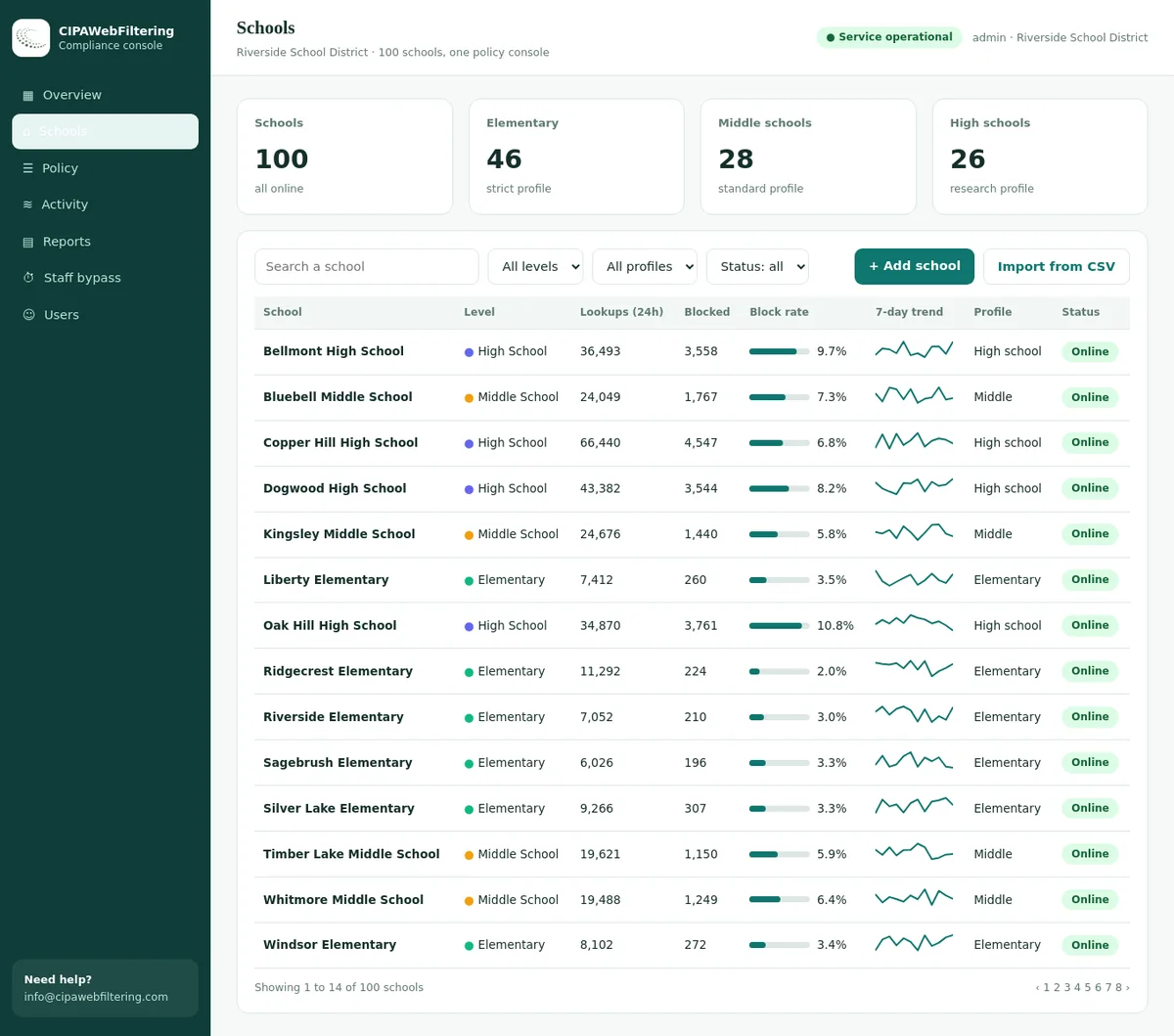
Connecticut has no filtering statute of its own, but Public Act 16-189 can treat a filter vendor as a contractor. Our hosted CIPA filter makes domain-level decisions, so what it does for your schools is short to write down.
- It decides by domain, not by page, and it is not a monitoring or classroom screen tool
- CIPA categories do the blocking, with Adult and VPN/Proxy/Anonymizers on in the preset
- Activity reports and a log export are there for the contract and the E-Rate file
2What Connecticut adds, and what it does not
It helps to be plain about the state layer, because staff often assume Connecticut has a filtering law of its own. It does not.
Not in Connecticut law
- A separate state duty to filter school internet
- A state list of categories schools must block
- A statewide ban on student phones during the school day
In Connecticut law and guidance
- A detailed student data privacy law for contractors and operators
- Parent notice when boards sign contracts that involve student data
- State Board of Education guidance urging strong phone limits
- Protections for minors' data in the state consumer privacy law
3Connecticut's student data privacy law
Public Act 16-189 took effect on October 1, 2016, and is codified at sections 10-234aa to 10-234dd of the General Statutes. It was later amended, including by acts in 2017 and 2018. It sets duties for two groups.
- An operator or consultant that holds or can access student data under a contract with a board of education
- The contract must contain required terms on use, protection and deletion of student information
- The board notifies parents and guardians when the contract is executed
- Rules on responding to a breach of student information
- Runs a website, online service or app used for school purposes and handles student information
- Keeps reasonable security practices
- Deletes student data on request from a student, parent, guardian or board
- No targeted advertising, no profiles for non-school purposes and no sale of student information, with listed exceptions
Board of education
Signs contracts, sends parent notices and adopts the internet safety policy.
IT department
Maps what each tool collects and sets retention and access controls.
Business office
Checks that required data terms are in every agreement before signing.
Vendor
Secures, limits and deletes student data as the contract and the law require.
4How the data law reaches your web filter
A web filter or monitoring tool usually sees student usernames, device names and every site visited. That puts most of these services inside the contractor definition. The flow below is how a careful Connecticut district handles it.
Map the data
List what the filter collects: usernames, IP addresses, URLs, alerts, screenshots if any.
Contract terms
Put the required use, security and deletion terms into the agreement before go-live.
Parent notice
Notify parents and guardians that the contract was executed, as the law requires.
Retention and deletion
Set how long logs are kept and how deletion requests are handled.
5Questions to ask a filter or monitoring vendor in Connecticut
Use these in a request for proposals or at renewal. They follow the themes of the state law, written in plain language.
What do you collect?
Ask for a full list of student data fields, including anything captured from screens or messages.
Where is it stored?
Ask about location, encryption and who on the vendor side can see it.
How long is it kept?
Ask for default retention and whether the district can shorten it.
How is it deleted?
Ask how a deletion request from a parent or the board is carried out and confirmed.
Is it used for anything else?
Ask whether data trains products, builds profiles or reaches advertisers. The answer should be no beyond allowed school purposes.
Have you signed the pledge?
Ask whether the vendor signed the state Student Data Privacy Pledge, and keep a copy.
Answers the hosted filter can give your privacy lead
Ask what the service sees, and the answer is requested domains, per school, with reports and a log export. Nothing is installed on school computers, and the filter does not read pages or messages.
6Phones in Connecticut schools: where things stand
Phone rules are a live topic in Connecticut, and the status has changed more than once. As of October 2026, these are the facts.
State Board guidance
The State Board of Education urged districts to eliminate phone use for elementary and middle school students during the day, and to limit it strongly for high schoolers.
House passes bell-to-bell bill
The Governor's bill, HB 5035, would have kept student phones out of use from morning to afternoon bell. The House passed an amended version.
Dropped in the Senate
Senators removed the proposal on the final day of the session. There is no statewide phone ban, and the Governor said he expects to try again.
- Keep student Wi-Fi closed to personal phones during lessons where local policy limits them
- Make sure school devices, not phones, are the path to approved learning tools
- Report phone-related network use to principals if the policy asks for it
- Filter phones running on their own cellular data
- Replace classroom rules and storage with network settings
- Enforce a state ban that does not yet exist
7What this means for filtering and monitoring
Without a state filter law, Connecticut districts set categories from CIPA and local policy, and shape logging around the data privacy law.
| Need | Source | Filter setting | Data and process |
|---|---|---|---|
| Block obscene, child pornography and harmful to minors images | CIPA | Adult and related categories blocked for all student groups | Policy after notice and a public meeting |
| Monitor minors' online activity | CIPA | Category-level reports | Keep only what monitoring needs |
| Protect students' personal data | CIPA, 10-234aa to 10-234dd | Malware / Phishing / Suspicious blocked | Contract terms, retention limits, deletion process |
| Stop bypass | CIPA in practice | VPN / Proxy / Anonymizers blocked | Acceptable use policy and discipline |
| Phone limits during the day | Local board policy | Student Wi-Fi closed to personal phones in class | Policy shared with families |
| Social media access | Local board policy | Social Networking restricted by age band | Teacher request route for lessons |
Navy: CIPA core for every student. Teal: common local blocks. Blue: decided by age band and teacher need. See the web filtering categories taxonomy for each one.
8Data minimization settings that help
These settings support both the CIPA monitoring duty and Connecticut's data law. Most filters offer some version of each.
Category reports
Report by category and school rather than storing every URL by student for long periods.
Short retention
Keep detailed logs only as long as investigations need, then delete.
Role access
Limit who can see named student activity to staff with a safety role.
Local lookups
Run category lookups inside your own network so browsing data stays home.
9Take-home devices and off-campus filtering
Many Connecticut districts lend Chromebooks or laptops for use at home. CIPA was written for school networks, but families and boards expect the same protection on a school device wherever it is used.
Filter on the device
A device agent or managed browser policy keeps category rules active on home Wi-Fi and public hotspots.
Same policy, both places
Use one category set at school and at home, so students do not learn that rules switch off after 3 pm.
Log with care
Home browsing is sensitive. Apply the same retention limits and role access you use for school logs.
10Libraries and AI tools
Two areas come up often in Connecticut districts and towns: shared library spaces, and the fast growth of AI tools. Neither has a specific state filtering rule, so local policy decides.
- Libraries taking E-Rate for covered services follow CIPA on their computers
- Under CIPA, an adult may ask for the filter to be disabled for bona fide research or other lawful purposes
- Give students, adult patrons and staff their own filter policies on shared networks
- Decide by grade: many districts open approved tools only for older students
- Treat AI image generators more strictly than text tools
- Check each AI vendor's data terms against the state student data law before approval
How writing and AI assistants are labelled in our data
Connecticut has no specific rule on AI tools, so the town or district decides. The lookups below show that most of these sites share one category, which makes a single switch possible.
| Site | Categories we hold |
|---|---|
| quillbot.com | AI / LLM Tools |
| otter.ai | AI / LLM Tools |
| jasper.ai | AI / LLM Tools |
| poe.com | AI / LLM Tools |
| you.com | AI / LLM Tools, Computers & Technology, Search Engines & Platforms, Web-based Applications |
11Common myths about Connecticut school internet rules
A strong privacy law and a public phone debate have left some staff with the wrong picture. These are the points we hear confused most often.
"Connecticut has its own filter law"
It does not. CIPA and the board's own policy set the filter rule for E-Rate schools and libraries.
"The privacy law means we cannot monitor"
Monitoring is still a CIPA duty. The state law shapes how vendors use and keep the data, not whether you monitor.
"Phones are banned statewide"
Not as of October 2026. The 2026 bill did not pass, so phone rules are local.
"A signed pledge ends our review"
The pledge is a useful public statement, but your own contract terms and parent notice duties still apply.
"A block list from a few years ago is fine"
New domains appear every day. Our database categorizes about 300,000 newly registered domains daily.
"More logging is always safer"
Under a strict data law, keeping less is often the safer choice. Keep what monitoring needs.
12Connecticut school internet safety checklist
Tick through once a year. Items are federal unless marked. The general CIPA compliance checklist goes deeper on the federal side.
13Evidence to keep
In Connecticut, the data side of your file matters as much as the filter side. Keep both in one place.
| Record | Shows | Refresh |
|---|---|---|
| Internet safety policy, notice and meeting minutes | CIPA policy duty | When revised |
| Filter configuration export by student group | CIPA protection measure | Each term |
| Monitoring report samples and reviewer list | CIPA monitoring | Monthly or termly |
| Signed vendor contracts with data terms | Contractor duties under state law | At signing and renewal |
| Copies of parent contract notices | Notice duty under state law | Each new contract |
| Vendor pledge signatures | Public statement of compliance | At signing |
| Deletion request log | Operator deletion duty in practice | Ongoing |
| Filed Form 486 or Form 479 | E-Rate certification | Each funding year |
Drafting the policy text? Our CIPA internet safety policy guide lists each required topic.
Choosing a filter under Connecticut's student data law
The rows set the CIPA job beside the privacy questions this state adds.
| Connecticut question | Tool that inspects traffic | Hosted CIPA filter |
|---|---|---|
| What does the service look at? | Possibly the content of pages | The domain requested, not the page |
| Software on student devices | Often an agent per machine | Nothing installed on computers |
| Blocking for CIPA | Custom rules to maintain | Category blocking with Adult and VPN/Proxy/Anonymizers in the preset |
| Settings across districts and towns | One policy for all | Separate settings per school or branch |
| Chromebooks sent home | Depends on each account policy | A private encrypted link keeps the rules on the device |
| Records for the board | Hand-built exports | Activity reports, policy record and log export |
14Connecticut school internet safety FAQ
Does Connecticut require schools to filter the internet?
There is no separate state filtering statute. CIPA sets the duty for schools and libraries that take E-Rate, together with each board's own policy.
Does the student data privacy law apply to web filter vendors?
Usually yes. A filter or monitoring service that holds student usernames and browsing data under a board contract typically fits the contractor definition in sections 10-234aa to 10-234dd.
Must districts tell parents about new edtech contracts?
Yes. Boards notify parents and guardians when a contract with a student data contractor is executed. Check current guidance for timing and format.
Is there a statewide school cell phone ban?
Not as of October 2026. The State Board urged limits in 2024, and a 2026 bell-to-bell bill passed the House but was dropped in the Senate.
What is the Student Data Privacy Pledge?
A pledge run by the Commission for Educational Technology where vendors attest compliance with the state law. Guidance treats signing as a public statement of compliance.
Other state guides
Browse every state on the school internet safety laws by state hub.
Not legal advice. This page summarizes federal and Connecticut rules in our own words for general information. Statutes, guidance and bill status change, so check the current General Statutes and state guidance, and confirm your obligations with your board's counsel.
Related guides
Pricing comes from the number of schools and devices, and a quote reaches you within one business day. A pilot at one Connecticut school lets your privacy lead and your IT team look at the blocks and reports first.
Talk to us about your Connecticut district
Want strong CIPA filtering while keeping student data in house? We will show how our category database runs inside your own systems, and how the hosted CIPA filter pilot works.
Talk to us about your district