Rhode Island School Internet Safety Laws
Rhode Island is one of the few states with a school filtering law built around transparency. It does not tell districts what to block. It tells them to say what they block, why, and how teachers can ask for a change.
This guide for Rhode Island technology directors, library media specialists and principals covers CIPA, the state filtering policy law and the 2026 phone rule. Planning guidance, not legal advice.
The CIPA baseline
Every Rhode Island school or library that takes E-Rate discounts for internet access or internal connections must meet the Children's Internet Protection Act. Background is in what is CIPA.
Filter
A technology protection measure that blocks visual depictions that are obscene or child pornography for all users, and harmful to minors for minors.
Policy
An internet safety policy on inappropriate material, email and chat safety, hacking, disclosure of minors' data and the filter. Adopted after public notice and a hearing or meeting.
Monitor and teach
Monitor minors' online activities and educate students about appropriate online behavior, social networking safety and cyberbullying.
Name your blocked categories once and let the filter hold them
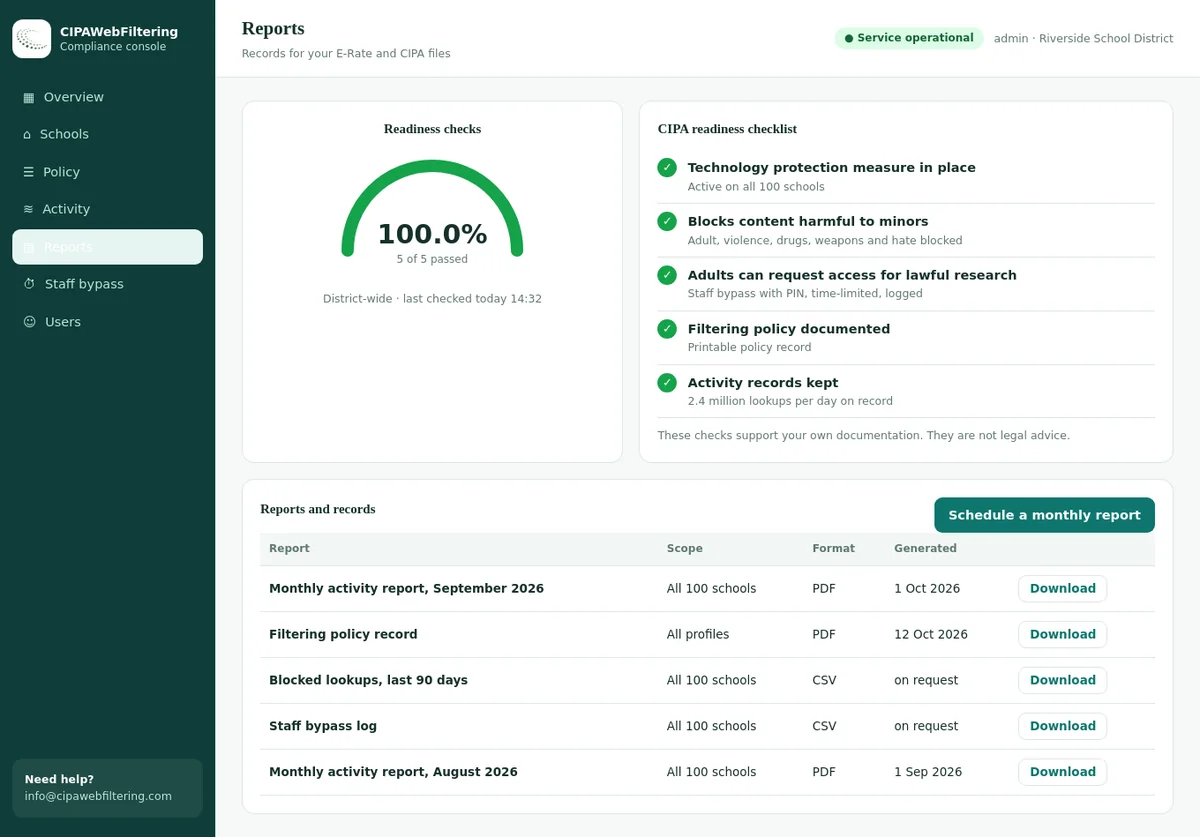
Section 16-21.6-1 wants Rhode Island districts to publish which categories are blocked and why. Our hosted CIPA filter is a DNS filter that we run for you, and it works from named categories, which is the shape a published list needs.
- Each school has its own category switches, so grade-band differences match what the policy says
- The always-allow list gives a teacher's approved request a quick home, per school
- The policy record and activity reports back up the yearly review the law describes
What Rhode Island adds: the internet filtering policy law
Chapter 16-21.6 of the Rhode Island General Laws, section 16-21.6-1, was enacted in 2016 after bills in several earlier sessions. It defines internet-filtering measures as the use of a specific technology or program to block or filter access to websites.
A state model policy
The Rhode Island Department of Education develops a written model internet filtering policy for districts, state schools, charter schools and mayoral academies.
Districts adopt the model
Each school district must adopt the department's model written policy, rather than writing its own from scratch.
Name the categories
The policy must list the specific categories of websites that are blocked.
Give the rationale
It must explain why each category is blocked, so staff and families can see the reasoning.
Say who decides
It must identify who makes blocking decisions, typically by position rather than by name.
Teacher unblock route
It must set a procedure for teachers to request that a site be unblocked, and the criteria used to deny a request, with specific reasons for any denial.
Public record
Districts keep a public record of unblock requests and the response to each one.
Yearly report and review
Districts report to the school committee each year and review the prior year's requests to decide whether the blocked categories should change.
CIPA and 16-21.6-1 side by side
| Question | Federal CIPA | Rhode Island 16-21.6-1 |
|---|---|---|
| What triggers it? | E-Rate discounts or certain library grants | Being a Rhode Island school district |
| Does it say what to block? | Visual depictions that are obscene, child pornography or harmful to minors | No; it requires you to list what you block |
| Policy source | Your own internet safety policy | The Department of Education's model policy |
| Unblocking | Disabling allowed for adults doing lawful research | A teacher request procedure with written denial criteria |
| Public reporting | Public notice and a hearing or meeting on the policy | Public record of requests and a yearly report |
| Review cycle | None set in the statute | Yearly review of the prior year's requests |
The teacher unblock request, step by step
The heart of the state law is a fair, recorded process for teachers who find a useful site blocked. This is one way to run it that leaves the record the law expects.
Request
Teacher submits the site, the class and the teaching purpose through one form.
Look up
Staff check the site's categories, for example with a domain category check.
Decide
The named decision maker applies the written criteria.
Answer
Approve, approve for a group, or deny with specific reasons.
Record
Log the request and the response in the public record.
Review
Feed the year's requests into the annual category review.
What a clean public record looks like
| Date | Site | Category | Request purpose | Decision | Reason |
|---|---|---|---|---|---|
| 2026-09-08 | example-history-archive.org | Forums / Message Boards | Grade 11 primary source research | Approved, grades 9 to 12 | Educational value; moderated content |
| 2026-09-15 | example-proxy-tool.net | VPN / Proxy / Anonymizers | Networking unit demo | Denied | Bypasses the filter; demo offered on a lab network |
| 2026-09-22 | example-health-site.org | Health & Medicine | Health class | Approved, all secondary | Category reviewed and opened for secondary |
Approved requests that stay approved and leave a trail
When a request is approved, the site goes onto that school's always-allow list and the change is kept in the policy record. The activity reports and log export then give your yearly review something concrete to count.
Rhode Island's phone-free school day
In 2025 the General Assembly passed a law requiring each public school district to adopt a policy that keeps students off personal phones and devices during the school day. Reports give the effective date as August 1, 2026, ahead of the 2026 to 2027 school year.
What the phone law does
- Districts adopt a policy limiting student access to personal devices during the school day.
- Exceptions cover IEPs, 504 plans, medical needs such as glucose monitoring, plans for emergent multilingual learners and emergencies.
- Details, including storage and enforcement, are left to local school officials.
What it means for filtering
- Student browsing shifts to school devices, so your filter and its category list carry more weight.
- Phones that join school Wi-Fi under an exception should get the student rule set.
- Block VPN / Proxy / Anonymizers so devices cannot tunnel around the filter. See blocking proxy sites in schools.
- Update your acceptable use policy to match the new device rules.
What it means for filtering and monitoring in Rhode Island
A Rhode Island filter has to block what CIPA requires and be explainable to a school committee. Category design is the key decision.
| Policy item | Example entry | Rationale to publish |
|---|---|---|
| Blocked for all users | Adult | CIPA requires blocking obscene and child abuse imagery for everyone |
| Blocked for students | Gambling, Illegal Drugs, Weapons, Violence, Hate/Discrimination, Dating | Harmful to minors or unlawful for minors |
| Blocked for students | VPN / Proxy / Anonymizers | Prevents bypass of the protection measure |
| Blocked for younger grades | Social Networking, Alcohol, Tobacco, Lingerie/Swimsuits/Intimate Apparel | Age-appropriate restrictions by grade band |
| Blocked for security | Malware / Phishing / Suspicious | Protects devices, accounts and student data |
| Allowed by policy choice | Approved AI / LLM Tools | Listed tools reviewed for privacy and teaching value |
Stable category names
The policy names categories, so pick a filter whose categories are well defined and do not change name every year. Our web filtering categories taxonomy shows one such set.
Fewer custom blocks
One-off site blocks are hard to explain in a category policy. Prefer category rules and keep a short, documented exceptions list.
Monitoring stays modest
CIPA monitoring can be supervision plus category reports. Read student data privacy and filtering before turning on detailed logs.
AI tools by category
If you block AI, list it like any other category. The AI tools blocklist for schools separates approved tools from the rest.
Off-campus devices
Take-home devices should carry the same rule set. See filtering school devices off campus.
Fresh data
Around 300,000 new domains are categorized each day and rechecked after a week and a month, which keeps proxy and adult blocks current.
Writing the rationale for each blocked category
The law asks for a rationale, not a legal essay. One or two plain sentences per category work best, because the school committee and families will read them.
Adult
Sample wording: "Blocked for all users because federal law requires schools to block obscene images and child sexual abuse material."
Gambling
Sample wording: "Blocked for students because gambling is unlawful for minors and betting sites target young people."
VPN / Proxy / Anonymizers
Sample wording: "Blocked for students because these tools hide traffic and let users bypass the district's required filter."
Malware / Phishing / Suspicious
Sample wording: "Blocked for all users to protect district devices, staff accounts and student records."
Social Networking
Sample wording: "Blocked for grades K to 8 because most platforms set minimum ages above 13; open to staff for school communication."
AI / LLM Tools
Sample wording: "Unapproved tools blocked for students pending a privacy and teaching review; approved tools are listed on the district site."
Which category our data gives sites behind the sample rationales above
A rationale reads better when it points to a real category. We looked these names up in our database, and a few belong to more than one.
| Site | Category in our data | Rationale line it supports |
|---|---|---|
| draftkings.com | Gambling, Sports & Recreation | Gambling is unlawful for minors, so the whole category stays closed |
| fanduel.com | Gambling, Sports & Recreation | A second betting name that the same switch already covers |
| hola.org | VPN / Proxy / Anonymizers | Tools that hide traffic work against the required filter |
| snapchat.com | Social Networking | A grade-band decision a committee can discuss in the open |
| chatgpt.com | AI / LLM Tools | Held for review until a privacy and teaching check is done |
| khanacademy.org | Education/Reference | A teaching resource that should never need a request |
Preparing the annual school committee report
The yearly report is the moment the public record turns into decisions. A short, consistent format makes it easy for the committee and keeps each year comparable.
Volume
- Total unblock requests
- Approved, partly approved and denied
- Requests by school level
Patterns
- Categories with the most requests
- Repeat requests for the same site
- Average time to answer
Decisions
- Categories proposed for change
- Grade bands affected
- Reasons for keeping blocks in place
Common Rhode Island misreadings
The state law is short, which leaves room for confusion. These are the points we see misread most often.
| Misreading | What the law says |
|---|---|
| "Rhode Island tells us which sites to block." | It requires a policy that names your blocked categories and reasons. The choices stay with the district, within CIPA. |
| "Any district can write its own filtering policy." | Districts adopt the Department of Education's model written policy. |
| "Unblock requests are internal." | Districts keep a public record of requests and responses and report on them yearly. |
| "A denial needs no explanation." | The policy sets denial criteria, and a denial comes with specific reasons. |
| "The phone law changes what the filter blocks." | It limits personal device use. Filtering duties come from CIPA and your policy. |
Rhode Island compliance checklist
Run it each summer, before the E-Rate form window and before the annual school committee report. The CIPA compliance checklist covers the federal items in more detail.
- CIPA internet safety policy covers every required topic
- Public notice and hearing or meeting held and documented
- Department of Education model filtering policy adopted
- Blocked categories listed by name in the policy
- Rationale written for each blocked category
- Decision maker named by position
- Teacher unblock form live and known to staff
- Denial criteria written; reasons given on every denial
- Public record of requests and responses kept current
- Annual report delivered to the school committee
- Prior year's requests reviewed; categories updated if needed
- Filter rule sets match the categories in the policy
- Phone policy adopted before August 1, 2026 with exceptions
- Online safety lessons delivered and logged
- Form 486 or 479 filed on time
- Vendor contracts reviewed for student data terms
Evidence to keep
Rhode Island adds records that CIPA alone does not ask for. Store them with your E-Rate evidence in one folder per school year.
| Record | What it shows | Source of the duty |
|---|---|---|
| Adopted model filtering policy with blocked categories, rationale and decision maker | State policy in place | 16-21.6-1 |
| Public log of unblock requests and responses | Transparency duty met | 16-21.6-1 |
| Annual report to the school committee and minutes | Reporting duty met | 16-21.6-1 |
| Annual category review notes and any changes | Review duty met | 16-21.6-1 |
| Exported filter rule sets by grade band and staff | Protection measure matches the policy | CIPA, 16-21.6-1 |
| Hearing notice, minutes and lesson records | CIPA process and education duty | CIPA |
| Filed Forms 486 or 479 | Federal certification | CIPA |
| Adopted phone policy and exception records | Phone law followed | 2025 phone law |
Publishing a category policy: by hand or with a hosted filter
This table sets the chores that 16-21.6-1 creates next to how each one looks with our filter.
| Chore under the state law | Spreadsheet and separate device rules | Hosted CIPA filter |
|---|---|---|
| List the categories you block | A document that can drift from the live settings | The category switches are the list, per school |
| Differ by grade band | Several rule sets to keep aligned | Separate settings for each school or branch in one console |
| Act on an approved teacher request | Edit a block list and hope it reaches every device | Add the site to the school's always-allow list |
| Stop bypass tools | Chase new proxy sites one at a time | VPN/Proxy/Anonymizers blocked as a category |
| Review last year's requests | Dig through email and tickets | Activity reports, policy record and a log export |
| Same rules on take-home devices | Depends on the device and the account | A private encrypted link keeps the rules on laptops and phones off the network |
Rhode Island school internet safety FAQ
Does Rhode Island have its own school internet filtering law?
Yes. Section 16-21.6-1 requires each district to adopt the Department of Education's model filtering policy. It is a transparency law: it requires naming blocked categories, explaining them and giving teachers an unblock route.
What must the filtering policy include?
The blocked categories, the rationale and who decides, plus a teacher unblock procedure and denial criteria, with specific reasons given for any denial.
Do districts have to publish unblock requests?
They keep a public record of requests and responses, report yearly to the school committee and review the prior year's requests when deciding on categories.
Does the law apply to charter schools?
The model policy is written for districts, state schools, charter schools and mayoral academies. Check with your governing body and the department on how adoption applies to you.
Are phones banned in Rhode Island schools?
A 2025 law requires district policies keeping students off personal devices during the school day, effective August 1, 2026, with exceptions for IEPs, 504 plans, medical needs, multilingual learner plans and emergencies.
Does the state law replace CIPA?
No. CIPA still applies with E-Rate. The state law adds transparency and review duties on top of the federal ones.
Does Rhode Island require schools to block AI tools?
We found no such statute. If you block an AI category, list it in the policy with a rationale and handle teacher requests like any other category.
Other state school internet safety laws
Compare Rhode Island with other Northeast states, or browse every guide on the school internet safety laws by state hub.
Related guides
We price by the number of Rhode Island schools and devices and reply with a quote in one business day. A pilot in a single school shows your committee real blocks and reports before you roll the policy out to the district.
Talk to us about your district
Clear category names make a Rhode Island filtering policy easy to publish and defend. We can show how CIPA category filtering and simple unblock reviews fit your district.
Talk to us about your district