Hawaii School Internet Safety Laws
Hawaii runs all of its public schools as one statewide system. There is no separate state filtering statute, so CIPA and Department of Education policy set the filter rules.
The big change for 2026-27 is Board of Education Policy 301-11, a statewide phone policy. Here is how it, CIPA and Hawaii's student privacy law fit together.
One statewide school system
The Hawaii State Department of Education operates every regular public school in the state. Policy set at the state level reaches all of them at once, which makes Hawaii different from states with hundreds of local boards.
CIPA
The federal filter rule for E-Rate schools and libraries.
Policy 301-11
Statewide phone limits from 2026-27.
Act 40 (2016)
Student online privacy rules for edtech operators.
No filter statute
No extra Hawaii law on school filtering.
What CIPA requires of Hawaii schools
CIPA applies to schools and libraries that take E-Rate discounts for internet access or internal connections. Certification happens each funding year on FCC Form 486, or on Form 479 for consortium members.
Protection measure
Blocks or filters obscene, child pornography and harmful to minors images on computers minors use.
Internet safety policy
Covers inappropriate material, email and chat safety, hacking and disclosure of minors' data.
Public meeting
Reasonable notice and at least one public hearing or meeting before adoption.
Monitoring and teaching
Monitoring minors' online activity and teaching social networking safety and cyberbullying awareness.
Read what CIPA is and who must comply and how the rules connect to E-Rate CIPA funding.
Run CIPA filtering for a school across the islands from a single console
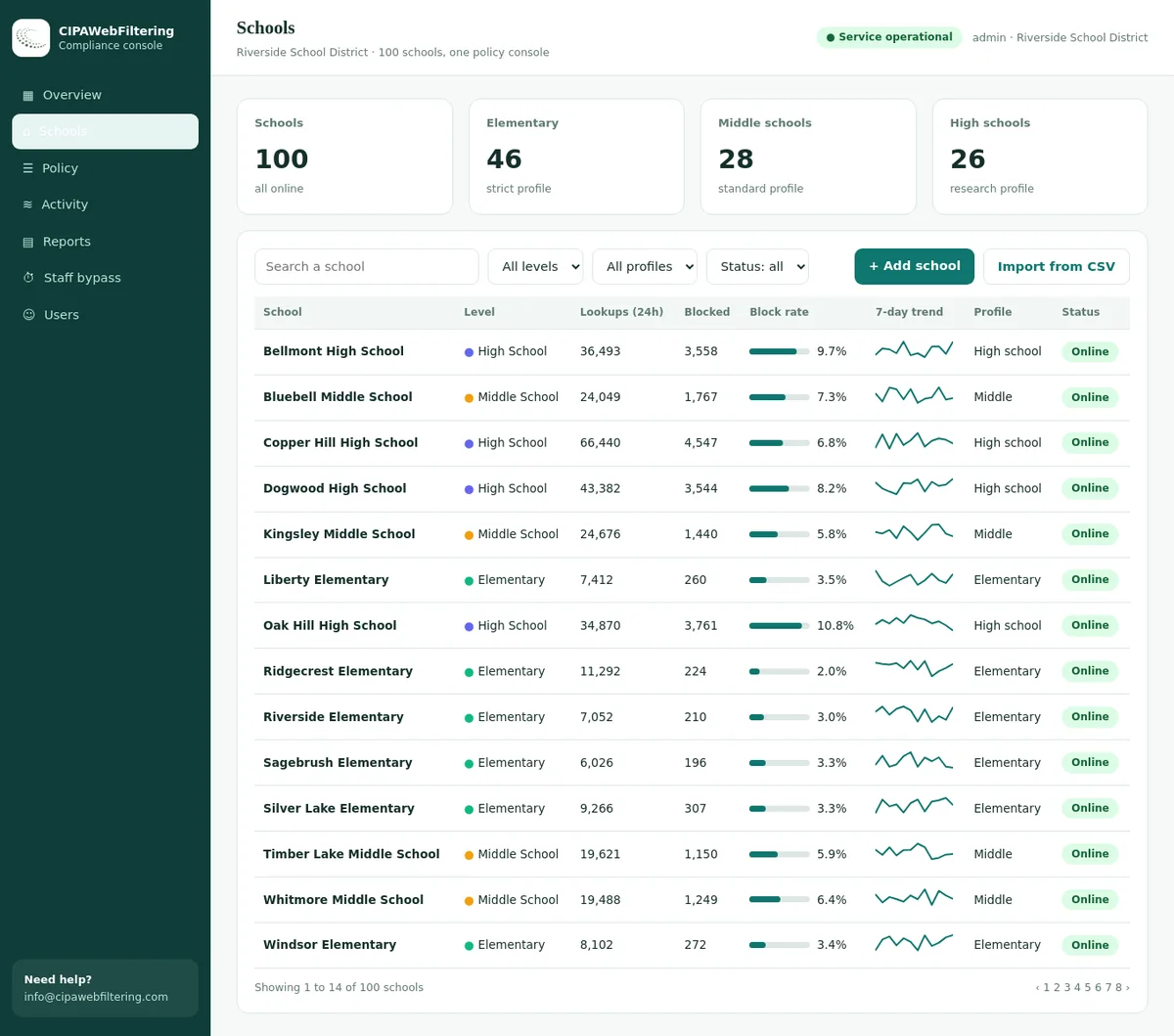
Hawaii has no state filter statute, so the job is to make CIPA work for every campus, including charter and independent schools outside the Department. Our hosted CIPA filter is a DNS filter that we run, with separate settings for each school or branch.
- Pointing a campus at the filter takes one DNS setting on its router or firewall
- Lookups are answered in milliseconds, so a long island link is not a bottleneck for category checks
- Hawaiian language and cultural sites stay open unless you choose to block their category
What Hawaii adds on top of CIPA
Plainly: Hawaii has no state statute that adds its own school filtering requirement. CIPA is the legal filter rule. Hawaii's additions are a Board of Education phone policy and a student data privacy law for operators.
What one statewide system means for filtering
- Filtering decisions are usually made centrally, not school by school
- Schools on different islands share the same baseline policy
- Local requests, such as a teacher needing a site, follow a statewide process
Who sits outside that system
- Public charter schools operate under their own governing boards and authorizer
- Private and independent schools set their own rules
- Public libraries run their own internet policies, with CIPA where they take E-Rate
Policy 301-11: Hawaii's statewide phone policy
The Board of Education adopted Policy 301-11, Cell Phone Use by Students in Schools, on February 12, 2026. The Department set out its implementation plan in May 2026, and the policy applies from the first day of instruction in the 2026-27 school year.
- No phone use during the school day
- Covers class time, lunch and recess
- Exceptions listed below still apply
- No phone use during instructional time
- Administrators may allow use at lunch and passing periods
- School-level rules decide non-instructional time
Emergencies
Including perceived threats to safety.
Instruction
When a teacher or administrator authorizes it.
Health needs
As determined by a licensed physician.
IEP
When included in a student's plan.
What changes for school IT on day one of 2026-27
Policy 301-11 is about behavior, but a few network and device steps make it easier for teachers to apply and harder for students to work around.
Student Wi-Fi rules by level
Close student Wi-Fi to personal phones all day at elementary and middle schools, and during class time at high schools.
School devices carry the learning
Move approved apps and sites to school devices, so teachers never need students' phones for a lesson.
Exceptions that work
Health and IEP exceptions may need network access. Give those devices a documented, narrow route rather than reopening student Wi-Fi for everyone.
Why the Legislature did not pass a phone law
Several phone bills were introduced in 2025 and 2026, such as proposals for a statewide Department policy and a ban on phones and related devices during school hours. None became law. The Board's policy is the rule schools follow.
2025 session
Bills including HB 485 and SB 1264 proposed statewide phone limits. They were not enacted.
February 12, 2026
The Board adopted Policy 301-11 the same day a broader phone bill, HB 2562, was deferred.
2026-27 school year
Implementation begins with the first day of instruction, with parent letters sent ahead of the year.
Student data privacy: Act 40 of 2016
Act 40 of 2016, which began as SB 2607, added a Student Online Personal Information Protection subpart to Chapter 302A of the Hawaii Revised Statutes. It follows the common operator model used in several states.
Who and what it covers
- Operators who know their site, service or app is used primarily for K-12 school purposes and was designed and marketed for them
- "Covered information": personally identifiable student information that is not public and reaches the operator through K-12 use
- Information from students, parents, school staff, or gathered by the operator
Operator duties
- Keep reasonable security procedures to protect covered information
- Delete a student's covered information within a reasonable time when the school asks
- Limits on targeted advertising and on building student profiles outside K-12 purposes; check the current statute for exact terms and exceptions
Filtering and monitoring tools hold usernames next to browsing activity, so they often count as operators. Our guide to student data privacy, FERPA and filtering lists the questions to ask.
What this means for filtering and monitoring
With no extra filter statute, category settings come from CIPA and Department policy. Policy 301-11 shapes how student Wi-Fi should behave during the day.
| Need | Source | Filter or network setting | Process |
|---|---|---|---|
| Block obscene, child pornography and harmful to minors images | CIPA | Adult and related categories blocked for all student groups | Internet safety policy after public meeting |
| Phones off during the day (elementary, middle) | Policy 301-11 | Student Wi-Fi closed to personal phones all day | School guidelines and consequences |
| Phones off during instruction (high school) | Policy 301-11 | Personal phones off student Wi-Fi in class; local choice at lunch | Administrator decision on non-instructional time |
| Stop filter bypass | CIPA in practice | VPN / Proxy / Anonymizers blocked | Acceptable use rules |
| Monitor minors' online activity | CIPA | Category reports by school and complex area | Named reviewers and schedule |
| Protect student data | CIPA, Act 40 | Malware / Phishing / Suspicious blocked | Operator terms, deletion on request |
CIPA core, every student
AdultLingerie/Swimsuits/Intimate ApparelDatingVPN / Proxy / AnonymizersCommon statewide blocks
GamblingIllegal DrugsWeaponsViolenceHate/DiscriminationAlcoholTobaccoSet by age band
Social NetworkingAI / LLM ToolsGamingStreaming MediaForums / Message BoardsIsland realities: devices, links and time zones
Running one policy across several islands brings its own practical questions. These are the ones we would plan for.
Take-home devices
Students on neighbor islands or in rural areas often rely on school devices at home. Filtering must travel with the device; see how to enforce CIPA off campus.
Inter-island links
Traffic that crosses long links to reach a central filter adds delay. Local category lookups keep pages quick.
Time zone
Hawaii is hours behind the mainland. Support and update windows from mainland vendors may land in the middle of the school day.
Local language and culture
Hawaiian language and cultural sites must stay reachable. Category rules should never block them by accident.
Tourism and community Wi-Fi
Some campuses host community events. Keep guest networks separate from student policy.
New domains daily
We categorize about 300,000 newly registered domains every day and recheck them after a week and a month.
Keeping the school rules on a device that lives off the network
Students in rural areas often use a school device at home, and the filter has to go with it. A private encrypted link in our hosted CIPA filter keeps the same rules on laptops and phones away from the network, and nothing is installed on the computer.
AI tools in a statewide system
No Hawaii statute covers AI tools in schools. In a single statewide system, one decision about AI tools reaches every campus, so it is worth getting the structure right.
Decide by grade band
Many systems keep AI / LLM Tools closed for younger students and open approved tools for older ones.
Approve by name
Allow named tools that passed a privacy review under Act 40, and keep the rest of the category closed.
Treat image tools strictly
AI image generators can produce content CIPA requires schools to block.
Keep the list current
Our AI tools set covers more than 11,800 AI-tool domains in 18 categories, updated daily. See the AI tools blocklist for schools.
How our data files the AI writing and study tools students open
An approved-by-name approach starts from how each tool is categorized. These lookups are from our AI tools data.
| Tool | Categories in our data |
|---|---|
| claude.ai | AI / LLM Tools, Web-based Applications |
| perplexity.ai | AI / LLM Tools |
| grammarly.com | AI / LLM Tools |
| quillbot.com | AI / LLM Tools |
| gamma.app | AI / LLM Tools, Web-based Applications |
Monitoring at statewide scale
CIPA asks the internet safety policy to provide for monitoring minors' online activities. In a statewide system the challenge is volume: reports from hundreds of schools need to reach the right people without flooding them.
Route alerts locally
Safety alerts should go to staff at the student's own school or complex area, not to one central inbox.
Report by category
Category trends by school show where problems grow, without storing every visited page by name for months.
Limit named access
Only staff with a safety role should see named student activity, and that access should be logged.
Set retention
Keep detailed logs only as long as needed. Shorter retention also supports Act 40 duties.
Review on a rhythm
Weekly alert review and termly trend review is a common pattern that is easy to evidence.
Explain it to families
A plain summary of what is monitored builds trust and heads off complaints.
Public libraries and shared spaces
Hawaii's public libraries are run separately from the Department of Education. Library filtering follows CIPA where a library takes E-Rate for covered services, and the library's own policy otherwise.
When students use a public library
- The library's policy applies, not the Department's
- Under CIPA, adults may ask for the filter to be disabled for bona fide research or other lawful purposes
- School devices brought to the library keep their own filter
When the public uses a school
- Keep community and guest Wi-Fi separate from student networks
- Apply an adult policy to guest networks
- Never route community traffic through student monitoring
More on patron policy in web filtering for libraries.
Common myths about Hawaii school internet rules
A Board policy, a privacy act and no filter statute make an unusual mix. These are the points we hear confused most often.
"Hawaii passed a phone ban law"
The statewide rule is Board of Education Policy 301-11, not a statute.
"High schoolers cannot use phones at all"
The high school rule covers instructional time. Administrators may allow use at lunch and passing periods.
"No filter law means no filter duty"
CIPA still applies to schools and libraries that take E-Rate for covered services.
"The network filter covers phones"
Phones on cellular data never reach the school network. The phone policy handles them.
"A central block list is enough"
New sites appear daily. Category data that refreshes daily keeps one statewide policy current.
Hawaii school internet safety checklist
Three groups, one yearly pass, best done before the new school year starts. For the federal side in more depth, use our CIPA compliance checklist.
CIPA
- Required categories blocked for every student group
- Internet safety policy covers every topic
- Public notice and meeting recorded
- Monitoring roles and schedule set
- Online safety lessons taught
- Form 486 or Form 479 filed
Policy 301-11
- School guidelines match the statewide policy
- Elementary and middle Wi-Fi closed to phones all day
- High school non-instructional rules decided
- Exceptions process ready
- Families informed before the year starts
Data and devices
- Operator terms checked against Act 40
- Deletion request process tested
- Take-home devices filtered off campus
- Log retention period set
- Hawaiian language sites tested as reachable
Evidence to keep
In a statewide system, much evidence is held centrally. Schools and complex areas should still know where to find it.
| Record | Shows | Refresh |
|---|---|---|
| Internet safety policy, notice and meeting record | CIPA policy duty | When revised |
| Filter configuration export by student group | CIPA protection measure | Each term |
| Off-campus device test results | Filtering follows school devices | Each semester |
| School guidelines under Policy 301-11 and parent letters | Phone policy in place and communicated | Each school year |
| Monitoring samples and reviewer list | CIPA monitoring | Monthly or termly |
| Operator contracts and deletion records | Act 40 duties in practice | At renewal and ongoing |
| Filed Form 486 or Form 479 | E-Rate certification | Each funding year |
For policy wording, see the CIPA internet safety policy guide.
Statewide policy against a per-school hosted filter in Hawaii
These rows follow the situations in this guide, from charter campuses to take-home laptops.
| Hawaii situation | Central baseline only | Our hosted CIPA filter |
|---|---|---|
| Charter or independent school outside the Department | Not covered by the state baseline | Its own settings in the same console |
| Campus on a distant island | Traffic may cross long links | One DNS setting, answers in milliseconds |
| Teacher needs a site | A statewide request process | Always-allow lists per school, applied in seconds |
| Adult research by staff | Handled case by case | PIN bypass for 15, 30 or 60 minutes, logged, then it reverts |
| Laptop used at home | Depends on the device setup | A private encrypted link keeps the same rules |
| Proof for reviewers | Collected by hand | Activity reports, a policy record and log export |
Hawaii school internet safety FAQ
Does Hawaii have a state law requiring school internet filters?
No. There is no separate Hawaii filtering statute. CIPA applies to E-Rate schools and libraries, together with Department and Board policy.
What is Board of Education Policy 301-11?
The statewide student phone policy adopted on February 12, 2026. Elementary and middle: off and away bell to bell. High school: off and away during instruction.
When does the phone policy start?
From the first day of instruction in the 2026-27 school year.
Did the Legislature pass a phone ban?
No. Bills were introduced in 2025 and 2026, but the statewide rule comes from Board policy, not a statute.
Is there a student data privacy law for edtech operators?
Yes. Act 40 of 2016 added a Student Online Personal Information Protection subpart to Chapter 302A for operators of K-12 services.
Other state guides
See all states on the school internet safety laws by state hub.
Not legal advice. This page summarizes federal and Hawaii rules in our own words for general information. Statutes, Board policies and Department guidelines change, so check the current Hawaii Revised Statutes and Board of Education policy, and confirm your obligations with counsel.
Related guides
- What Is CIPA? Children's Internet Protection Act Requirements
- CIPA Internet Safety Policy: What It Must Contain and How to Write One
- Presenting Web Filtering to the School Board: Budget, Risk, Metrics
- Alaska School Internet Safety Laws: CIPA and HB 57 Phones
- California School Internet Safety Laws: CIPA, SOPIPA, Phones
Cost follows the number of schools and devices you have, and we reply with a quote inside one business day. If you would rather see it first, a pilot on one campus shows the blocks and reports before you decide.
Talk to us about filtering in Hawaii
One policy, many islands, many take-home devices. We will show how our CIPA category data and the hosted CIPA filter pilot handle that at statewide scale.