Utah School Internet Safety Laws
Utah is one of the most active states on minors and technology. It ties state funds to a school online access policy, added parent filtering and monitoring rules for July 1, 2026, and has moved to bell-to-bell phone limits.
This guide for Utah technology directors, librarians and administrators sets out what CIPA requires, what Utah adds and what it means for your filter. Planning guidance, not legal advice.
Utah in five points
- CIPA applies to every E-Rate school and library.
- Utah Code 53G-7-1002 conditions state funds on an obscene-material access policy.
- SB 88 (2026) requires a parent-accessible monitoring system and, on parent request, allowlist-only filtering.
- Phones: classroom limits from 2025, bell to bell from July 1, 2026.
- Social media and app store laws target platforms, and some are in litigation or delayed.
What federal CIPA requires
CIPA is the federal baseline for any Utah school or library that takes E-Rate discounts for internet access or internal connections. Background is in what is CIPA.
The three duties
- Technology protection measure: block visual depictions that are obscene or child pornography for all users, and harmful-to-minors depictions on computers used by minors.
- Internet safety policy: cover inappropriate material, email and chat safety, hacking, disclosure of minors' personal data and the filter, adopted after public notice and a hearing or meeting.
- Monitoring and education: monitor minors' online activity and teach online behavior, social networking safety and cyberbullying awareness.
Certification and adults
- Certify each funding year on FCC Form 486, or Form 479 for consortium members.
- An authorized person may disable the filter for an adult doing bona fide research or other lawful work.
- Utah's state policy must meet its own process rules too, which differ from CIPA's hearing rule. See the process section below.
An access policy backed by categories you can show a parent
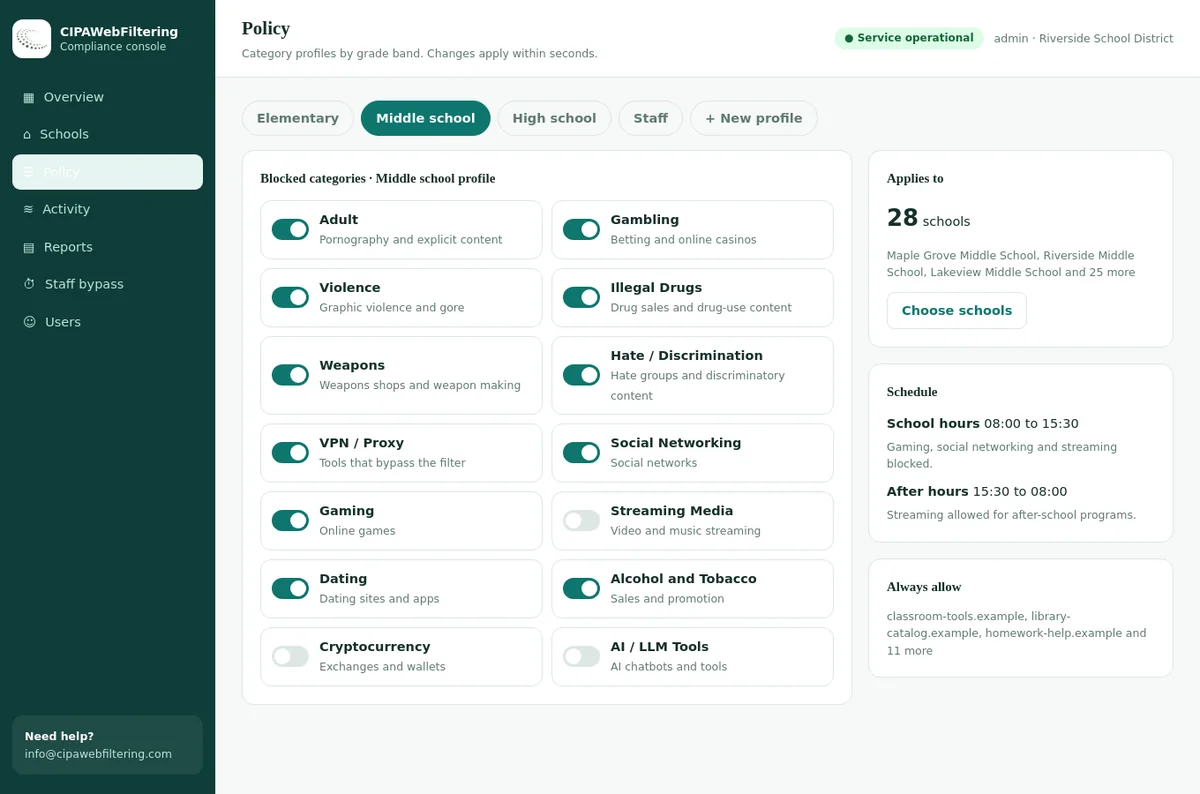
Utah Code 53G-7-1002 ties state funds to a policy that restricts obscene sites on student and educator devices, and SB 88 asks boards to explain how they meet it. Our hosted CIPA filter is a DNS filter we run for you, so the category settings behind that explanation sit in one console.
- Adult and VPN/Proxy/Anonymizers are on in the CIPA preset for every school
- Education/Reference and Science sites stay open, and an always-allow list adds teacher-requested ones per school
- The policy record and activity reports give a board something specific to read at its three-year review
What Utah adds: the statute map
Utah law touches school internet use in several places. The first two items are the core filtering rules; the rest shape the environment around them.
State funds tied to an access policy
No state funds to a board that provides internet access unless it adopts and enforces a policy restricting sites with obscene or pornographic material. Covers devices provided to students or educators.
In forcePolicy process and content (SB 88)
Repealed and reenacted by SB 88, School Technology Amendments. Adds parent-accessible monitoring and parent-requested allowlist filtering.
Effective July 1, 2026Electronic device policies
A State Board of Education rule on required policies for electronic devices in public schools. It has been updated several times, so check the version in effect.
Check current versionStudent phones
Classroom-hours phone ban from July 1, 2025. A 2026 law moved the default to bell to bell from July 1, 2026.
In forceMinor Protection in Social Media Act
Duties on social media companies for minor accounts. Preliminarily enjoined by a federal court on September 10, 2024; on appeal at our last check.
EnjoinedApp Store Accountability Act
Age verification and parental consent duties for app stores and developers. Amended in 2026, with the main compliance dates moved later.
Delayed, check statusThe 2001 foundation: Utah Code 53G-7-1002
Utah's school internet rule dates from 2001 (H.B. 131), when it was numbered in Title 53A. It was later renumbered into Title 53G, Chapter 7, Part 10. The core idea has not changed: state money depends on a policy.
Funding lever
A board that provides internet or online access cannot receive state funds under the part unless it adopts and enforces the policy. That makes this a state funding condition, separate from E-Rate.
Content standard
The policy restricts access to sites, databases or networks with obscene or pornographic material as described in Utah Code 76-10-1203.
Devices covered
The part applies to any computer, phone or other internet-capable device provided to students or educators, not only to lab desktops.
SB 88 (2026): what every Utah online access policy must contain
SB 88, School Technology Amendments, was sponsored by Sen. Lincoln Fillmore and Rep. Ariel Defay. It repeals and reenacts Utah Code 53G-7-1003 and takes effect on July 1, 2026. The board must make sure the policy does the following.
Restricts obscene sites
Restricts access to internet or online sites that contain obscene material.
Explains how 1002 is met
States how the board intends to meet the requirements of 53G-7-1002.
Parent-requested allowlist
At a parent's request, requires a preapproved content filtering system when the student uses a school approved device.
Parent monitoring
Requires the use of a parent-accessible monitoring system for school managed devices.
Staff procedures
Tells the public that the school has administrative procedures and guidelines for staff to follow in enforcing the policy.
Complaint procedures
Tells the public that the school handles complaints about the policy, its enforcement and observed behavior.
Open for review
States that the staff and complaint procedures are available for review at the school.
Effective date
The reenacted section takes effect on July 1, 2026, so policies should be updated for the 2026 to 2027 school year.
The board process under SB 88
SB 88 also sets how the policy is made and kept current. These steps differ from CIPA's notice and hearing rule, so most boards will follow both.
Category filtering, allowlist mode and parent monitoring
SB 88 introduces two features that many districts have not run at scale. Here is how they compare with the default category filter, and what each needs from your technology.
| Mode | Who it applies to | How it works | What you need |
|---|---|---|---|
| Category filtering (default) | All students and staff | Blocks categories such as Adult, Gambling and VPN / Proxy / Anonymizers; everything else is allowed | A current category database and grade-band rule sets |
| Preapproved content filtering (allowlist) | Students whose parent requests it | Only sites the board or administrator preapproves are reachable | Per-student policy assignment, an approved site list, a request and change process |
| Parent-accessible monitoring | Parents of students using school managed devices | Parents review their own student's device activity | Parent accounts, identity checks, clear data scope and retention |
Build the allowlist from categories
Start the approved list from Education/Reference, Science and the school's own learning tools, then add sites teachers request. Category data makes it quicker to review requests.
Keep parent views narrow
A parent should see only their own student's activity. Show categories and sites, not other students or staff, and set a sensible retention period.
Track requests
Record each parent request for allowlist mode, the date it took effect and any change. That record is your proof that the policy is enforced.
Utah phone rules and how they meet the filter
Utah moved in two steps. SB 178 (2025) banned student cellphone use during classroom hours from July 1, 2025, with local room for modifications. A law signed in March 2026 moved the default to bell to bell from July 1, 2026.
What the phone laws do
- Limit student use of personal phones at school, now for the full school day by default.
- Leave some local choices and exceptions; check the enacted text and R277-495.
- Apply to personal devices, not to the school network itself.
What it means for filtering
- With phones put away, most student browsing happens on school managed devices, which is exactly where SB 88's monitoring applies.
- Phones that join school Wi-Fi should still meet the student rule set.
- Block VPN and proxy categories for students so Wi-Fi traffic cannot tunnel out.
- For acceptable use wording, see acceptable use policies for schools.
Social media and app store laws: what schools should know
Utah's laws on minors' social media and app stores get a lot of attention. They place duties on companies, not schools, and their status keeps moving.
| Law | Who it targets | Status at our last check | Effect on a school filter |
|---|---|---|---|
| SB 194 (2024), Minor Protection in Social Media Act | Social media companies | Preliminarily enjoined September 10, 2024; appeal pending | None directly; your Social Networking category choices stay local |
| SB 142 (2025), App Store Accountability Act | App stores and developers | Amended in 2026; main compliance dates moved later | None directly; may change how apps verify student ages |
School-managed devices keep their rules off the network
SB 88 speaks of school-managed devices, and those leave the building every afternoon. A private encrypted link applies your school's category settings to a laptop or phone away from the network, with nothing installed on the computer. The filter decides by domain and is not a monitoring tool, so parent-facing activity views stay a separate choice for the board.
What it means for filtering and monitoring in Utah
A Utah setup has to satisfy CIPA, the state funding policy and SB 88's parent features at once. These decisions get you there.
One baseline for all devices
Block Adult content on every student and educator device, as both CIPA and 53G-7-1002 expect.
Student categories by grade
Add Gambling, Illegal Drugs, Weapons, Violence, Hate/Discrimination, Dating and VPN / Proxy / Anonymizers for students, with grade-band differences.
Per-student allowlist
Make sure your filter can switch a single student to allowlist mode on request without changing the class rule set.
Off-campus coverage
SB 88 speaks of school managed devices, which go home. See filtering school devices off campus.
AI tools by policy
No Utah statute requires blocking AI tools. Use the AI tools blocklist for schools to allow approved tools and block the rest.
Fresh category data
New domains appear daily. Daily categorization of newly registered domains keeps both block lists and allowlist reviews accurate.
Learning sites a Utah allowlist would start with, and student blocks beside them
Our database labels these names as follows, which shows how a category-first list is quicker to review than a blank page.
| Domain | Categories in our data | Likely treatment |
|---|---|---|
| khanacademy.org | Education/Reference | Open for students from the first day |
| nasa.gov | Science | Open, and easy to find through the Science category |
| desmos.com | Education/Reference | Open, since it shares a category with other study tools |
| coolmathgames.com | Education/Reference, Gaming | Two categories, so a Gaming block could catch it by mistake |
| stake.com | Gambling, Cryptocurrency | Blocked for students under the Gambling switch |
| kik.com | Email and Messaging, Social Networking | A grade-band choice, reached through either category |
Common Utah misreadings
Utah's many new laws make it easy to mix them up. These are the points that most often confuse staff and parents.
| What people say | What the law says |
|---|---|
| "SB 88 puts every student on an allowlist." | Allowlist mode applies at a parent's request. Category filtering stays the default for everyone else. |
| "Parent monitoring is optional." | From July 1, 2026, each policy must require a parent-accessible monitoring system. |
| "The social media law protects students at school." | It targets companies and was enjoined. The school filter and policy remain the controls you own. |
| "Without E-Rate we have no filtering duty." | Utah ties state funds to the access policy under 53G-7-1002, separately from E-Rate. |
| "The phone ban means phones get filtered." | The phone laws limit use of personal devices. Filtering covers your network and your devices. |
Utah compliance checklist
Use this before July 1, 2026 and then every year before the E-Rate window. The general CIPA compliance checklist covers the federal items in detail.
- CIPA internet safety policy covers all required topics
- Public notice and hearing or meeting documented
- Online access policy restricts obscene sites (53G-7-1002)
- Policy states how the board meets 53G-7-1002
- Parent-requested allowlist mode written into the policy and working
- Parent-accessible monitoring system in place
- Staff enforcement procedures and complaint procedures available at each school
- Policy adopted in an open meeting with an effective date
- Review date footnote added; next review within three years
- Notice of the policy posted in each school
- Educator devices covered by the obscene-material restriction
- Phone policy matches the bell-to-bell default and R277-495
- Contracts for filter and monitoring tools reviewed for student data terms
- Form 486 or 479 filed on time
Evidence to keep
Utah adds several records that CIPA alone does not ask for. Keep them in the same yearly folder as your E-Rate evidence.
| Record | What it shows | Rule |
|---|---|---|
| Open-meeting minutes adopting the online access policy, with effective date | Adoption process | 53G-7-1003 |
| Policy with last-review footnote | Three-year review kept | 53G-7-1003 |
| Photo or record of the notice posted in each school | Posting requirement met | 53G-7-1003 |
| Parent allowlist requests and activation dates | Parent filtering enforced | 53G-7-1003 |
| Parent monitoring system description and access log | Monitoring system in use | 53G-7-1003 |
| Filter rule set exports for students and educators | Obscene and harmful content blocked | CIPA, 53G-7-1002 |
| Hearing or meeting notice and lesson records | CIPA process and education duty | CIPA |
| Filed Forms 486 or 479 | Federal certification | CIPA |
Running the Utah access policy: manual lists or a hosted filter
These rows follow the baseline decisions in the filtering section above.
| What the policy has to cover | Manual lists and device settings | Hosted CIPA filter |
|---|---|---|
| Obscene sites on student and educator devices | Separate lists for each group of machines | Adult blocked for every user through the CIPA preset |
| Grade-band student categories | Copied rule sets that drift apart | Separate settings for each school or branch |
| Sites a teacher asks to open | A change request that waits in a queue | Always-allow list per school, applied in seconds |
| Staff who need adult-topic research | The filter turned off for the day | PIN bypass for 15, 30 or 60 minutes that logs and reverts |
| Phones that join school Wi-Fi | A guest network nobody reviews | The same DNS setting and student categories apply, with proxies still blocked |
| Records for the three-year review | Exports pulled together at the last minute | Activity reports, policy record and a log export |
Utah school internet safety FAQ
Does Utah have its own school internet filtering law?
Yes. Utah Code 53G-7-1002 bars state funds to a board that provides internet access unless it adopts and enforces a policy restricting obscene or pornographic sites, on devices provided to students or educators. Section 53G-7-1003 sets the policy's process and content.
What does SB 88 (2026) change?
From July 1, 2026, each policy must require a parent-accessible monitoring system and, on a parent's request, a preapproved content filtering system on school approved devices. Boards adopt in an open meeting, review every three years and post notice in each school.
What is a preapproved content filtering system?
SB 88 defines it as internet access control that permits only the websites or online resources the board or school administrator preapproves. In practice it is an allowlist mode for students whose parent asks for it.
What is a parent-accessible monitoring system?
A technology platform that lets a parent review their own student's activity on school managed devices. Every policy must require one from July 1, 2026.
Are phones banned in Utah classrooms?
SB 178 banned use during classroom hours from July 1, 2025. A 2026 law extended the default to the full school day from July 1, 2026. Check the enacted text for local options and exceptions.
Are Utah's social media laws for minors in force?
SB 194 (2024) was preliminarily enjoined in September 2024 and was on appeal at our last check. SB 142 (2025) was amended and its main dates moved. Both target companies, not schools.
Does the online access law cover staff devices?
Yes. It applies to internet devices provided to students or educators. CIPA still lets an authorized person disable the filter for adults doing lawful research.
Other state school internet safety laws
Compare Utah with neighbouring and peer states.
Browse every state guide on our school internet safety laws by state page.
What you pay depends on how many Utah schools and devices are covered, and we send a quote inside one business day. A pilot in one school lets your team read the blocks and reports before the rest of the district joins.
Talk to us about your district
Getting ready for SB 88? We can show how CIPA category filtering, per-student allowlist mode and clear category reporting can fit your Utah district.
Talk to us about your district