Idaho School Internet Safety Laws
Idaho is one of the few states that ties its own money to school web filtering. Idaho Code 33-132 makes internet content filters a condition of state general fund money, on top of federal CIPA.
This guide is for Idaho technology directors, charter school leaders and librarians. It covers the CIPA baseline, what Idaho adds, the 2025 changes and what it all means for your filter. Planning guidance, not legal advice.
The CIPA baseline for Idaho schools
Federal CIPA applies to every Idaho school or library that takes E-Rate discounts for internet access or internal connections. If you need the background first, read what is CIPA.
What CIPA asks for
- A technology protection measure that blocks or filters visual depictions that are obscene or child pornography for all users, and harmful to minors on computers used by minors.
- An internet safety policy covering inappropriate material, safety in email and chat, hacking and other unlawful activity, disclosure of minors' personal information and the filter itself.
- Public notice and at least one public hearing or meeting on the policy.
- A policy of monitoring minors' online activities, and education on appropriate online behavior, social networking and cyberbullying.
How it is certified
- Schools and libraries certify on FCC Form 486 each funding year. Consortium members use Form 479.
- An authorized person may disable the filter for an adult doing bona fide research or other lawful work.
- CIPA does not list categories or brands. It sets outcomes, and you choose how to reach them.
- The funding link is explained in E-Rate and CIPA funding.
Treat the Idaho filter as a budget control and keep proof of how it is used
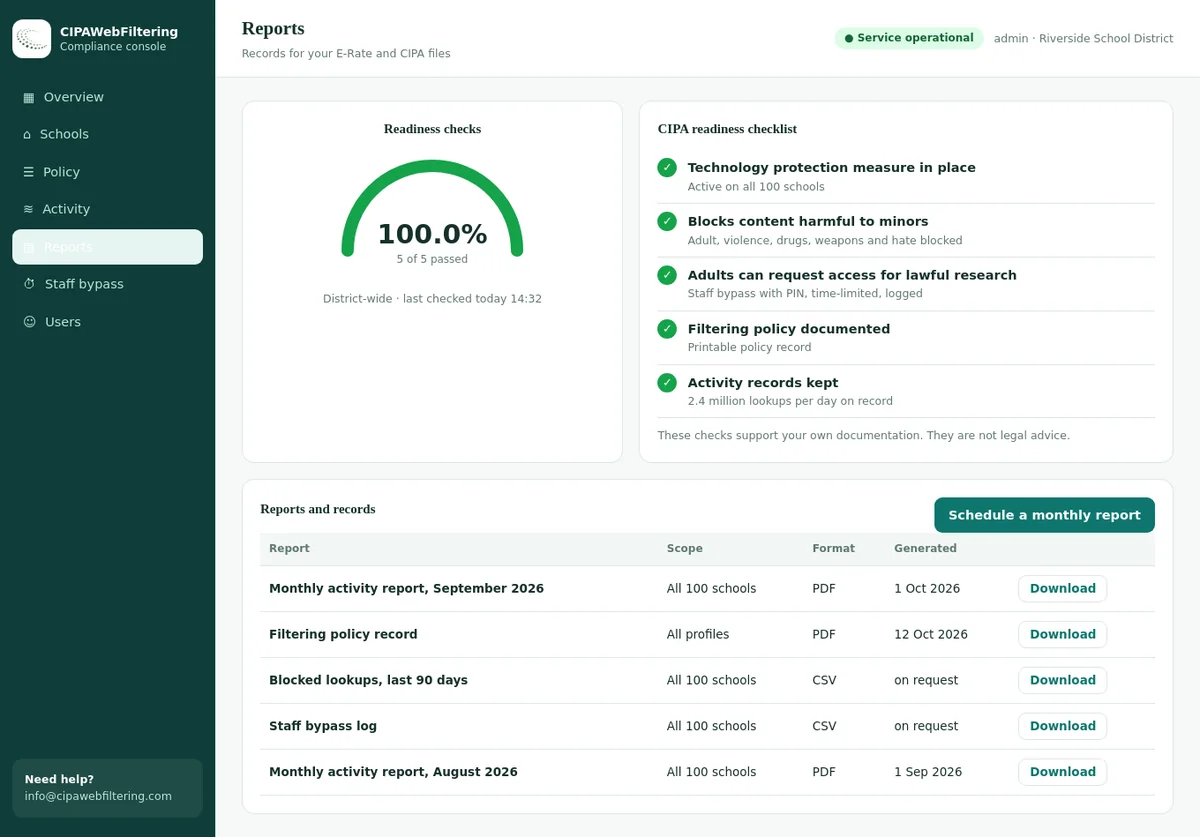
With general fund money tied to filtering, a district or charter needs a filter it can show working on every wireless network children can join. Our hosted CIPA filter is run for you and keeps a policy record and activity reports for that purpose.
- A charter that skips E-Rate can still put the same CIPA preset in place
- Guest Wi-Fi at an event can point at the same DNS setting as the student network
- Log export gives you records of what was blocked and what was changed
What Idaho adds: Idaho Code 33-132
Idaho's rule sits in Title 33, Chapter 1, the general education provisions. Its key move is the funding lever: state general fund money, not E-Rate, depends on having content filters in place.
Funding condition
Internet content filters are a condition of receiving state general fund money. That reaches districts and charters that never apply for E-Rate.
Who is covered
Each local school district and each public charter school. Private schools are outside the section unless another rule reaches them.
Wireless included
The filters must be part of any wireless internet access made available to children, not only the wired lab network.
What gets blocked
Obscene material, material harmful to minors and material depicting the sexual exploitation of minors, with definitions that point to Idaho's criminal code.
How Idaho's school internet rule developed
The section has been in place for more than a decade and was reshaped in 2025. Knowing the sequence helps when you read older district policies that still cite repealed sections.
CIPA becomes federal law
Congress passes CIPA, and E-Rate schools begin certifying filters and internet safety policies each year.
Idaho adopts its own filter requirement
The legislature passes the internet use policy and filter rule that became Idaho Code 33-132, with near-unanimous support.
Library resources and wireless rules added
Related sections covered digital and online library resources for K-12 students (33-137) and wireless technology standards (33-1025).
Executive order on phones
Executive Order 2024-11, the Phone Free Learning Act, urges districts to restrict phones and offers a one-time $5,000 award to those that adopt a policy.
House Bill 275 and Senate Bill 1032
HB 275 revises 33-132 on board internet policies and repeals 33-137 and 33-1025. SB 1032 requires every board and charter to adopt a student device policy.
The 2025 changes: House Bill 275
House Bill 275 of 2025 revised the parts of Idaho Code 33-132 that deal with local school boards and internet policies. Public summaries describe a focus on district-managed filtering, with records that show how the filter is used and changed.
| Topic | What changed in 2025 | What to do |
|---|---|---|
| Board internet policy | 33-132 was revised on local board duties and internet policies | Re-read your policy against the enrolled 2025 text and readopt if needed |
| Digital library resources | Section 33-137 on K-12 digital and online library resources was repealed | Keep vendor safety terms in contracts as good practice, but update the legal citation |
| Wireless technology standards | Section 33-1025 was repealed | Keep filtering on all school Wi-Fi, which 33-132 and CIPA still expect |
| Filter reporting | Summaries mention usage reporting and auditing of filter changes | Confirm the exact duty in the enrolled bill, then set up reports that match it |
CIPA and Idaho law side by side
Most Idaho districts meet both rules with one filter and one policy. The table shows where they line up and where Idaho reaches further.
| Question | Federal CIPA | Idaho Code 33-132 |
|---|---|---|
| What triggers it | E-Rate discounts for internet access or internal connections | Receiving state general fund money |
| Who is covered | E-Rate schools and libraries | School districts and public charter schools |
| Content standard | Obscene, child pornography, harmful to minors (visual depictions) | Obscene, harmful to minors, sexual exploitation of minors |
| Wireless | Covers computers with internet access, including Wi-Fi in practice | Filters must be part of wireless access made available to children |
| Policy process | Public notice and a hearing or meeting | Board internet policy, as revised in 2025 |
| Proof | Form 486 or 479 each funding year | Keep the policy and filter records ready for state review |
Idaho phone policies and Senate Bill 1032
Idaho chose a local policy model rather than one statewide ban. The 2024 executive order encouraged restrictions, and SB 1032 (2025) turned the policy requirement into law.
What SB 1032 requires
- Every local school board and public charter school adopts a policy on student use of electronic communication devices.
- The policy covers school buildings and grounds during school hours.
- It aims to keep student use as limited as possible and to reduce classroom distraction.
- It does not impose a complete statewide prohibition, so local policies differ.
What it means for filtering
- When personal phones are put away, more browsing moves to school devices that your filter already controls.
- Phones allowed on school Wi-Fi for exceptions still sit inside 33-132's wireless rule.
- Block VPN / Proxy / Anonymizers on student Wi-Fi so devices cannot tunnel around the filter.
- Cellular data is outside the network, which is why the device policy matters.
Student data: Idaho Code 33-133
Filtering and monitoring tools record which student visited which site and when. Idaho's Student Data Accessibility, Transparency and Accountability Act of 2014 governs how that kind of student data is handled, together with federal FERPA.
Know what is logged
List every field your filter keeps: user, device, site, category, time, action. That list is the start of your data review.
Contract terms
Check that filter and monitoring contracts limit use of student data to the school's purpose and bar resale.
Retention
Keep logs long enough to answer questions and investigate incidents, then delete them on a schedule you can explain.
Access
Limit who can search browsing logs and record each search. A small group with clear reasons is easier to defend.
What it means for filtering and monitoring in Idaho
CIPA and 33-132 set the content floor. Everything above it is a local choice. These category decisions turn the law into a working rule set.
Required by law for students
These map directly to the obscene, harmful to minors and exploitation standard.
Blocking VPN and proxy sites is not named in the law, but without it the Adult block is easy to get around.
Common local choices
Most Idaho districts add these for students, with grade-band differences.
CIPA expects a policy of monitoring minors' online activity. Category reports by school and grade usually meet that, without reading every student's history.
School Chromebooks leave the building. Filter them off campus too, as covered in filtering school devices off campus.
No Idaho statute names AI tools. Use the AI tools blocklist for schools to allow approved tools and block the rest.
How the game and puzzle sites on Idaho request lists are labeled
When a teacher asks about a blocked site, the first step is to see its category. Here is what our data says for common requests.
| Site | Categories in our data | What a district can decide |
|---|---|---|
| coolmathgames.com | Education/Reference, Gaming | Mixed, so an always-allow entry is a clean fix |
| minecraft.net | Gaming | Open only where a class uses it |
| epicgames.com | Gaming | Normally off for students |
| poki.com | Gaming | Follows the Gaming switch |
| crazygames.com | Gaming | Follows the Gaming switch |
| y8.com | Gaming | Follows the Gaming switch |
Idaho situations and how the rules settle them
These come up in rural districts, virtual charters and small libraries across the state. Each answer applies the two rules together.
CIPA does not apply, but 33-132 still does through state general fund money. Keep the filter and the board internet policy in place.
If children can join it, 33-132 expects filtering on that wireless access. Apply at least the Adult and proxy blocks to guest networks.
CIPA lets an authorized person disable filtering for adults doing lawful research. Use a logged, time-limited override for staff.
Students learn on school devices at home. Device-level filtering carries the rule set with the device wherever it connects.
Show the data list, retention period and who can see it. That answer comes straight from your 33-133 review.
Look the domain up with the domain category checker, then allow it locally if it is safe and needed for class.
Carrying the rule set with a device that learns at home
Idaho students on school devices at home still fall under the district filter. Our hosted CIPA filter uses a private encrypted link to keep the same rules on a laptop or phone away from the network, and nothing is installed on the computer.
Idaho school internet safety checklist
Run through this every summer before school starts, and again before the E-Rate filing window. The federal side is covered in more depth in the CIPA compliance checklist.
- Internet safety policy covers every CIPA topic, including monitoring and online safety education.
- Public notice and hearing or meeting on the policy are documented.
- Board internet policy re-read against the 2025 text of 33-132 and readopted if needed.
- Citations to repealed sections 33-137 and 33-1025 removed from board policies.
- Filter blocks obscene, harmful to minors and exploitation content for students on every network.
- Every Wi-Fi network that children can join, including guest networks, runs the student rule set.
- VPN and proxy categories blocked for students.
- Off-campus filtering confirmed on take-home devices.
- SB 1032 device policy adopted and linked to the acceptable use policy.
- Filter usage and change reports set up to match the enrolled HB 275 wording.
- Filter and monitoring contracts reviewed against Idaho Code 33-133 and FERPA.
- Form 486 or 479 filed on time for the funding year.
Evidence to keep
Idaho adds a state funding condition, so keep proof for two audiences: E-Rate reviewers and the state. One folder per school year works well.
Board policy and minutes
The current internet policy, the date adopted and the meeting minutes.
CIPA and 33-132Hearing notice
The public notice and agenda for the CIPA hearing or meeting.
CIPARule set exports
Exports of student and staff filter settings with the date taken.
CIPA and 33-132Network map
A list of every wired and wireless network, showing which rule set each runs.
33-132 wireless ruleUsage and change reports
Monthly category reports and a log of who changed filter rules and when.
33-132 as revisedOverride log
Records of staff overrides for research, with dates and approvers.
CIPA adult accessLesson records
Plans or rosters showing online safety and cyberbullying lessons.
CIPA education dutyDevice policy
The adopted SB 1032 policy and how it was shared with families.
SB 1032Data review
Your list of logged fields, retention period and contract checks.
33-133 and FERPAIdaho filter needs set against what the hosted service provides
The left column repeats situations Idaho districts and charters deal with.
| Idaho need | Our hosted CIPA filter |
|---|---|
| Filters on all wireless access for children | One DNS setting on the router or firewall, nothing installed on computers |
| Rules for a charter outside E-Rate | CIPA preset with Adult and VPN/Proxy/Anonymizers on, plus optional Lingerie, Gambling and Weapons |
| Teacher research access | Staff PIN for 15, 30 or 60 minutes, logged, with VPN/Proxy still blocked |
| Records for state review | Activity reports, policy record and log export |
| Several buildings, different ages | One console with separate settings per school or branch |
| Students who skip the filter | Public encrypted DNS and browser settings that bypass the filter are blocked by default |
Idaho school internet safety FAQ
Does Idaho have its own school internet filtering law?
Yes. Idaho Code 33-132 makes internet content filters a condition of state general fund money for school districts and public charter schools. The filters must block obscene material, material harmful to minors and material depicting the sexual exploitation of minors, including on wireless access for children.
Does the Idaho rule apply if we do not take E-Rate?
Yes. CIPA follows E-Rate, but 33-132 follows state general fund money. A district or charter without E-Rate still needs filters to stay eligible for that money.
What did Idaho change in 2025?
House Bill 275 revised 33-132 on board internet policies and repealed 33-137 on digital library resources and 33-1025 on wireless technology standards. Read the enrolled bill for the exact wording before rewriting your policy.
Are phones banned in Idaho schools?
Not by one statewide ban. SB 1032 (2025) requires each board and charter to adopt a policy that keeps student device use during school hours as limited as possible. Districts set the detail.
Which Idaho law covers student data in filter logs?
The Student Data Accessibility, Transparency and Accountability Act of 2014, Idaho Code 33-133, alongside federal FERPA. Review what your tools log and who can see it.
Do Idaho private schools have to filter?
Idaho Code 33-132 names school districts and public charter schools. A private school that takes E-Rate discounts still has to meet CIPA, and most private schools filter anyway as a matter of duty of care and parent expectations.
Does Idaho require schools to block AI tools or social media?
We found no Idaho statute that names AI tools or social media for schools. Those are local choices, made on top of the CIPA and 33-132 content floor. See social media filtering for schools for options.
Compare Idaho with other states
Neighbouring and western states take different routes to the same goal. Browse every guide on our school internet safety laws by state page.
Related guides
Pricing depends on the number of schools and devices, and the quote comes back within one business day. A pilot on one Idaho site shows the blocks and reports before you commit.
Talk to us about your district
We can show how CIPA category filtering, wireless coverage and clear usage reporting can fit an Idaho district or charter, from one school to a full system.