Nevada School Internet Safety Laws
A working guide for Nevada district technology staff, charter school leaders and school librarians. It covers what CIPA requires, what Nevada law adds, and how both shape the way you filter and monitor student internet use.
Planning guidance, not legal advice. Check the current statutes and guidance before you act.
Nevada adds three things around the filter:
- SB 444 (2025): device limits during instruction
- NRS 388 school service provider data rules
- Bullying and cyber-bullying duties in NRS 388
The CIPA requirements Nevada schools certify
Every Nevada district, charter school or library that takes E-Rate for internet access or internal connections falls under CIPA. Our guide to what CIPA is has the history; these are the working parts.
A technology protection measure
A filter that blocks or filters visual depictions that are obscene or child pornography for all users, and harmful-to-minors depictions on computers minors use.
An authorized person may disable it for an adult's bona fide research or other lawful purpose.
An internet safety policy
- Covers inappropriate material, safety in email, chat and other direct messaging, hacking and unlawful activity, unauthorized disclosure of minors' personal information, and the filter.
- Adopted after reasonable public notice and at least one public hearing or meeting.
Monitoring and education
Schools monitor the online activities of minors and teach appropriate online behavior, including on social networking sites and in chat rooms, and cyberbullying awareness and response.
Yearly certification
Certify on FCC Form 486, or Form 479 if you receive services through a consortium. Missing the certification puts discounts at risk.
Keep betting and proxy sites off every Nevada student profile
CIPA is the only filtering rule in Nevada, but the guide singles out Gambling as a category that deserves a firm block. Our hosted CIPA filter lets you switch it on per school next to the CIPA preset.
- Adult and VPN/Proxy/Anonymizers are on from the start, Gambling is one switch away
- Phones used under an SB 444 exception can be pointed at the same filter on school Wi-Fi
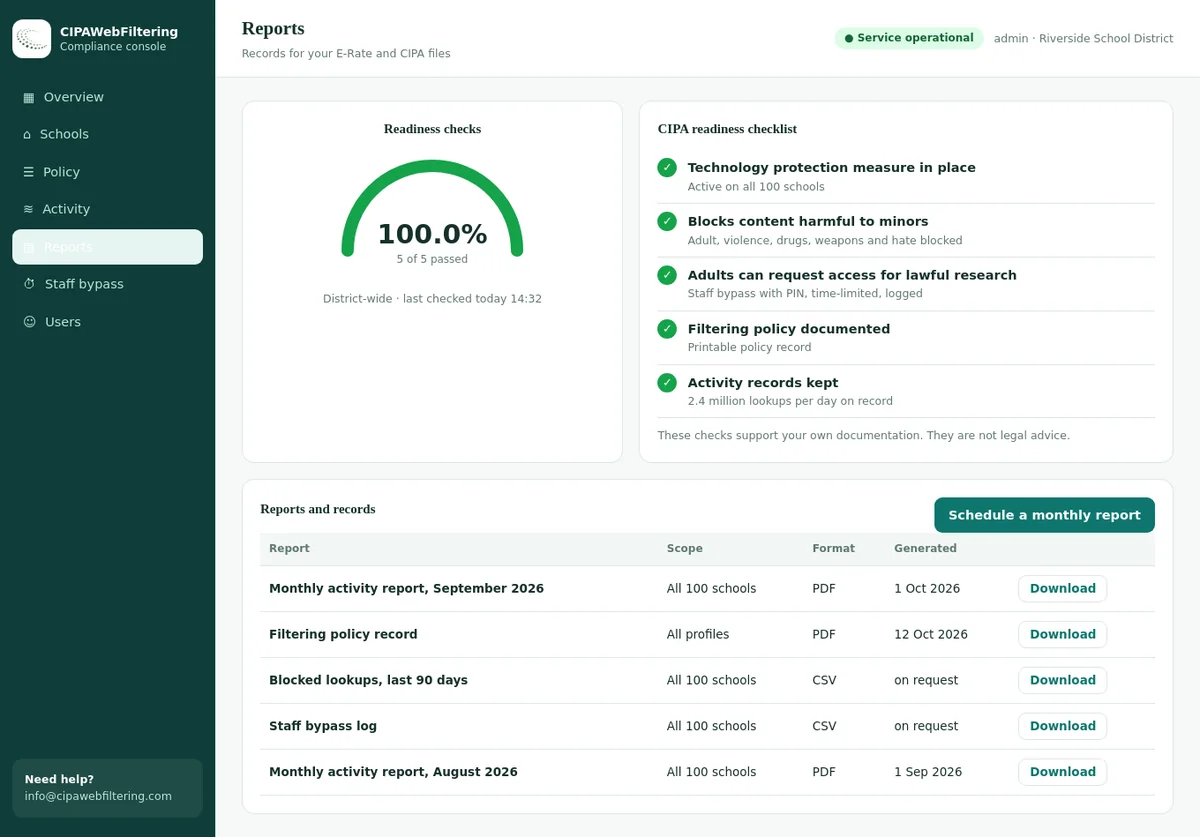
- Reports by school give your 90-day review something concrete to look at
What Nevada adds beyond CIPA
We found no Nevada statute that sets a separate filtering standard or tells schools which categories to block. What Nevada does add is a set of rules that change how students use devices, how their data is handled and how online harm is addressed.
| Nevada rule | What it does | Who it binds | Link to filtering |
|---|---|---|---|
| SB 444 (2025), electronic communication devices | Board policies limiting student device use during instruction, with discipline and exceptions | School districts and their schools | Moves browsing onto school devices and school Wi-Fi |
| NRS 388.281 and following, school service providers (amended by SB 403, 2019) | Limits use of pupil data, bars targeted ads, requires a security plan and breach notice | Providers, with posting duties for public schools | Covers filter, monitoring and classroom tools that hold pupil data |
| Safe and respectful learning environment provisions in NRS 388 | Defines bullying and cyber-bullying and sets reporting and response duties | Public schools | Monitoring alerts may trigger a response |
| No state filtering statute | Not applicable | Not applicable | CIPA remains the only filtering rule |
SB 444: the anatomy of a Nevada device policy
Governor Lombardo signed SB 444 on May 28, 2025, after unanimous votes in both chambers. Boards had to adopt policies limiting electronic communication devices during instruction, and full implementation was due by July 1, 2026.
Devices covered
Electronic communication devices, which include cellphones. Check the enacted definition for smartwatches and similar devices.
Limit during instruction
The policy limits students' use of these devices during instructional time. Some districts chose stricter all-day rules.
Emergencies
Students may use a device in an emergency.
Instructional use
A teacher may allow device use for instructional purposes.
IEP needs
Use that is part of a student's individualized education program is allowed.
Progressive discipline
Districts set up a system of discipline for violations, reported as stepping up with repeated violations.
Some large Nevada districts moved early, using locking pouches or lockers. Whatever the storage method, the filtering question is the same: what happens when a phone is used under an exception on school Wi-Fi? Put those devices in the student filter profile.
Student data: school service providers under NRS 388
Filters, monitoring tools and classroom platforms often hold browsing logs, search terms and alerts tied to named students. Nevada's school service provider rules decide what those providers may do with that data.
What providers must do
- Use pupils' personally identifiable information only in the ways the law allows.
- Not engage in targeted advertising based on pupil data.
- Keep a plan for the security of pupil data they collect or maintain.
- Tell the school if there is a breach of the security of pupil data. SB 403 (2019) added this duty.
What schools must do
- Before pupils use a school service, public schools post information on their website, including a description of the provider laws and a list of the school's service providers.
- When a provider reports a breach, the school notifies pupils and the parents or guardians of pupils under 18.
- Keep your filter and monitoring providers on the posted list.
Federal rules sit on top. Our guide to student data privacy, FERPA and filtering covers retention, access and parent requests.
What it means for filtering and monitoring in Nevada
A Nevada setup has to satisfy CIPA and work smoothly with SB 444 and the data rules. These are the choices that matter most.
CIPA core
Block obscene and child pornography content for everyone, and harmful-to-minors content on student devices.
Student extras
Most districts add age-sensitive categories for students, tighter for elementary grades.
Bypass routes
Students who lose phone access look for other ways out. Block the tunnels and review attempts.
Gambling matters here
Online casino and sports betting sites are a known concern for students in a gaming state. Keep the category blocked on every student profile.
Devices that go home
Filtering should follow school devices off campus. See enforcing CIPA off campus.
Personal devices on Wi-Fi
Phones used under an SB 444 exception should get the student rule set, not guest access.
AI tools
Nevada law does not require blocking AI tools. Use an AI tools blocklist for schools to allow what you approve.
Monitoring with a plan
Decide who reviews alerts and when a cyber-bullying alert becomes a report under your procedures.
New gambling, proxy and game sites register every day. Category data that adds newly registered domains daily keeps rules current. Read our guide to blocking gambling and sports betting sites in schools, and check any site with the domain category checker.
How betting and casino names are categorized
Nevada districts that keep Gambling blocked on every student profile can use these names for the test days in their review. Every row is a real result from our category data.
| Domain | Categories in our data | Note for the test log |
|---|---|---|
| betmgm.com | Gambling | Casino brand with a Nevada link, plain Gambling label |
| caesars.com | Gambling | Blocked wherever the Gambling switch is on |
| fanduel.com | Gambling, Sports & Recreation | Also reads as sports, so the label is not only one category |
| pokerstars.com | Gambling | Online poker |
| stake.com | Gambling, Cryptocurrency | Crypto betting carries two labels |
A 90-day review plan for Nevada districts
With SB 444 now fully in place, many districts are checking whether their filter settings still fit how students use technology. This plan spreads the review over one term.
Days 1 to 15: inventory
List every device type students use: Chromebooks, Windows laptops, iPads, and personal phones used under exceptions. Note which filter covers each one.
Days 16 to 40: test
Try a set of known Adult, Gambling and proxy test sites on each device, on campus and at home. Record the result with a dated screenshot.
Days 41 to 70: tune
Fix gaps, review the unblock request log for over-blocking, and update the AI tools allow list with teachers.
Days 71 to 90: document
Export the final rule sets, update the provider list on your website and brief the board on what changed.
For a full rollout method, see how to implement web filtering in schools. Districts weighing a different approach can review our hosted CIPA filter.
Why the test and tune days of a review go quickly
Changes in the console apply in seconds, so a gap found in testing can be closed and tried again the same day. An always-allow or always-block entry covers a single site for one school without touching the rest.
Nevada timeline for school technology staff
The dates that shape a Nevada district's filtering and device plans, with their status at our last check in October 2026.
CIPA certification
Nevada E-Rate schools and libraries certify CIPA each funding year. It is still the filtering rule.
School service provider rules
Nevada set limits on how providers use pupil data, now found from NRS 388.281 onward.
SB 403 amendments
Added breach notice from providers to schools, and from schools to families, plus posting duties.
SB 444 signed
Boards must adopt device limits for instructional time, with discipline and exceptions.
Early rollouts
Several districts started before the deadline, using pouches or lockers for phones.
Full implementation
The deadline for SB 444 policies to be fully in place across Nevada districts.
Questions to ask your filter and monitoring provider
Nevada's provider rules make these questions part of due diligence, not just good practice. Ask them before you sign or renew.
What pupil data do you collect, and why?
Browsing history, search terms, screenshots and alerts are all pupil data when tied to a student. Ask for a plain list of what is collected and the purpose of each item.
Can we see your data security plan?
Nevada expects providers to keep a security plan for pupil data. Ask for a summary and keep it in your file.
How fast will you tell us about a breach?
You must pass breach notices on to families. Write the provider's notice duty and contact route into the contract.
How long are logs kept, and who can read them?
Short retention and narrow access lower risk. A filter that runs on category data inside your own environment can keep browsing logs off third-party systems entirely.
Nevada libraries and community access
Public and school libraries in Nevada follow the same CIPA rules when they take E-Rate or LSTA funds for internet access. Adults and minors often share the same building and network.
Public libraries
- CIPA applies when the library uses E-Rate, or LSTA funds for internet access or computers used to reach it.
- Adults may ask staff to disable the filter for bona fide research or other lawful use.
- Separate adult and minor profiles reduce complaints. See web filtering for libraries.
School libraries and after-hours use
- School library computers sit under the district's CIPA filter and policy.
- Community use of school buildings in the evening still runs on the school network, so set a clear guest profile.
- Licensed research databases need their own safe settings checked.
Common Nevada questions, answered briefly
These come up in Nevada board meetings and staff trainings. Short answers, with the rule behind each.
| Question | Short answer | Rule |
|---|---|---|
| Does SB 444 require us to filter phones? | No. It limits use. Filtering applies to your network and devices. | SB 444, CIPA |
| Do we need a state-approved filter? | No state approval list exists. The filter must meet CIPA. | CIPA |
| Can we let teachers unblock a site? | Yes, through a documented process. Keep the CIPA core blocked for minors. | CIPA, local policy |
| Must our filter provider be listed on our website? | Public schools post a list of school service providers. Include the filter if it holds pupil data. | NRS 388 provider rules |
| Does SB 444 apply during lunch and passing periods? | The state rule targets instructional time. Many districts chose stricter all-day rules, so check your own board policy. | SB 444, local policy |
| Are school-issued tablets covered by SB 444? | School-approved devices used for instruction are the point of the exception. They stay under your filter and monitoring. | SB 444, CIPA |
| Must we block social media? | No law requires it. Most districts restrict Social Networking for younger grades and set rules by age. See how to block social media at school. | Local policy |
| Does CIPA apply to adult education programs? | Filtering of obscene and child pornography content applies to all users; adults may request disabling for lawful purposes. | CIPA |
Nevada compliance checklist
Run it before each E-Rate window and whenever policies change. The general CIPA compliance checklist has more detail on each federal item.
- Internet safety policy covers every CIPA topic
- Public notice and hearing or meeting on file
- Filter blocks the CIPA core for all users
- Harmful-to-minors categories blocked for students
- Gambling and VPN / Proxy blocked on all student profiles
- Monitoring procedure and alert owners written down
- Online safety and cyber-bullying lessons recorded
- SB 444 device policy adopted and in use
- Exceptions match SB 444: emergency, instruction, IEP
- Personal devices on Wi-Fi get the student profile
- School service provider list posted and current
- Provider data security plans and breach terms on file
- Off-campus filtering tested on school devices
- Form 486 or 479 filed on time
- Unblock request process documented and logged
- Guest and community Wi-Fi profile reviewed
- Breach notice route to families tested with the provider
- AI tools allow and block lists reviewed with teachers
Evidence to keep
Keep one folder per funding year. Reviews ask for documents, and these cover both federal and Nevada items.
Adopted policy
Internet safety policy with board minutes and date.
Public process
Notice and hearing or meeting agenda.
Rule set exports
Student, staff and guest profiles with categories.
Block tests
Dated screenshots on each device type, on and off campus.
SB 444 policy
Adopted device policy, discipline steps and exception records.
Provider list
Screenshot of the posted school service provider list.
Data agreements
Provider contracts with security plan and breach notice terms.
Lesson records
Dates and topics of online safety teaching.
E-Rate forms
Form 486 or 479 copies and confirmations.
Writing or updating the policy? See our internet safety policy guide and E-Rate and CIPA funding.
Nevada filtering jobs: hosted filter next to a manual approach
The rows come from the Nevada checklist and the 90-day plan earlier in the guide.
| Nevada job | Hosted CIPA filter | Manual approach |
|---|---|---|
| Gambling blocked on every student profile | One category switch per school | Betting domains added by hand as they appear |
| Bypass tunnels such as proxies and VPNs | VPN/Proxy blocked, even with the staff PIN | Block list maintained in-house |
| Phones used under an SB 444 exception | Same filter when the phone joins school Wi-Fi | Often parked on a guest network |
| Chromebooks used at home | Private encrypted link carries the school rules | Rules stay at the school gate |
| Teacher asks for a site | Always-allow entry for that school, applied quickly | Ticket and manual edit |
| Evidence for the provider file | Policy record, activity reports and log export | Dated screenshots |
Nevada school internet safety FAQ
Does Nevada have a state law requiring schools to filter the internet?
We found no Nevada statute with its own filtering standard. E-Rate schools and libraries filter because of CIPA. Nevada adds rules on devices in class, provider data and bullying.
What does Nevada SB 444 (2025) require?
Board policies limiting student use of electronic communication devices during instruction, with discipline and exceptions for emergencies, teacher-approved use and IEP needs. Full implementation was due by July 1, 2026.
Which Nevada law covers student data held by filter and monitoring providers?
The school service provider rules in NRS Chapter 388, from NRS 388.281, amended by SB 403 in 2019. They bar targeted advertising and require a security plan and breach notice.
Do Nevada charter schools have to follow CIPA?
Yes, if they apply for E-Rate discounts on internet access or internal connections. They certify on Form 486 or 479.
Can a Nevada school allow phones for classwork under SB 444?
Yes, a teacher may allow instructional use. Those devices should get the student filter profile on school Wi-Fi.
Does SB 444 change E-Rate or CIPA certification?
No. It is a state rule on device use. CIPA certification is unchanged.
Other state school internet safety laws
See how Nevada's neighbours and peers handle filtering, phones and student data, or browse the full list of school internet safety laws by state.
Related guides
Our quote depends on how many Nevada schools and devices you have, and you hear back within one business day. A pilot in a single school is available if you want to see the blocks and reports before committing.
Talk to us about your district
We can show how CIPA category filtering, strong Gambling and proxy coverage and clear category reports can fit your Nevada schools.
Talk to us about your district