New Hampshire School Internet Safety Laws
New Hampshire asks every district to have a network use policy, and since 2025 a bell-to-bell phone policy. It does not set a state filtering standard. The filter itself is governed by federal CIPA.
For New Hampshire technology directors, SAU leaders, library media specialists and charter school staff. Planning guidance, not legal advice.
The statutes on this page
- RSA 194:3-d
- School district computer networks: a required use policy (since 1998)
- RSA 189:1-a, paragraph V
- Bell-to-bell phone policy, added by HB 2 in 2025
- RSA 189:68-a
- Student online personal information (since 2016)
- RSA 193-F
- Pupil Safety and Violence Prevention Act, including cyberbullying
One filter team, several New Hampshire boards, each with its own rules
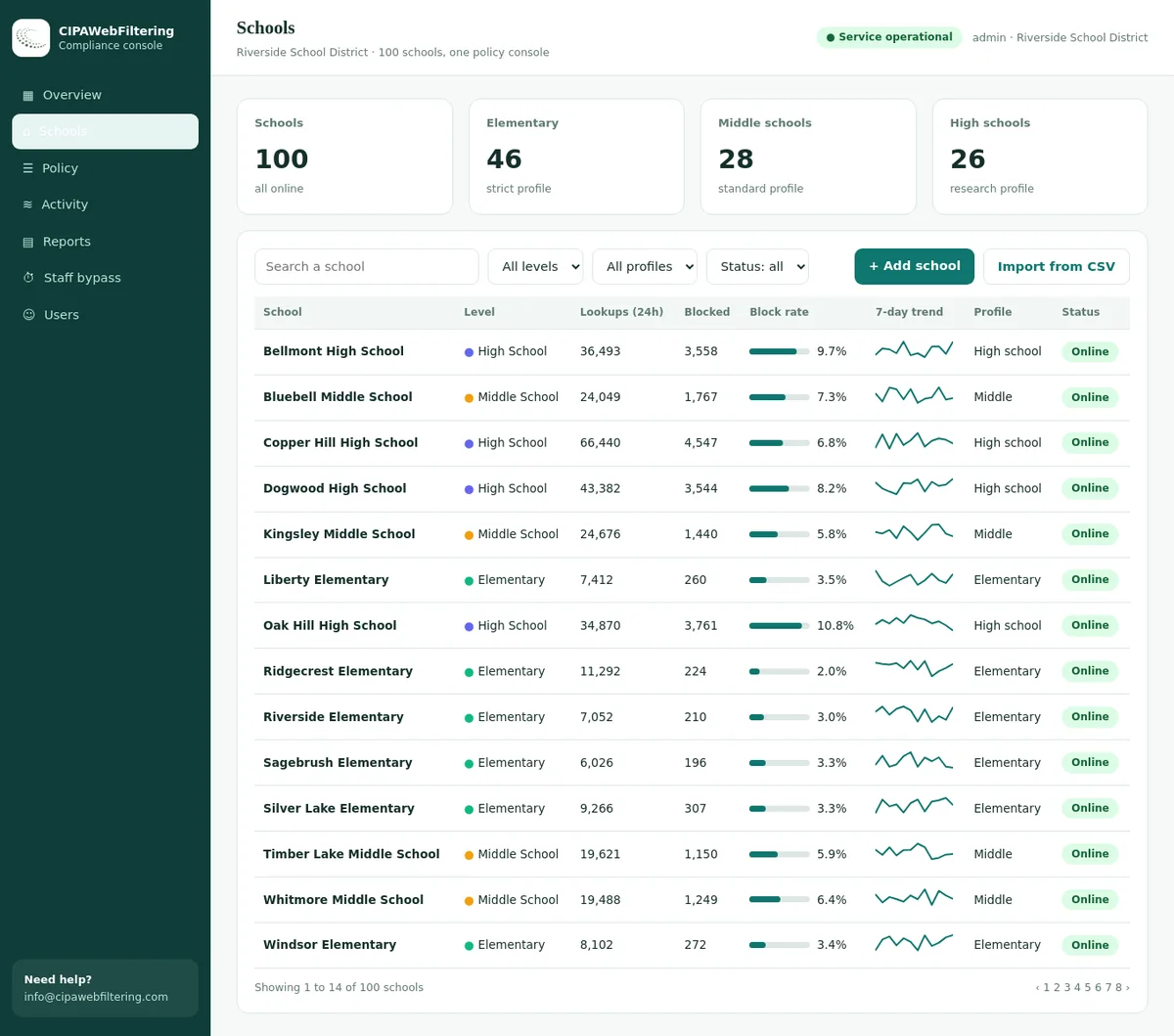
An SAU often runs filtering for several boards that each adopt their own policies. Our hosted CIPA filter keeps separate settings for every school or branch inside one console, so a shared team can serve them all.
- Adult and VPN/Proxy/Anonymizers are on from the CIPA preset, with Gambling, Weapons and Lingerie optional
- Exception phones approved under RSA 189:1-a can sit on the student Wi-Fi and meet the same filter
- The policy record and log export fit the folder you already keep for CIPA
Start with CIPA: the federal filtering rule
New Hampshire schools and libraries that take E-Rate discounts for internet access or internal connections must meet CIPA. It is the only law that requires a filter. Our guide to what CIPA is covers the background.
Filter and policy
- A technology protection measure blocking visual depictions that are obscene or child pornography for all users, plus harmful-to-minors depictions for minors.
- An internet safety policy covering inappropriate material, safety in email, chat and messaging, hacking, disclosure of minors' personal data, and the filter.
- Public notice and at least one public hearing or meeting before adoption.
Monitoring, teaching and certifying
- Monitoring of minors' online activities.
- Teaching about appropriate online behavior, social networking and cyberbullying.
- Yearly certification on FCC Form 486, or Form 479 for consortium members.
- An authorized person may disable the filter for an adult's bona fide research or other lawful purpose.
What New Hampshire adds: three statutes to know
New Hampshire does not tell schools what to block. It does require two policies and protects student data held by online services. Each one touches your filter.
Any district with computer systems or networks adopts a policy on appropriate and acceptable use, and on inappropriate and illegal use, including use of the internet.
- Enacted 1997, effective January 1, 1998.
- A user who intentionally breaks the policy and intentionally damages the system is liable for the damage.
- "User" covers anyone authorized to use district systems.
Added by HB 2, the budget trailer bill signed June 27, 2025. Boards and charter trustees adopt a policy restricting phones from the first bell to dismissal.
- In place for the 2025-26 school year.
- Exceptions for medical, disability and language needs, decided by the superintendent or designee.
- Developed with parents and teachers, and reviewed regularly, per the bill text.
Covers operators of websites, online services and apps that know they are used primarily for K-12 school purposes and were designed and marketed for them.
- Enacted by HB 520 in 2015, effective January 1, 2016.
- Does not cover general audience sites.
- Sits with RSA 189:65 to 189:68 on student information.
New Hampshire timeline
The dates that matter for school internet use in New Hampshire, with status at our last check in October 2026.
RSA 194:3-d in force
District network use policies required, including internet use.
CIPA
Filtering and safety policy duties for E-Rate schools and libraries.
RSA 189:68-a
Student online personal information protections take effect.
HB 2 signed, HB 781 vetoed
Bell-to-bell policy enacted through the budget trailer; the narrower bill was vetoed.
Phone-free year one
Public and charter schools run bell-to-bell policies; early reports were positive.
CIPA and New Hampshire side by side
The quickest way to see what each layer asks of you. Where New Hampshire is silent, CIPA and local choice fill the gap.
| Topic | Federal CIPA | New Hampshire law |
|---|---|---|
| Filter required | Yes, for E-Rate applicants | No state standard |
| Written policy | Yes, internet safety policy with public hearing or meeting | Yes, network use policy under RSA 194:3-d |
| Phone rules | None | Yes, bell-to-bell policy under RSA 189:1-a |
| Student data in online services | Policy topic only | Yes, RSA 189:68-a operator rules |
| Cyberbullying | Education topic | Yes, RSA 193-F policies and response |
| Damage to systems | Not addressed | Yes, liability for intentional damage under RSA 194:3-d |
| Applies to private schools | If they take E-Rate | Phone rule covers public and charter schools only |
One policy or two? Many New Hampshire districts merge the CIPA internet safety policy and the RSA 194:3-d use policy into one document. That works if it covers every CIPA topic and went through the CIPA public hearing or meeting. Our acceptable use policy guide for schools shows a structure that serves both.
The bell-to-bell policy and how it meets your filter
Governor Ayotte called for a bell-to-bell ban in her February 2025 budget. The House and Senate first passed narrower versions, then agreed in June to put the stricter rule into HB 2. The $1 million in grants she proposed was dropped.
Medical need
For example, a phone that runs a glucose monitor or insulin pump app. Approved by the superintendent or designee.
Disability
Where the device is part of an IEP or 504 plan.
Language proficiency
A student learning English who needs a device to communicate.
What the phone rule changes
- Most student browsing during the day now happens on school devices.
- Phones that stay in use are exceptions, so they are few and known.
- Students who lose phone access may try VPNs or proxies on school devices instead.
What to do on the filter
- Put approved exception phones on the student Wi-Fi profile, not guest access.
- Block VPN / Proxy / Anonymizers for students and watch for attempts. See blocking VPN extensions on Chromebooks.
- Check that filtering on school devices also works at home.
After year one of bell-to-bell: what to review
A state Department of Education survey reported in 2026 that educators were broadly satisfied with the phone rule. Districts kept room to shape the details, so year two is a good time to check how the policy and the filter fit together.
Filter log trends
Compare blocked attempts on school devices before and after the rule. A rise in proxy or game attempts shows where students moved.
Exception list
Confirm each approved exception is still needed, and that those devices are on the student profile.
Parent and teacher input
The policy was built with parents and teachers. Use the review to collect their feedback on device use for classwork.
Sites that a filter log review might turn up, and their categories
The review suggests comparing proxy and game attempts before and after the phone rule. These are well-known names with the categories our data gives them.
| Domain | Categories in our data | What the log would tell you |
|---|---|---|
| krunker.io | Gaming | A browser shooter, a sign of game time on a school device |
| friv.com | Gaming | Game portal that needs no login |
| expressvpn.com | VPN / Proxy / Anonymizers | A student looking for a way around the filter |
| hotspotshield.com | VPN / Proxy / Anonymizers | The same bypass category under another name |
| teamviewer.com | Freeware/Software, Remote Access Tools | Two labels, the second being the one RSA 194:3-d makes worth blocking |
What it means for filtering and monitoring in New Hampshire
New Hampshire leaves filtering details to districts and SAUs. These are the settings and habits that make a setup defensible under CIPA and consistent with state policy duties.
CIPA core everywhere
Adult blocked for all users. For minors, add Lingerie/Swimsuits/Intimate Apparel and other harmful-to-minors content.
Grade-band student rules
Gambling, Illegal Drugs, Weapons, Violence, Hate/Discrimination, Dating, Alcohol and Tobacco, tuned by age.
Protect the network
RSA 194:3-d covers damage to systems. Block Malware / Phishing / Suspicious and Remote Access Tools for students.
Off-campus coverage
Device-level filtering keeps rules in place at home. Read enforcing CIPA off campus.
AI tools by policy
New Hampshire law does not require blocking AI tools. Allow approved tools with an AI tools blocklist for schools.
Monitoring tied to RSA 193-F
Decide when an online alert becomes a bullying or cyberbullying report, and who handles it.
Not sure how a site is categorized? Use the domain category checker. Category data that adds newly registered domains daily keeps proxy mirrors and new game sites from slipping through.
Student data: RSA 189:68-a and your filter provider
Filtering and monitoring services usually know they are used for K-12 school purposes, which puts them in scope of RSA 189:68-a. Ask the right questions before you sign.
Covered information
- Information students or parents provide to the operator for K-12 school purposes.
- Information the operator gathers that identifies a student, which can include browsing histories tied to an account.
- Read the statute for the full operator duties and limits.
Contract questions
- What is collected, and is any of it used for advertising or profiles?
- How long are logs kept, and who can access them?
- How will a breach be reported, given New Hampshire's breach notice statutes?
- Does a data privacy agreement name RSA 189:68-a?
Federal rules apply too. Our guide to student data privacy, FERPA and filtering covers access requests and retention.
What a strong RSA 194:3-d use policy covers
The statute is short and leaves the content to each board. A use policy that also serves as your CIPA internet safety policy usually covers these parts.
Purpose of the network
State that district systems exist for education, research and school business, so staff can judge borderline uses.
Acceptable use
Give examples of expected use for students, staff and guests, in plain language each group can follow.
Inappropriate and illegal use
Name the uses that are not allowed, including bypassing the filter, accessing obscene material and hacking.
The filter
Describe the technology protection measure, who may disable it for adults, and how to request a review of a block.
Privacy expectations
Explain that activity on district systems may be monitored, and how student data is protected under RSA 189:68-a.
Damage and consequences
Note the liability for intentional damage in RSA 194:3-d, and the discipline steps for policy breaches.
SAUs, small districts and libraries
Many New Hampshire districts share a superintendent and technology team through an SAU, and many towns have small public libraries. These setups raise their own filtering questions.
| Setting | Common issue | What helps |
|---|---|---|
| SAU with several boards | Each board adopts its own policies, but one team runs the filter | One shared rule set, with board-specific differences documented |
| Small district, one technology person | Unblock requests and new sites pile up | Category rules that update on their own and a short teacher request form |
| Chartered public school | Smaller staff, same phone and CIPA duties | A hosted filter with clear reports, such as our hosted CIPA filter |
| Town public library | Adults and children on one network | Separate adult and minor profiles. See our public library internet filtering policy guide |
| Tuition students across districts | Students follow the receiving school's rules | Make sure devices from the sending district are filtered on the receiving network |
One team, many policies, with nothing to install
Our filter is a DNS filter run for you, with one DNS setting on the router or firewall and nothing installed on computers. Each school or branch keeps its own category choices, always-allow and always-block lists.
Common New Hampshire misreadings
These come up often in staff trainings and parent questions. The short answer sits next to each one.
| What people say | What applies |
|---|---|
| "The state tells us what to block." | No state standard exists. CIPA sets the minimum and your board sets the rest. |
| "Bell-to-bell means phones are filtered." | The rule restricts use. Filtering covers your network and school devices. |
| "HB 781 is the phone law." | HB 781 was vetoed. The bell-to-bell rule came through HB 2. |
| "Our use policy covers CIPA already." | Only if it includes every CIPA topic and went through the public hearing or meeting. |
| "Student data law is only about grades." | RSA 189:68-a reaches online services used for K-12 purposes, which can include filter and monitoring tools. |
New Hampshire compliance checklist with owners
Give each item an owner so nothing waits on one person. The general CIPA compliance checklist has more on the federal items.
| Task | Rule | Typical owner | |
|---|---|---|---|
| Internet safety policy covers every CIPA topic | CIPA | Technology director | |
| Public notice and hearing or meeting held | CIPA | Superintendent's office | |
| Network use policy current and covers internet use | RSA 194:3-d | School board | |
| Bell-to-bell policy adopted with parent and teacher input | RSA 189:1-a | School board or charter trustees | |
| Phone exceptions approved and recorded | RSA 189:1-a | Superintendent or designee | |
| Filter blocks CIPA core and student categories | CIPA | Technology director | |
| Filtering tested on and off campus | CIPA | Technology staff | |
| Monitoring and cyberbullying response linked | CIPA, RSA 193-F | Principals and counselors | |
| Online safety lessons delivered and recorded | CIPA | Library media and teachers | |
| Provider agreements reflect RSA 189:68-a | RSA 189:68-a | Business office | |
| Form 486 or 479 filed on time | CIPA | E-Rate coordinator | |
| Unblock request process written and logged | Local policy | Technology director | |
| Guest and community Wi-Fi profile reviewed | CIPA, RSA 194:3-d | Technology staff | |
| AI tools allow and block lists agreed with teachers | Local policy | Curriculum and technology leads | |
| Bell-to-bell policy review date set and recorded | RSA 189:1-a | School board | |
| Malware and phishing blocks checked on staff devices | RSA 194:3-d | Technology staff |
Evidence to keep
One folder per funding year, shared across the SAU if you file together. These records answer most review questions.
Internet safety and network use policy
Adopted text, date, and board minutes.
Hearing or meeting record
Notice and agenda showing the CIPA public process.
Bell-to-bell policy
Adopted policy, input sessions and review date.
Exception approvals
Superintendent or designee decisions, kept with student privacy in mind.
Filter configuration
Rule set exports and dated block tests on each device type.
Lesson records
Online safety and cyberbullying teaching by grade.
Provider agreements
Data privacy terms for filter, monitoring and classroom tools.
E-Rate forms
Copies of Form 486 or 479.
Unblock request log
Requests, decisions and dates, showing blocks are reviewed fairly.
Monitoring procedure
Who reviews alerts, response times and the link to RSA 193-F reporting.
For policy drafting, see our internet safety policy guide; for forms and deadlines, E-Rate and CIPA funding.
An SAU filter setup: hosted service or built in-house
These rows follow the SAU and small district situations described earlier in the guide.
| SAU situation | Hosted CIPA filter | Built in-house |
|---|---|---|
| Several boards, one technical team | Separate settings per school in one console | Separate rule sets in separate tools |
| One technology person | Domains already carry categories, so there is less list upkeep | Lists and rules to maintain alone |
| Chartered public school with a small staff | Reports and a policy record without extra equipment | Hardware to buy and update |
| Remote Access Tools and Malware / Phishing blocked | Category switches per school | Domain lists built by hand |
| Home use of school laptops | A private encrypted link keeps the rules on | Filtering ends at the building |
| Answering a board or reviewer | Activity reports and log export | Notes compiled before the meeting |
New Hampshire school internet safety FAQ
Does New Hampshire require school internet filtering?
Not through a state standard. RSA 194:3-d requires a network use policy covering internet use. The filtering duty comes from CIPA for E-Rate schools and libraries.
What is RSA 194:3-d?
The School District Computer Networks statute, in force since January 1, 1998. It requires a use policy and makes users liable for intentional damage done while intentionally breaking it.
Is there a bell-to-bell phone ban in New Hampshire schools?
Yes. HB 2, signed June 27, 2025, requires boards and charter trustees to adopt a bell-to-bell policy, in place for 2025-26, with exceptions for medical, disability and language needs.
Which law protects student data in online services?
RSA 189:68-a, effective January 1, 2016. It covers operators of K-12 websites, services and apps, alongside RSA 189:65 to 189:68.
What happened to HB 781?
It proposed a narrower, class-time phone policy. It was vetoed in July 2025 and the veto was sustained. HB 2 carried the bell-to-bell rule instead.
Does the bell-to-bell law apply to charter schools?
Yes, it reaches chartered public school trustees. Private schools are not covered by that provision.
Compare with other states
See how other Northeast states handle filtering, phones and student data, or open the full list of school internet safety laws by state.
Related guides
- What Is CIPA? Children's Internet Protection Act Requirements
- CIPA Compliance Checklist for Schools and Districts (8 Steps)
- Explaining Web Filtering to Parents: Letters, FAQs, Clear Limits
- Maine School Internet Safety Laws: CIPA, Phones and Privacy
- Rhode Island School Internet Safety Laws: Filtering Policy
A quote for your New Hampshire schools reflects how many schools and devices are involved, and it arrives within one business day. Running a pilot on one site first shows the blocks and reports before you decide on more.
Talk to us about your district
From a single SAU to a multi-town district, we can show how CIPA category filtering and clear category reports can fit your New Hampshire schools.
Talk to us about your district