Kansas School Internet Safety Laws
Kansas has its own children's internet protection act, passed in 2013, that covers school districts and public libraries. In 2026 it added a bell-to-bell ban on personal devices at school.
This guide is for Kansas superintendents, technology directors, principals and librarians. It sets out what CIPA asks, what Kansas adds and how to set up filtering and monitoring that meets both. Planning guidance, not legal advice.
The CIPA baseline for Kansas schools and libraries
Federal CIPA applies to any Kansas school or library that takes E-Rate discounts for internet access or internal connections. The full picture is in what is CIPA; the essentials are below.
Technology protection measure
Block or filter visual depictions that are obscene or child pornography for all users, and harmful to minors on computers that minors use.
Internet safety policy
Cover inappropriate material, safety in email and chat, hacking, disclosure of minors' personal data and the filter. Adopt it after public notice and a hearing or meeting.
Monitoring and education
Monitor minors' online activity and teach appropriate online behavior, social networking safety and cyberbullying awareness.
Show the Kansas act is enforced with a filter that is working and dated
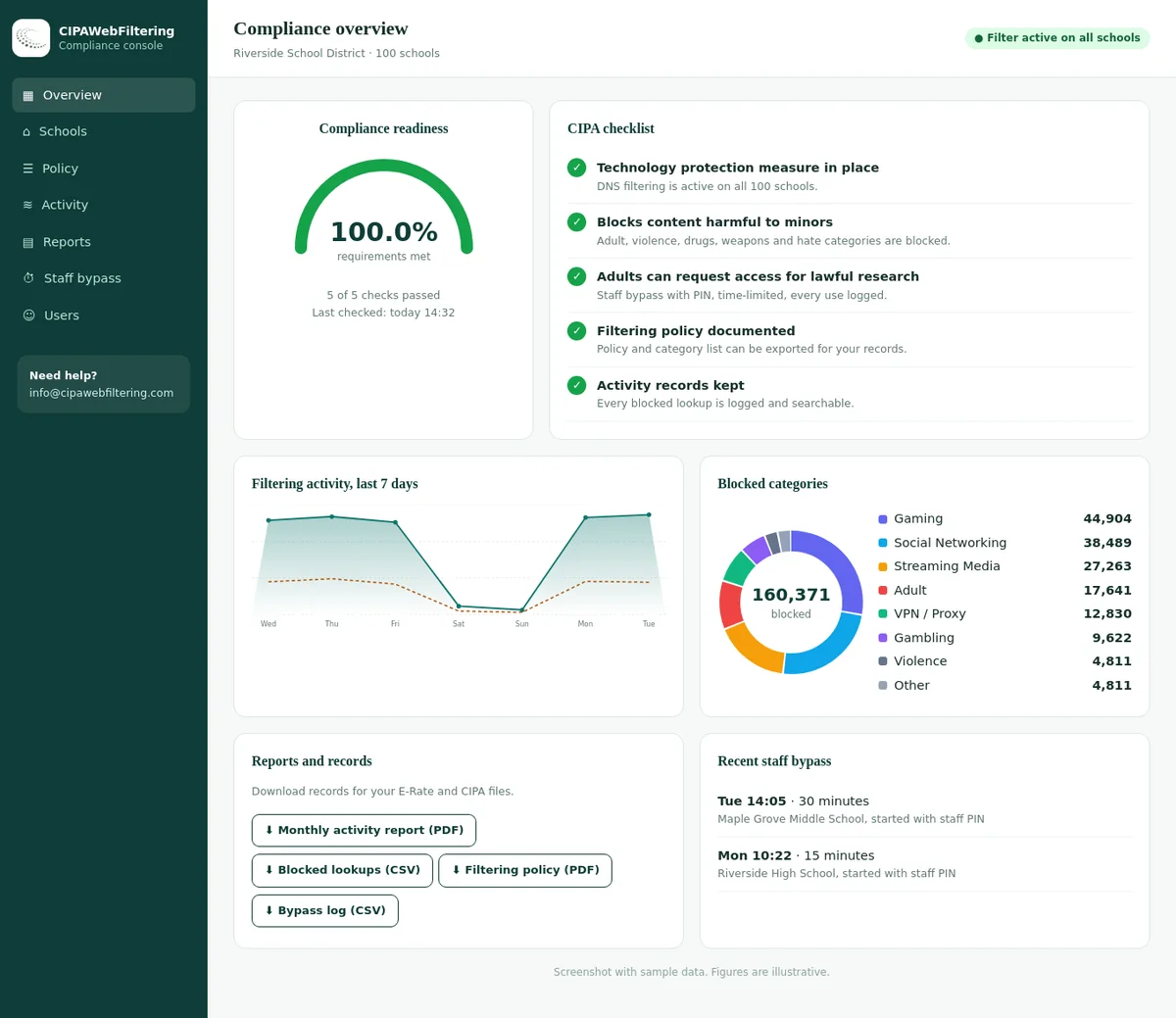
The Kansas act wants a technology protection measure that works, and a board policy to enforce it. Our hosted CIPA filter is a DNS filter that we run, and its reports and policy record show what was set and when.
- The CIPA preset blocks Adult and VPN/Proxy/Anonymizers so the base rule is in place immediately
- A school district and a library branch can each keep their own settings
- Log export gives your board a record to attach to its published policy
What Kansas adds: K.S.A. 75-2589 piece by piece
The Kansas Children's Internet Protection Act was enacted in 2013. Backers argued that some Kansas libraries and schools sat outside the federal rules, so the state wrote its own. Here is how it is built.
A school district that provides public computer access must use technology protection measures to protect minors from child pornography, material harmful to minors and obscenity.
Each board of education must adopt policies to enforce the filtering requirement, and those policies must be available to the public.
Public libraries that offer public computer access carry a similar duty, and the library part also addresses blocking child pornography and obscenity for adult users.
A technology protection measure is any computer technology or other process that blocks or filters online access to visual depictions. That is wide enough to cover network, DNS and device-level filtering.
The section may be cited as the Kansas children's internet protection act, which is why many library and school policies use that name.
Schools and libraries under the Kansas act
Many Kansas communities have a school library and a public library a few blocks apart. The duties are similar, but the users and the adult rules differ.
School district
- Protect minors from child pornography, harmful to minors material and obscenity.
- Board adopts and publishes enforcement policies.
- Mostly minor users, plus staff accounts.
- Staff override for research handled under CIPA rules if you take E-Rate.
Public library
- Similar protection for minors on public computers.
- Also addresses child pornography and obscenity for adults.
- Many Kansas library policies allow disabling for adult bona fide research or other lawful purposes.
- Policy wording help: public library internet filtering policy.
CIPA and the Kansas act compared
Most Kansas districts meet both with one filter and one policy. The table shows where the two line up.
| Question | Federal CIPA | K.S.A. 75-2589 |
|---|---|---|
| Trigger | E-Rate discounts and certain library grants | Providing public computer access |
| Who | E-Rate schools and libraries | School districts and public libraries |
| Content | Obscene, child pornography, harmful to minors | Child pornography, harmful to minors, obscenity |
| Policy | Internet safety policy after notice and a hearing or meeting | Board enforcement policies made public |
| Monitoring and education | Required | Not stated in the section |
| Proof | Form 486 or 479 | Published policy and working filter |
Misreading: "The Kansas act replaces CIPA"
It does not. E-Rate schools still certify CIPA, including the monitoring and education parts the Kansas section does not mention.
Misreading: "Only libraries are covered"
Subsection (a) covers school districts that provide public computer access. Both schools and libraries carry duties.
Misreading: "A filter list in the policy is enough"
The policy must be enforced. A working, current filter and dated rule set exports are what show that.
The 2026 bell-to-bell phone law
Governor Laura Kelly signed Senate Substitute for Substitute for House Bill 2299 in March 2026. In 2024 the State Board of Education had only encouraged phone policies. The new law makes a full-day ban the rule.
| Device or situation | Covered by the ban? | Notes |
|---|---|---|
| Personal cellphone | Yes | Turned off and stored away from the student, out of reach, for the school day |
| Personal tablet or laptop | Yes | Personal electronic communication devices are covered, not only phones |
| Smart watch, wireless headphones | Yes | Named in coverage of the law as covered devices |
| Lunch, recess, passing periods | Yes | The ban runs from the start of the school day through dismissal |
| District-issued Chromebook | No | School devices stay under your filter and acceptable use policy |
| IEP, 504 plan or physician-approved need | Exception | Use allowed where a plan requires it or a physician approves it as a medical necessity |
State Board encourages local phone policies
HB 2299 signed into law
Boards certify a compliant policy to the State Board
First full school year under the ban
Kansas Student Data Privacy Act and monitoring tools
K.S.A. 72-6312 through 72-6320 form the Student Data Privacy Act. It matters for filters and monitoring tools because they collect and process student activity data every day.
Disclosure limits
The Act restricts disclosure of student data and personally identifiable student data without authorization. Check who your filter shares logs with.
Biometric data
Unauthorized collection of biometric data from students is restricted. Avoid tools that use face or voice data unless you have cleared it.
Emotional state
The Attorney General's summary says the Act restricts using devices to assess a student's psychological or emotional state. Review any tool that scores student wellbeing.
Breach notice
Affected students must be told after a breach or unauthorized disclosure. Your contracts should require prompt notice from the provider.
Surveys
Surveys on personal beliefs and family practices are restricted. Keep that in mind for any digital citizenship survey tied to filtering.
Complaints
The Kansas Attorney General accepts complaints under the Act, so a clear data map is worth having before anyone asks.
What it means for filtering and monitoring in Kansas
The Kansas act and CIPA set the same kind of content floor. Category data turns that floor into rules your filter can apply and report on.
| Category | Students | Staff | Library public computers |
|---|---|---|---|
| Adult | Block | Block | Block, adult research override |
| VPN / Proxy / Anonymizers | Block | Local choice | Block in children's areas |
| Lingerie/Swimsuits/Intimate Apparel | Block by grade | Allow | Local choice |
| Gambling, Illegal Drugs, Weapons | Block | Local choice | Children's areas |
| Violence, Hate/Discrimination | Block by grade | Allow | Local choice |
| Malware / Phishing / Suspicious | Block | Block | Block |
| Social Networking, AI / LLM Tools | Local policy | Local policy | Local policy |
AI tools
No Kansas statute names AI tools. The AI tools blocklist for schools lets you allow approved tools only.
Spot checks
When a teacher reports a wrong block, look it up in the domain category checker before changing rules.
Library and reference sites and the categories our data gives them
Both schools and libraries have a duty under the Kansas act, and neither wants a book catalog blocked by mistake. These lookups show how our data files common reading sites.
| Site | Categories in our data |
|---|---|
| archive.org | Education/Reference |
| openlibrary.org | Education/Reference |
| gutenberg.org | Education/Reference |
| worldcat.org | Education/Reference |
| overdrive.com | Education/Reference, Arts & Entertainment |
| jstor.org | Education/Reference, Science |
Common Kansas situations and how the rules apply
Rural districts, shared community buildings and take-home devices create questions that the statute text does not answer on its own. These are the ones we hear most.
A shared school and community library
Both parts of the Kansas act may be in play. Run a minor rule set on student and children's computers and an adult rule set with a research override elsewhere.
Wi-Fi in the parking lot
If the public can join school Wi-Fi after hours, that is public access. Apply at least the Adult, proxy and malware blocks to the guest network.
No E-Rate this year
CIPA drops away, but the Kansas act does not. Keep the filter running and the board policy published.
A student with a medical exception
The phone may stay in use under HB 2299. If it joins school Wi-Fi, it should get the student rule set like any other device.
A teacher researching a sensitive topic
Use a logged, time-limited staff override. Write the approver and the reason into the log so it can be shown later.
A parent asks what is tracked
Share the data map from your Student Data Privacy Act review: fields, retention period and who can see them.
One policy that serves CIPA and the Kansas act
There is no need for two documents. A single internet safety policy can meet both laws if it covers these five points.
Name both CIPA and K.S.A. 75-2589 as the reasons for the policy, so reviewers see both duties at once.
State that child pornography, obscenity and material harmful to minors are blocked on every computer minors use, on every network.
Say that extra categories are set by grade band in an administrative procedure, so the list can change without a new board vote.
Describe how staff ask for research access, who approves it and how it is logged.
Post the policy on the district website, which meets the Kansas publication rule and helps with the CIPA notice.
A policy record and log export behind your board policy
The guide says a policy must be enforced, not only written. Our hosted CIPA filter keeps a policy record and lets you export logs, and a staff PIN for 15, 30 or 60 minutes handles adult research and then switches back.
Kansas compliance checklist by role
Split the work so nothing falls between desks. The CIPA compliance checklist covers the federal items in more depth.
Superintendent and board
- Internet safety policy adopted after notice and a hearing or meeting
- Kansas act enforcement policy adopted and posted publicly
- HB 2299 device policy adopted and certified by September 1, 2026
- Form 486 or 479 filed on time
Technology director
- Student rule set blocks child pornography, harmful to minors and obscene content on all networks
- VPN and proxy categories blocked for students
- Off-campus filtering working on take-home devices
- Filter and monitoring contracts reviewed against the Student Data Privacy Act
Principals and teachers
- Phone storage routine in place from first bell to dismissal
- Exceptions for IEP, 504 and medical needs recorded
- Online safety and cyberbullying lessons delivered and logged
- Site unblock requests sent through one channel
Librarians
- Public library policy matches subsection (b) of the Kansas act
- Adult research override process written and logged
- Children's area computers on the stricter rule set
- Signs explain that filtering is in place and how to ask for access
Evidence to keep
Keep records for E-Rate reviewers, the State Board and any parent or Attorney General inquiry. One folder per school year is enough.
- Internet safety policy, board minutes and hearing noticeCIPA
- Published Kansas act enforcement policy and where it is postedK.S.A. 75-2589
- Dated exports of student, staff and library rule setsCIPA and 75-2589
- Adult override log for staff and library patronsCIPA
- Monitoring reports and alert reviewsCIPA
- Online safety lesson plans and rostersCIPA
- Device policy and the September 1, 2026 certificationHB 2299
- Data map, retention schedule and provider contractsStudent Data Privacy Act
Kansas schools and libraries against the hosted filter, task by task
Both the district and the public library carry duties, so the rows cover each.
| Kansas task | Who it concerns | Our hosted CIPA filter |
|---|---|---|
| Technology protection measure on public computers | District and library | DNS filtering run for you, with nothing installed on computers |
| Adult research with the filter relaxed | Library, and staff in schools | PIN bypass for 15, 30 or 60 minutes, logged, then back on |
| Bypass of the Adult block | District and library | VPN/Proxy stays blocked even with the PIN |
| Different rules for schools and a library | Shared building or town | One console, separate settings per school or branch |
| Chromebooks used off the school network | District | A private encrypted link keeps the same rules away from the network |
| Proof that the policy is enforced | Board and E-Rate coordinator | Activity reports, a policy record and log export |
Kansas school internet safety FAQ
Does Kansas have its own school internet filtering law?
Yes. K.S.A. 75-2589, the Kansas Children's Internet Protection Act of 2013, requires districts that provide public computer access to protect minors from child pornography, harmful to minors material and obscenity, with public board policies.
Does the Kansas act apply to public libraries too?
Yes. A separate subsection applies a similar duty to public libraries that offer public computer access, including rules on child pornography and obscenity for adults. Read the current text before updating library policy.
What does the 2026 Kansas phone law require?
HB 2299 bans student use of personal electronic communication devices bell to bell in public and accredited nonpublic schools. Devices are turned off and stored out of reach, and boards certify their policy by September 1, 2026.
Does the Kansas phone law cover school Chromebooks?
No. It covers personal devices. District-issued devices stay under your filter and acceptable use policy.
Which Kansas law covers student data in filtering tools?
The Student Data Privacy Act, K.S.A. 72-6312 to 72-6320. It limits disclosure, restricts biometric data and, per the Attorney General's summary, restricts devices that assess a student's psychological or emotional state.
Does the Kansas act apply if we do not take E-Rate?
Yes. The Kansas act is triggered by offering public computer access, not by federal funding. A district or library without E-Rate still needs filtering and a public policy under it.
Do accredited private schools in Kansas fall under the phone law?
Yes. Coverage of HB 2299 says it applies to public schools and accredited nonpublic schools, and both must certify their policies to the State Board.
Does Kansas require schools to block AI tools or social media?
We found no Kansas statute that names them for schools. They stay local choices. See social media filtering for schools for options.
Compare Kansas with other states
Neighbouring states take different approaches. Find every guide on our school internet safety laws by state page.
Related guides
- CIPA Internet Safety Policy: What It Must Contain and How to Write One
- CIPA Compliance Checklist for Schools and Districts (8 Steps)
- Presenting Web Filtering to the School Board: Budget, Risk, Metrics
- Nebraska School Internet Safety Laws: CIPA, LB 140 and LB 383
- Oklahoma School Internet Safety Laws: CIPA, Bell to Bell Phones
We quote by the number of schools and devices, and the quote is with you within one business day. A pilot on one Kansas site shows the blocks and the reports before you commit.
Talk to us about your district
We can show how CIPA category filtering, separate student, staff and library rule sets and clear category reports can fit your Kansas district or library.
Talk to us about your district