Nebraska School Internet Safety Laws
Nebraska lawmakers have debated school filtering bills several times without passing one. The filtering rule for Nebraska schools is still federal CIPA. What changed recently is the law on student phones and a set of online safety acts aimed at platforms.
Written for Nebraska technology directors, school librarians and principals. Planning guidance, not legal advice.
Nebraska at a glance
With no state filtering law and LB 140 on the books, school devices carry the day
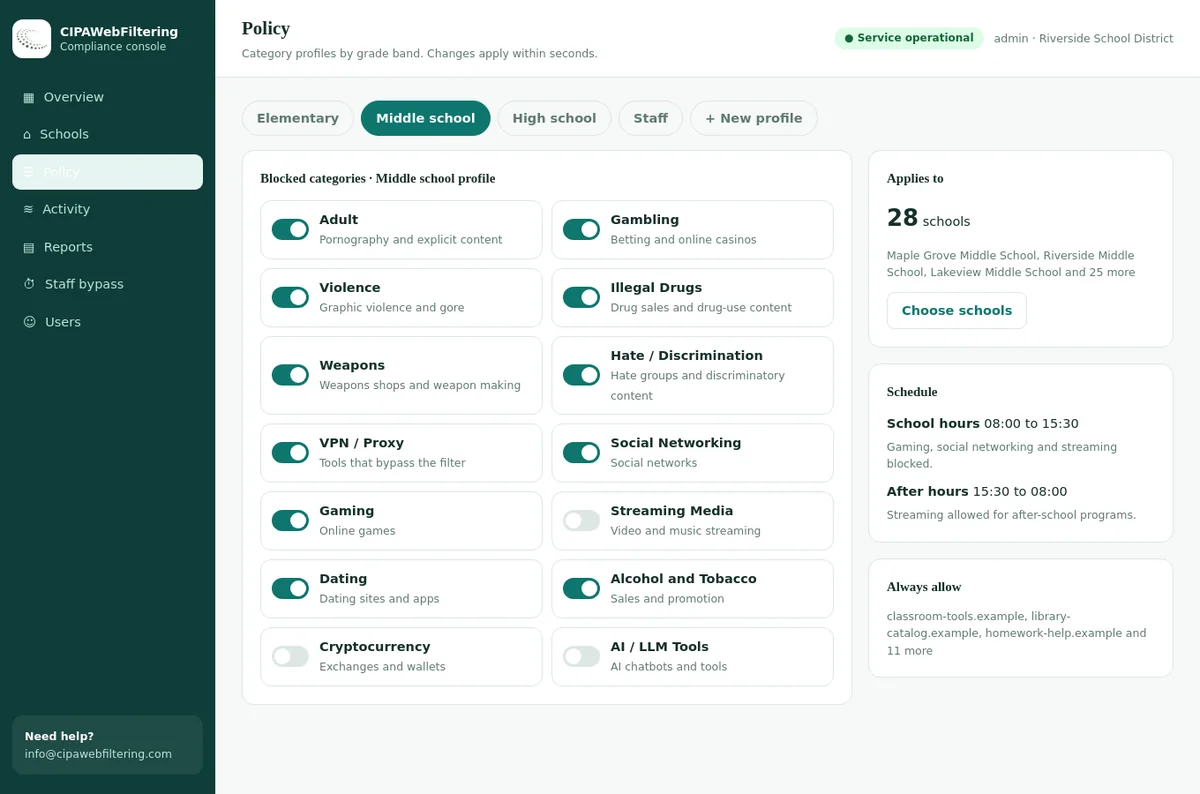
Nebraska bills on filtering never passed, so CIPA is the rule, and LB 140 sends more browsing onto school-owned devices. Our hosted CIPA filter keeps the same category rules on those devices in class and at home.
- A DNS filter that we run for you, set once per building
- Grade-band choices such as Gambling, Weapons or Lingerie are switches per school
- A personal device that joins the Wi-Fi under an LB 140 exception meets the same filter
The CIPA baseline for Nebraska schools and libraries
CIPA attaches to E-Rate discounts on internet access and internal connections, and to some library funding. Opponents of a 2023 Nebraska bill made the point plainly: every Nebraska school already filters because of CIPA. Background is in what is CIPA.
The filter
- A technology protection measure that blocks or filters visual depictions that are obscene or child pornography.
- On computers used by minors, it must also cover depictions harmful to minors.
- An authorized person may disable it for an adult's bona fide research or other lawful purpose.
The policy and certification
- An internet safety policy, adopted after reasonable public notice and at least one hearing or meeting.
- Monitoring of minors' online activities and education about online behavior and cyberbullying.
- Certification each funding year on FCC Form 486, or Form 479 for consortium members.
What Nebraska adds on top of CIPA
The plain answer: Nebraska does not add a filtering standard. It adds a phone policy duty for public schools, a student data law, a bullying policy duty and platform laws that sit outside the school.
| Rule | Applies to schools? | What it requires | Filter impact |
|---|---|---|---|
| Federal CIPA | E-Rate applicants | Filter, internet safety policy, monitoring, education | Sets the categories you must block |
| LB 140 (2025), personal electronic devices | Public school boards | Board policy banning student device use at school, with exceptions | More browsing moves to school devices |
| Student Online Personal Protection Act (LB 512, 2017) | Through vendors | Limits on how K-12 operators use student information | Shapes filter and monitoring contracts |
| Bullying policy statute (Neb. Rev. Stat. 79-2,137) | School districts | A district policy on bullying, reviewed regularly | Monitoring alerts feed into it |
| LB 383 (2025), Parental Rights in Social Media Act | Platforms | Age checks and parental consent for minor accounts | None directly; partly enjoined |
| LB 504 (2025), Age-Appropriate Online Design Code Act | Online services | Design and data duties for services used by minors | None directly |
Nebraska timeline at a glance
The dates that matter for a Nebraska district technology plan, with their status at our last check in October 2026.
2001 onward: CIPA certification
Nebraska E-Rate schools and libraries certify CIPA compliance each funding year. This is still the only filtering mandate.
2017: Student Online Personal Protection Act
LB 512 sets limits on how K-12 online services use student information. It applies to many filter and monitoring providers.
2022 to 2024: filtering bills debated
LB 1213, LB 635 and LB 441 drew attention to online library resources and staff liability, but did not become law.
2025: LB 140, LB 383 and LB 504
A phone policy duty for public boards before the 2025-26 school year, plus two platform acts aimed at companies.
2026: platform rules start, then court action
LB 504 was reported operative from January 1, 2026. LB 383's core age and consent duties were enjoined on June 27, 2026.
Nebraska filtering bills that did not become law
Nebraska districts are often asked about these bills by parents and board members. As far as we can find, none of them was enacted, so they do not bind schools today. Check the Legislature's records for any new version.
Would have required schools and the Library Commission to block obscene material in online resources for K-12 students, with parent accounts and a civil action against vendors.
Not enactedAimed at K-12 database vendors, requiring them to filter obscene or harmful material, with early contract termination for failures. It advanced from the Education Committee.
Not enactedWould have removed an affirmative defense for school and library employees charged with distributing obscene material. It failed to advance in March 2024.
Failed to advanceHow well-known research databases are labelled in our data
The bills that failed in Nebraska were about online databases offered to students. A filter sees these services by domain, as shown below, while the content settings inside each one stay with the vendor.
| Domain | Categories in our data | What the filter can and cannot do |
|---|---|---|
| ebsco.com | Education/Reference, Science | Allowed as study material; safe search is set inside the vendor account |
| proquest.com | Education/Reference | Reachable by students, so check its age settings |
| jstor.org | Education/Reference, Science | Usually wanted for older grades |
| overdrive.com | Education/Reference, Arts & Entertainment | Two categories, one of them leisure reading |
| hoopladigital.com | Arts & Entertainment | Media lending, a local choice by grade band |
LB 140: building your personal electronic device policy
LB 140 was a 2025 priority of Governor Pillen and was signed in May 2025. It requires every public school board to adopt a policy before the 2025-26 school year. Here is the shape of a policy that follows the law.
Gather input
The policy is developed with input from students, parents and educators. Record who took part and when.
Set the default ban
Ban student use of phones and other electronic communication devices on school property and at school instructional functions.
List the exceptions
Allow use required by an IEP or 504 plan, for district-approved class work, during an emergency or perceived threat, for health monitoring, or when the board or a staff member allows it.
Decide enforcement
Discipline is left to each district. Write it down so staff apply it the same way.
Connect it to the network
Decide what happens when a personal device joins school Wi-Fi during an allowed use. It should land in the student filter profile.
LB 383 and LB 504: platform laws, not school laws
Nebraska passed two online safety acts in 2025. Both place duties on companies. Schools should know them, mainly so they can answer parents accurately.
LB 383, Parental Rights in Social Media Act
- Signed May 20, 2025, with its main duties set for July 1, 2026.
- Requires social media companies to verify account holders' ages and get parental consent for minors.
- On June 27, 2026, a federal court preliminarily enjoined enforcement of the age verification and parental consent requirements. Other parts may still apply.
LB 504, Age-Appropriate Online Design Code Act
- Signed in 2025 and reported as operative from January 1, 2026.
- Asks online services likely to be used by minors to protect their data, limit compulsive-use design and give parents tools.
- Does not create duties for schools and does not change CIPA.
Student data: the Student Online Personal Protection Act
Nebraska's 2017 law, passed as LB 512, covers operators of websites, online services and apps designed and used mainly for K-12 school purposes. Filter and monitoring providers often fall in that group.
No targeted advertising
Operators may not use covered student information to target ads at students or parents.
No selling or renting
Student information may not be sold or rented, and disclosure to others is allowed only under set conditions.
Reasonable security
Operators must protect covered information with reasonable security. Ask how browsing logs are stored.
Contract terms
Write retention periods, access limits and breach notice into the agreement with each provider.
What it means for filtering and monitoring in Nebraska
With CIPA as the only filtering mandate, a Nebraska setup is mostly about doing CIPA well, plus handling the effects of LB 140. These are the settings to review.
CIPA core for all users
Adult content blocked on every device. For minors, add Lingerie/Swimsuits/Intimate Apparel and similar harmful-to-minors categories.
Grade-band rule sets
Gambling, Illegal Drugs, Weapons, Violence, Hate/Discrimination, Dating, Alcohol and Tobacco for students, tuned by age.
Bypass categories
VPN / Proxy / Anonymizers and File Sharing/P2P blocked for students. See how to block VPN extensions on school Chromebooks.
School devices carry more load
With phones put away, Chromebooks and laptops do more of the browsing. Make sure filtering follows them home.
AI tools by board decision
Nebraska law does not require blocking AI tools. Use an AI tools blocklist for schools to allow what you approve.
Monitoring with clear owners
Name who reviews alerts, and link serious alerts to your bullying and safety procedures.
The same rules at the kitchen table as in the classroom
A private encrypted link keeps the school rules on laptops and phones off the network, with nothing installed on the computers. Settings stay separate for each school or branch in one console.
Nebraska public and school libraries
Library staff ask the most questions about filtering, because the debated bills focused on library resources. The rules that actually apply today are short.
Public libraries
- CIPA applies when the library takes E-Rate for internet access or internal connections, or LSTA funds used for internet access or computers that reach it.
- Adults may ask for the filter to be disabled for bona fide research or other lawful purposes.
- Many libraries keep separate adult and children's profiles. Our public library internet filtering policy guide shows how.
School library media centers
- Covered by the district's CIPA filter and internet safety policy, like any other school computer.
- Online databases licensed by the school are a common gap: content is served through the vendor's site, so check its own safety settings.
- Book selection and reconsideration stay under board policy, separate from the web filter.
Common Nebraska misreadings
Parents, staff and even board members mix up the bills and acts above. These are the points we see confused most often.
| What people say | What applies |
|---|---|
| "Nebraska passed a school filtering law." | Filtering bills were debated but, as far as we can find, none was enacted. CIPA remains the filtering rule. |
| "LB 140 means phones are filtered." | LB 140 limits student use of personal devices. Filtering covers your network and your school devices. |
| "The social media law protects students at school." | LB 383 targets platforms and its core duties were enjoined in June 2026. Your filter and policy are what protect students on school systems. |
| "Private schools are outside every rule." | LB 140 skips private schools, but a private school that takes E-Rate certifies CIPA like anyone else. |
| "The design code act tells schools what to block." | LB 504 is about how online services are built and how they handle minors' data. It gives schools no blocking duties. |
Questions to bring to your next board meeting
If your board is reviewing the internet safety policy or the LB 140 policy, these questions help keep the discussion practical.
Which categories do we block, and for whom?
Ask for the student and staff rule sets on one page, by grade band, so members can see the actual settings.
How do teachers get a site unblocked?
A fast, logged request process reduces over-blocking complaints and keeps decisions consistent.
Do school devices stay filtered at home?
With phones put away at school, students rely more on school devices, including for homework.
Who sees student browsing data?
List the staff roles and providers with access, and how long logs are kept.
Nebraska compliance checklist
Use it each spring before the E-Rate window, and again when a policy changes. The full CIPA compliance checklist covers the federal items in more depth.
- Federal CIPA
- Internet safety policy covers every CIPA topic
- Public notice and hearing or meeting documented
- Filter blocks obscene and child pornography depictions for all users
- Harmful-to-minors categories blocked on student devices
- Monitoring procedure written and staffed
- Online safety lessons delivered and recorded
- Form 486 or 479 filed on time
- Adult disable procedure documented
- Nebraska items
- LB 140 device policy adopted with stakeholder input
- Device exceptions list matches the law
- Personal devices on Wi-Fi get the student profile
- Bullying policy references online conduct
- Vendor contracts reflect the Student Online Personal Protection Act
- Licensed research databases reviewed for age settings
Evidence to keep
A single folder per funding year saves time in a review. These records cover both CIPA and the Nebraska items.
| Record | Shows | Source rule |
|---|---|---|
| Internet safety policy and board minutes | Policy adopted | CIPA |
| Public notice and hearing or meeting agenda | Public process | CIPA |
| Filter rule set exports and dated test screenshots | Filter in place and working | CIPA |
| Lesson plans and attendance for online safety teaching | Education duty met | CIPA |
| LB 140 policy, stakeholder input notes and adoption date | Device policy adopted before 2025-26 | LB 140 |
| Signed vendor data agreements | Student data protected | Student Online Personal Protection Act |
| Form 486 or 479 copies | Federal certification | CIPA |
Board-meeting questions answered by the hosted filter
The earlier section lists questions Nebraska boards tend to ask, and this table shows how our filter answers four of them next to a typical manual approach.
| Board question | Hosted CIPA filter | Typical manual approach |
|---|---|---|
| Which categories do we block, and for whom? | Category switches per school, one page to show the board | Long lists in several tools |
| How does a teacher get a site unblocked? | Always-allow entry for that school | Email to whoever manages the lists |
| Do school devices stay filtered at home? | Private encrypted link keeps the same rules | Often only on the school network |
| Can students go around the filter? | VPN/Proxy blocked, plus public encrypted DNS and browser settings that skip the filter | Depends on how complete the lists are |
| What can we show a reviewer? | Activity reports, policy record and log export | Dated screenshots |
Nebraska school internet safety FAQ
Does Nebraska require schools to filter the internet under state law?
We found no Nebraska statute with its own filtering standard for schools. E-Rate schools and libraries filter because of CIPA. Bills such as LB 1213 and LB 635 did not become law as far as we can find.
What does Nebraska LB 140 require?
Each public school board had to adopt, before the 2025-26 school year, a policy banning student use of personal electronic devices at school and instructional functions, with listed exceptions. It does not cover private schools.
Does LB 383 apply to schools?
No. It puts duties on social media companies. Its age verification and parental consent requirements were preliminarily enjoined on June 27, 2026.
What is Nebraska's student data privacy law?
The Student Online Personal Protection Act, passed as LB 512 in 2017. It bars K-12 operators from targeted advertising and from selling student data, and requires reasonable security.
Do Nebraska private schools need to follow LB 140?
LB 140 applies to public school boards. Private schools may adopt their own policy, and E-Rate private schools still meet CIPA.
Does the Age-Appropriate Online Design Code Act change school filtering?
No. LB 504 places duties on online services used by minors. It does not create school duties or change CIPA.
Other state guides
Compare Nebraska with nearby states, or browse all of them on our school internet safety laws by state page.
Not legal advice. This page summarizes federal and Nebraska rules as we understand them in October 2026, for planning only. Bills, court cases and guidance change. Confirm current requirements with district counsel, the Nebraska Department of Education or your E-Rate consultant before acting.
Related guides
- CIPA Internet Safety Policy: What It Must Contain and How to Write One
- Web Filtering for Small and Rural School Districts
- Explaining Web Filtering to Parents: Letters, FAQs, Clear Limits
- Iowa School Internet Safety Laws: CIPA, HF 782 and SF 496
- Kansas School Internet Safety Laws: CIPA, 75-2589 and Phones
A Nebraska quote is based on how many schools and devices you run, and it reaches you within one business day. Trying one school first with a pilot lets your board see real blocks and reports.
Talk to us about your district
We can show how CIPA category filtering, grade-band rule sets and clear category reports can fit your Nebraska schools.
Talk to us about your district