New Mexico School Internet Safety Laws
New Mexico has no statute of its own on school web filtering. Filtering in New Mexico schools and libraries comes from federal CIPA. Since 2025, state law also requires every district and charter school to have a policy on student devices during instruction.
Written for technology coordinators, library staff and school leaders across New Mexico's districts, charter schools and tribal communities. Planning guidance, not legal advice.
Two lanes: federal CIPA and New Mexico law
It helps to keep the two sources apart. CIPA governs the filter and the internet safety policy. New Mexico law governs student devices and the records that your systems create. Background on the federal side is in what is CIPA.
Federal CIPA
- Applies to schools and libraries that take E-Rate for internet access or internal connections.
- Filter visual depictions that are obscene or child pornography for all users, and harmful-to-minors content for minors.
- Adopt an internet safety policy after public notice and a hearing or meeting.
- Monitor minors online and teach online safety, social networking and cyberbullying awareness.
- Certify each year on Form 486, or Form 479 for consortium members.
New Mexico law
- No state filtering standard and no list of categories to block.
- SB 11 (2025): a wireless communication device policy for instructional time in every district and charter school.
- Public Education Department minimum guidelines for those policies.
- Education records kept in line with FERPA and state records law.
- Bullying prevention policies under state education rules, which reach online conduct.
A filter that fits the way New Mexico schools are actually run
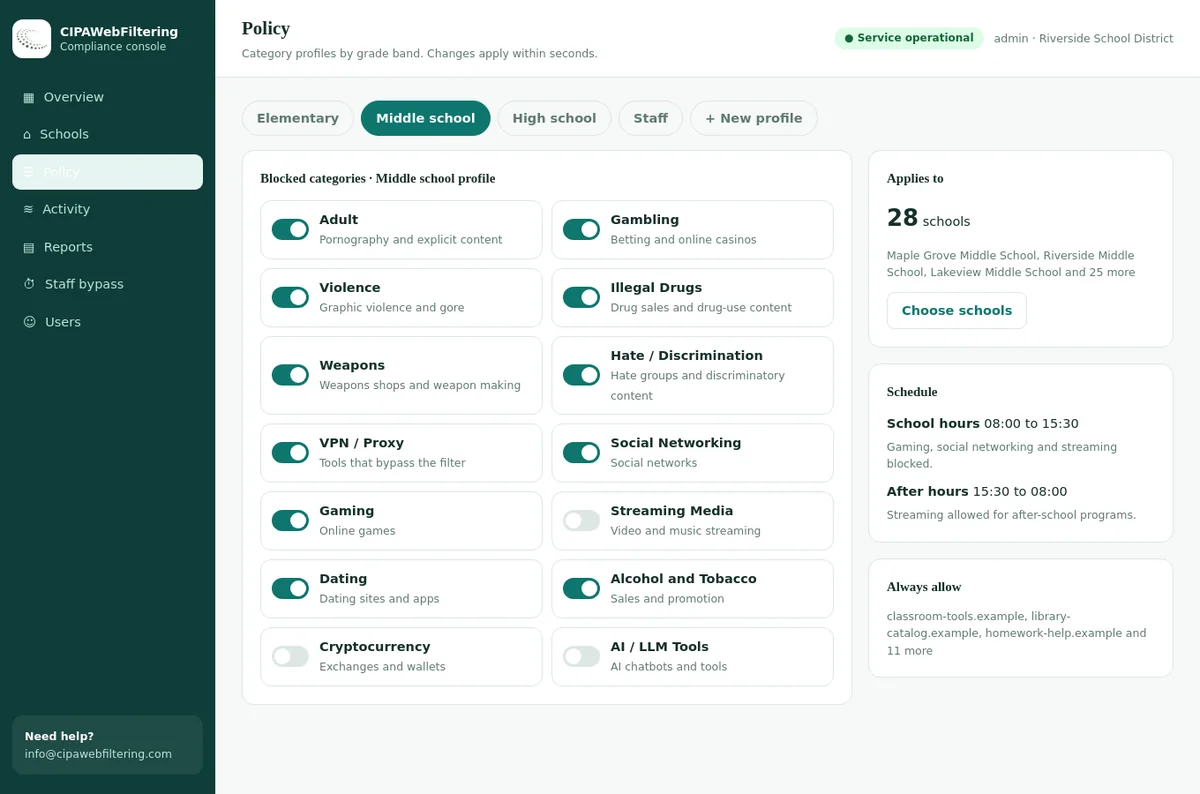
New Mexico leaves filtering to CIPA and puts a device policy duty in SB 11, while the schools themselves range from large districts to small charters and tribally controlled campuses. Our hosted CIPA filter is a DNS filter that we run for you, so a small team does not have to host anything.
- Every school or branch gets its own settings in one console
- Personal devices allowed on Wi-Fi under an SB 11 exception can use the student rules
- Library and adult staff use is handled with a logged PIN, not by switching the filter off
What New Mexico adds: the device law, and the one that did not pass
The plain answer is that New Mexico adds nothing to filtering itself. What it adds is a device policy duty. A stricter bill came close in 2026 and failed, which still confuses many parents and staff.
SB 11, phone-free schools policy
- Districts and charter schools adopt a wireless communication device policy for instructional time.
- Covers personal phones, smartwatches, tablets, laptops and gaming devices.
- Policies were due by August 1, 2025.
- The Public Education Department provides minimum policy guidelines.
- Creates a grant program for items such as phone lockers.
SB 23, bell-to-bell ban
- Would have banned phone use from the first bell to the last bell, including lunch and passing periods.
- Passed the Senate 32 to 6.
- Did not pass the House before the session ended.
- Lawmakers said they would look at a statewide ban again in the interim.
- Until then, SB 11 is the state rule and districts may go further locally.
Context: when she signed SB 11, the governor called it a first step and criticized lawmakers for weakening the original bill, which would have barred phones during instructional hours outright. She listed a stronger ban among her 2026 priorities.
New Mexico timeline for school technology teams
The dates that shape filtering and device decisions in New Mexico, with their status at our last check in October 2026.
| When | What happened | Effect on schools |
|---|---|---|
| 2001 onward | CIPA takes effect for E-Rate schools and libraries | Filter, internet safety policy and yearly certification |
| April 10, 2025 | SB 11 signed | Device policies required for instructional time |
| August 1, 2025 | SB 11 policy deadline | Districts and charter schools had policies in place for 2025-26 |
| 2025-26 school year | Grants for storage such as lockers | Funding help for districts putting the policy into practice |
| 2026 session | SB 23 passes the Senate, stalls in the House | No statewide bell-to-bell rule; local choice continues |
| 2026 interim | Lawmakers signal a return to the issue | Watch for a new bill in the next session |
Building an SB 11 device policy that works with your filter
SB 11 leaves the details to each district and charter school, within the department's minimum guidelines. These building blocks make a policy that staff can apply and that fits your network setup.
Define the devices
List personal phones, smartwatches, tablets, laptops and gaming devices, as SB 11 does. Separate them clearly from school-issued devices.
Define the time
SB 11 covers instructional time. Decide whether your district will go further, for example all day.
Set exceptions
Plan for health needs, IEP and 504 accommodations, emergencies and teacher-directed use. Check the department guidelines for required items.
Storage method
Lockers, pouches or backpacks. SB 11 grants can help pay for storage.
Network rule
Personal devices allowed onto school Wi-Fi under an exception should get the student filter profile.
School device rule
School-issued laptops and tablets stay under the CIPA filter and monitoring at all times.
Enforcement
Write consistent steps for staff, and tell families how devices are returned.
Review
Set a date to review the policy, especially if the Legislature returns to a statewide ban.
For the wording of personal device and network rules, see our guide to acceptable use policies for schools.
Tribal, BIE and rural schools
New Mexico's school landscape includes Bureau of Indian Education funded schools, tribally controlled schools, tribal libraries and many small rural districts. The rules that apply depend on who runs the school and how it is funded.
| School or library type | CIPA | SB 11 | Practical note |
|---|---|---|---|
| Public school district | Yes, if it takes E-Rate | Yes | Both apply; most districts do |
| Charter school | Yes, if it takes E-Rate | Yes | Smaller teams often prefer a hosted filter |
| BIE funded or tribally controlled school | Yes, if it takes E-Rate | Check with counsel; state rules may not apply | Tribal and federal policies may add their own rules |
| Tribal library | Yes, if it takes E-Rate | No | Separate adult and minor profiles, as in web filtering for libraries |
| Private school | Yes, if it takes E-Rate | No | Local phone policy at the school's choice |
Rural reality: many students do homework on cellular or community networks far from school. Filtering that travels with the device is the only way the school's rules apply there. See enforcing CIPA off campus and 1:1 Chromebook filtering.
Rules that travel with the laptop to cellular and community networks
A private encrypted link keeps the same rules on laptops and phones away from the school network. Nothing is installed on the computers, and public encrypted DNS and browser settings that skip the filter are blocked by default.
What it means for filtering and monitoring in New Mexico
Because New Mexico leaves filtering to CIPA and local choice, the quality of your setup depends on your own decisions. These six areas matter most.
CIPA core
Block obscene and child pornography content for all users, and harmful-to-minors content on student devices.
Student categories
Common additions for students, set by grade band.
Bypass categories
With phones put away, more students try to tunnel out on school devices.
Games and streaming
No law requires blocking them. Many districts limit Gaming and Streaming Media during class hours to protect bandwidth and focus.
AI tools
New Mexico law is silent on AI tools. Allow approved ones and block the rest with an AI tools blocklist for schools.
Monitoring
CIPA expects monitoring of minors. Link serious alerts to your bullying prevention procedures. See filtering vs monitoring vs classroom management.
New sites appear daily, including proxy mirrors and unblocked game sites. Category data that adds newly registered domains every day keeps rules current. Check any site with the domain category checker, or read how to block proxy sites in schools.
Student data from filters and monitoring
New Mexico does not have a separate student online privacy statute like some states. Filter and monitoring data still counts as education records when it is tied to a student, so federal and state records rules apply.
Rules that apply
- FERPA, for education records that identify a student.
- New Mexico rules requiring districts and charter schools to keep personally identifiable education records in line with FERPA and state public records law.
- CIPA's policy topic on unauthorized disclosure of minors' personal information.
- A 2025 consumer privacy bill (HB 307) excluded schools, and we found no record that it became law.
Contract checks
- What browsing data is collected, and is any of it used for advertising?
- How long are logs kept, and where are they stored?
- Who at the provider can read student activity?
- How will you be told about a breach?
- Can you export or delete a student's records on request?
- Does the provider pass data to any other company, and under what written terms?
- Are staff at the provider trained on student privacy?
More detail is in student data privacy, FERPA and filtering. A filter that runs on category data inside your own environment keeps browsing data off outside systems.
New Mexico public and school libraries
Libraries face the most balancing work, because adults and children often share computers and the same network. CIPA gives the framework.
Public libraries
CIPA applies when the library takes E-Rate, or LSTA funds for internet access or the computers used to reach it. See our public library internet filtering policy guide.
Adult access
An adult may ask staff to disable the filter for bona fide research or other lawful purposes. Write the request process into the policy.
School libraries
Library computers sit under the district filter and policy. Check the safe settings of licensed research databases, which are served from outside sites.
Preparing for a possible statewide ban
A stronger phone law may come back. Districts that prepare now will need fewer changes if it does, and the steps help students today.
Count your devices
Know how many students have school-issued devices, so you can plan for more browsing on them.
Check Wi-Fi profiles
Make sure guest networks do not give students a way around the student rule set.
Review bypass logs
Look for VPN and proxy attempts on school devices. They often rise when phones are put away.
Talk to families
Explain how parents can reach students during the day, so a stricter rule meets less resistance.
Bypass and game names worth watching for in your logs
The preparation steps suggest looking for VPN and proxy attempts as phones disappear. This is how some familiar names sit in our category data.
| Domain | Categories in our data | What to do with it |
|---|---|---|
| ultrasurf.us | VPN / Proxy / Anonymizers | Counts as a bypass attempt on a school device |
| utorrent.com | File Sharing/P2P, Freeware/Software, Computers & Technology | Three labels, with P2P the one that matters for a school link |
| crazygames.com | Gaming | A class-hours decision, not a legal one |
| y8.com | Gaming | Another browser game portal |
| miniclip.com | Gaming | Often turns up once phones are locked away |
Common New Mexico misreadings
These are the statements we hear most often from staff and families, with what actually applies.
| What people say | What applies |
|---|---|
| "New Mexico banned phones all day in 2026." | SB 23 did not pass the House. SB 11's instructional-time policy remains the state rule. |
| "SB 11 tells us which sites to block." | SB 11 is about devices, not websites. Filtering rules come from CIPA and your board. |
| "Without a state law, filtering is optional." | Not for E-Rate schools and libraries. CIPA certification depends on it. |
| "Laptops are exempt from SB 11." | Personal laptops are named in SB 11. School-issued laptops are governed by your instructional policy and filter. |
| "Monitoring means reading every student message." | CIPA asks schools to monitor minors' online activity. How you do it, and what you look at, is a local choice that should respect student privacy. |
| "The state approves school filters." | There is no state approval list. Your filter must meet CIPA, and your board sets the rest. |
| "Tribal schools follow the same rules as districts." | CIPA applies to any E-Rate applicant. Whether a state rule applies depends on governance; ask counsel. |
New Mexico compliance checklist
Review it each spring before the E-Rate window, and when your device policy changes. The full CIPA compliance checklist goes deeper on the federal items.
Policy
- Internet safety policy covers every CIPA topic
- Public notice and hearing or meeting recorded
- SB 11 device policy adopted and current
- Device policy matches department minimum guidelines
- Bullying prevention policy covers online conduct
Filter
- CIPA core blocked for all users
- Student categories set by grade band
- VPN / Proxy / Anonymizers blocked for students
- Personal devices on Wi-Fi get the student profile
- Filtering tested on school devices at home
People
- Monitoring owners named and trained
- Online safety lessons delivered and recorded
- Unblock request process published to teachers
- Adult disable procedure documented
- Families told how the device policy works
- AI tools allow list agreed with teachers
Records and forms
- Provider contracts reviewed for data terms
- Rule set exports saved for the year
- SB 11 grant records kept if you received one
- Form 486 or 479 filed on time
Evidence to keep
Keep one folder per funding year. These records answer most E-Rate review and board questions.
| Record | What it proves | Rule |
|---|---|---|
| Adopted internet safety policy and board minutes | Policy in place | CIPA |
| Public notice and hearing or meeting agenda | Public process followed | CIPA |
| Filter rule set exports and dated block tests | Filter working on each device type | CIPA |
| Lesson plans and dates for online safety teaching | Education duty met | CIPA |
| SB 11 device policy and adoption date | Device policy adopted | SB 11 |
| Grant documents for device storage, if any | Use of state grant funds | SB 11 |
| Signed provider data agreements | Student records protected | FERPA, state records rules |
| Form 486 or 479 copies | Federal certification | CIPA |
| Unblock request log with decisions and dates | Blocks reviewed fairly and on time | Local policy |
| Monitoring procedure and alert response records | Monitoring of minors in practice | CIPA, bullying prevention rules |
| Off-campus filtering test results | Rules apply on school devices at home | CIPA, local policy |
Our internet safety policy guide lists the CIPA topics, and E-Rate and CIPA funding explains the forms and timing.
School types in New Mexico and how the hosted filter fits each
This follows the table of school and library types earlier in the guide, with what our filter offers in each setting.
| Type of school or library | What the hosted CIPA filter offers | Point to keep in mind |
|---|---|---|
| Public school district | Separate settings per school in one console | CIPA and SB 11 both apply |
| Charter school | A filter run for you, with reports and a policy record | Small teams gain most from not hosting anything |
| BIE funded or tribally controlled school | Same DNS filter and CIPA preset for E-Rate schools | Ask counsel whether state rules reach you |
| Tribal library | Adult research through a PIN bypass, logged | Separate adult and minor profiles are still worth setting |
| Private school | One DNS setting on the router or firewall | CIPA applies if E-Rate is used |
New Mexico school internet safety FAQ
Does New Mexico have a state law requiring schools to filter the internet?
We found no New Mexico statute with its own filtering standard. E-Rate schools and libraries filter because of CIPA. SB 11 adds a device policy duty.
What does New Mexico SB 11 require?
A wireless communication device policy for instructional time in every district and charter school, due by August 1, 2025, within department guidelines, plus grants for storage such as lockers.
Did New Mexico pass a bell-to-bell phone ban in 2026?
No. SB 23 passed the Senate 32 to 6 but did not pass the House. SB 11 remains the state rule.
Do tribal and BIE schools in New Mexico follow CIPA?
Yes, if they apply for E-Rate discounts. Whether state rules such as SB 11 apply depends on how the school is governed.
Can New Mexico districts ban phones all day?
Yes. SB 11 sets a floor for instructional time, and boards may adopt stricter local rules.
Which privacy rules apply to filter and monitoring data?
FERPA and New Mexico records rules for education records. Review each provider contract for data use, retention and access.
Other state guides
Compare New Mexico with its neighbours, or see every state on our school internet safety laws by state page.
Related guides
- CIPA Internet Safety Policy: What It Must Contain and How to Write One
- Web Filtering for Small and Rural School Districts
- Presenting Web Filtering to the School Board: Budget, Risk, Metrics
- Texas SCOPE Act School Compliance: HB 18 Filtering Guide
- Colorado School Internet Safety Laws: CIPA and C.R.S. 22-87
The price follows how many New Mexico schools and devices you have, and our quote comes within one business day. If you want to see it in use first, a pilot on a single campus shows the blocks and reports.
Talk to us about your district
From rural districts to charter schools, we can show how CIPA category filtering that follows the device can fit your New Mexico schools.