Iowa School Internet Safety Laws
Iowa does not have a school web filtering statute of its own. For filtering, federal CIPA sets the bar, and each district fills in the detail through board policy.
What Iowa does add is a class-time phone rule (HF 782, 2025) and library material limits (SF 496, 2023). This guide shows how those pieces fit together for technology directors, principals and teacher librarians. Planning guidance, not legal advice.
Iowa at a glance
Write down your Iowa filter choices and let the settings match them
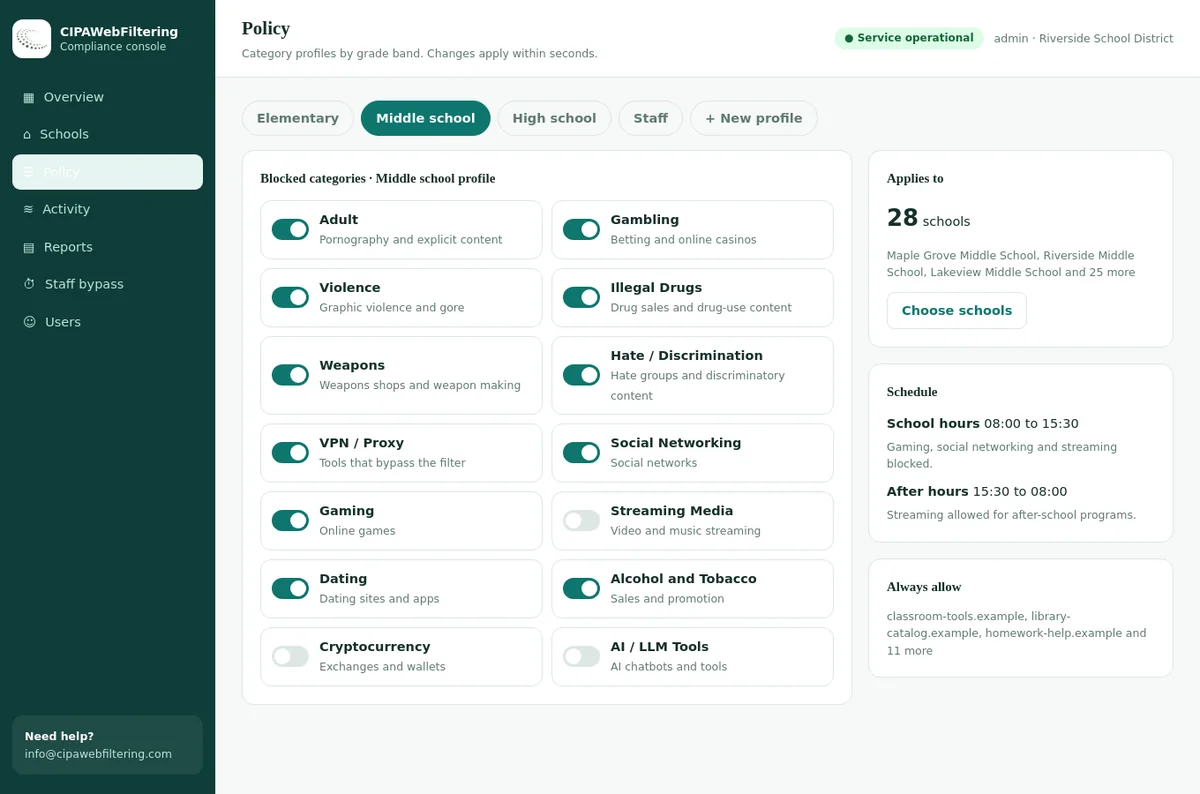
Because the state hands you no list of categories, your board has to defend what you block. Our hosted CIPA filter is a DNS filter that we run for you, built around category switches that are easy to explain and to record.
- The CIPA preset starts with Adult and VPN/Proxy/Anonymizers switched on
- Lingerie, Gambling and Weapons are optional, so each grade band can differ
- Always-allow and always-block lists per site hold the exceptions your board approves
The CIPA baseline: what every Iowa E-Rate school must do
Because Iowa adds no filtering statute, CIPA is the legal standard your filter is measured against. A full explanation is in what is CIPA; here is the short version.
Three things CIPA requires
- Technology protection measure. Block or filter visual depictions that are obscene or child pornography for everyone, and harmful to minors on computers used by minors.
- Internet safety policy. Address inappropriate material, safety in email and chat, hacking, unauthorized disclosure of minors' data and the filter.
- Monitoring and education. Monitor minors' online activities and teach online behavior, social networking and cyberbullying awareness.
Process and proof
- Give reasonable public notice and hold at least one public hearing or meeting on the policy.
- Certify on FCC Form 486 each funding year, or Form 479 for consortium members.
- An authorized person may disable the filter for adults doing bona fide research or other lawful work.
- How this links to discounts is set out in E-Rate and CIPA funding.
What Iowa adds, and what it does not
It helps to be plain about this. Iowa law gives school boards broad power to make rules, and many districts use it to adopt an internet appropriate use policy. Several Iowa districts number it 605.6. But the state does not dictate filter categories or methods.
What Iowa law does add
- A required phone policy that bans student cellphone use during class time, at minimum (HF 782).
- Age-appropriate limits on school library materials and notice to the state of removed books (SF 496).
- General board rulemaking power, which is the usual legal basis for local internet policies.
What Iowa law does not add
- No state-defined list of categories to block.
- No state filter mandate for schools that skip E-Rate, as far as we could find.
- No state rule on AI tools, social media blocking or monitoring software in schools.
House File 782: the Iowa class-time phone law
Governor Kim Reynolds signed HF 782 on April 30, 2025. It passed the Senate unanimously and the House by a wide margin, and it applies from the 2025 to 2026 school year.
The core rule
School districts, charter schools and innovation zone schools must adopt policies that, at a minimum, prohibit student cellphone use during class time. Boards may go further and restrict devices during other parts of the day.
Model policy
The Iowa Department of Education was directed to issue a model policy that districts could adopt or adapt.
Required exceptions
Policies include exceptions such as students with an IEP or 504 plan that relies on a device, and English learners who need device support.
Health petitions
Parents may petition the district to let their child keep phone access during class for a legitimate physical or mental health reason.
Parent contact
Each policy must explain how parents and guardians can reach their student during school hours, events and emergencies.
What dropped out
An earlier version would have required instruction on the effects of social media for grades 6 to 8. The Senate removed it before passage. CIPA's online safety education duty still applies to E-Rate schools.
Senate File 496 and the school library
SF 496 (2023) is often mentioned in the same breath as filtering, but it works on a different layer. It governs what a school library holds, not what the network blocks.
| Part of SF 496 | What it does | Overlap with your filter |
|---|---|---|
| Library materials | School libraries may hold only age-appropriate materials, and materials with descriptions or depictions of sex acts are excluded | Low. It covers the collection, not open web sites |
| Removal notices | Districts notify the Department of Education of books removed for obscene or sexually explicit content | None. This is a library workflow |
| Instruction limits | Restricts instruction on gender identity and sexual orientation in kindergarten through grade 6 | None. This is curriculum policy |
| Digital library resources | E-books and databases bought for the library sit inside the same collection rules | Medium. Check vendor content settings for younger grades |
What it means for filtering and monitoring in Iowa
With CIPA as the only filtering law, your categories fall into three tiers. The first is required, the second is standard practice, and the third is a local choice you should record.
| Tier | Categories | Why |
|---|---|---|
| Required | Adult, plus Lingerie/Swimsuits/Intimate Apparel for younger grades | Maps to CIPA's obscene and harmful to minors standard |
| Required in effect | VPN / Proxy / Anonymizers | Without it, the Adult block is easy to bypass. See how to block proxy sites in schools |
| Standard practice | Gambling, Illegal Drugs, Weapons, Violence, Hate/Discrimination, Dating, Malware / Phishing / Suspicious | Most districts block these for students, with grade differences |
| Local choice | Social Networking, Gaming, Streaming Media, AI / LLM Tools | Allow or block by grade and teaching need, and record the reason |
Monitoring that fits CIPA
CIPA expects a monitoring policy, not live screen watching. Category reports by school and grade, plus alerts for serious categories, usually cover it.
Devices that go home
Filter take-home Chromebooks off campus too. Our guide on filtering school devices off campus covers the setup.
AI tools
Iowa has no AI tool rule for schools. Use the AI tools blocklist for schools to allow approved tools only.
Where media, chat and AI sites land when your board decides by grade
Social, gaming, streaming and AI tools are the choices Iowa leaves to you. This is how our data files some well-known names in that tier.
| Site | Categories in our data | Board decision it feeds |
|---|---|---|
| netflix.com | Streaming Media | Allow or block video streaming by grade |
| spotify.com | Podcasts, Streaming Media | Music and audio on school networks |
| twitch.tv | Streaming Media, Gaming | Falls under two local choices at once |
| crunchyroll.com | Streaming Media | Entertainment video outside class use |
| character.ai | AI / LLM Tools, Web-based Applications | Chat-style AI held back by grade |
| chatgpt.com | AI / LLM Tools | Approve by name, if at all |
Student data in filters and monitoring tools
Filtering logs are student records in practice: who visited what, from which device, when. Federal FERPA and your board's records policy apply to them, and so do any contract terms you sign.
Map the data
List each field your filter and monitoring tools collect, where it is stored and for how long.
Check contracts
Make sure the provider may use student data only to deliver the service, and may not sell or reuse it.
Limit access
Name the few staff who can search browsing history and log every search they run.
Set a retention period
Keep logs long enough to answer parent questions and support investigations, then delete them on a schedule. A short, written schedule is easier to defend than keeping everything.
Read more
See student data privacy and web filtering for a fuller checklist.
Keeping VPN tunnels shut for students who may keep a device
HF 782 lets some students keep a phone in class, so a school device or network may still meet a tunnel app. In our hosted CIPA filter, VPN/Proxy stays blocked even when staff use the PIN for adult research, and it covers take-home devices through a private encrypted link.
Common Iowa misreadings
These come up in board meetings and parent emails. Each has a short, accurate answer.
It does not. CIPA sets a content standard, and your board decides the rest through policy.
SF 496 covers library collections and instruction, not open web filtering. Treat it separately.
The state floor is class time. Districts may choose full-day limits, and many have.
HF 782 is about personal cellphones. School devices fall under your filter and acceptable use policy.
There is no state filter mandate we could find, but parent trust and duty of care still call for a filter.
CIPA asks for a monitoring policy. Category reports and alerts on serious categories are a common, proportionate way to meet it.
New sites appear every day. Category data that is refreshed daily keeps the same rules working as the web changes.
Consent bills have been proposed. They target platforms, and their status should be checked.
Building an Iowa internet policy without a state template
With no state filtering statute to copy, Iowa boards write their own. These six steps keep the policy short, defensible and in line with CIPA.
1. Start from the CIPA topics
List each element CIPA requires, then write one plain paragraph for each. That is the legal core of the policy.
2. Name the content floor
State that the district blocks obscene, child pornography and harmful to minors content on all student devices and networks.
3. Describe local choices
Say that further categories are blocked by grade band, and that the technology department keeps the current list.
4. Set the override route
Explain how a teacher asks for a site to be allowed, who approves it and how adults get research access.
5. Cover monitoring and data
Say what is logged, who can see it and how long it is kept. Parents ask about this more than anything else.
6. Link the phone policy
Point to the HF 782 policy so families see one joined-up set of device rules.
Iowa public libraries and CIPA
Iowa public libraries face the same federal choice as schools. CIPA applies when a library takes E-Rate discounts for internet access or certain federal library grant money for technology.
Library with E-Rate
- Filters all public computers, including those used by adults.
- Disables the filter on request for adults with a lawful purpose.
- Adopts an internet safety policy after a public meeting.
Library without E-Rate
- No CIPA duty, and no Iowa filter statute we could find.
- Many still filter children's areas as a local policy choice.
- Policy and signage carry more weight when there is no federal rule.
Iowa compliance checklist by season
Spread the work over the year. The federal items are covered in detail in the CIPA compliance checklist.
Spring
- Review the internet safety policy against every CIPA topic
- Schedule the public notice and board meeting if the policy changes
- Review the HF 782 phone policy and its exceptions
- Collect teacher requests for sites to allow or block
Summer
- Export and archive the student and staff rule sets
- Confirm VPN and proxy blocking on student networks
- Test off-campus filtering on take-home devices
- Review filter and monitoring contracts for student data terms
Fall
- Deliver online safety and cyberbullying lessons and keep records
- Share the phone policy and parent contact routes with families
- Run the first monthly category report and review alerts
- File Form 486 or 479 on time
Evidence to keep
In a state without its own filtering statute, your records are the main proof of a sound program. Keep one folder per school year.
| Record | What it shows | Rule |
|---|---|---|
| Internet safety policy and board minutes | Policy adopted and covers required topics | CIPA |
| Public notice and meeting agenda | Hearing or meeting held | CIPA |
| Filter rule set exports with dates | Technology protection measure in place | CIPA |
| Category decision log | Why each local choice was made | Board policy |
| Monitoring reports and alert reviews | Monitoring policy carried out | CIPA |
| Online safety lesson records | Education duty met | CIPA |
| Adopted phone policy, exceptions and health petitions | Class-time rule in place | HF 782 |
| Filed Forms 486 or 479 | Federal certification | CIPA |
Backing an Iowa board decision with what the filter can show
These rows pair a decision an Iowa board makes with the record that the hosted CIPA filter keeps.
| Decision the board makes | How it is set in the filter | Record you can keep |
|---|---|---|
| Which categories to block for students | Category switches per school, starting from the CIPA preset | Policy record |
| A site allowed for one class | Always-allow list on that school only | Log export |
| Adult research for staff | Staff PIN for 15, 30 or 60 minutes that switches back | Logged use |
| Preventing proxy bypass | VPN/Proxy blocked, plus public encrypted DNS and browser settings that skip the filter | Activity reports |
| Chromebooks that go home | A private encrypted link keeps the rules on devices off the network | Activity reports by school |
| Monitoring under CIPA | Category reports, no reading of messages or classroom screen views | Exported reports for the evidence folder |
Iowa school internet safety FAQ
Does Iowa have a state law requiring school web filters?
We found no Iowa statute that sets its own school filtering standard. CIPA is the filtering requirement for E-Rate schools and libraries, and districts set the detail through board policy.
What does Iowa House File 782 require?
Signed April 30, 2025, it requires districts, charters and innovation zone schools to adopt policies that at least ban student cellphone use during class time, with required exceptions and parent contact routes. Boards may be stricter.
Does Iowa SF 496 affect web filtering?
Not directly. It deals with library materials, removal notices and instruction topics. A federal appeals panel vacated the injunctions against it in April 2026, and further review was sought.
Do Iowa schools have to teach social media safety?
The social media lessons in an early version of HF 782 were removed. E-Rate schools still have CIPA's duty to teach online behavior, social networking and cyberbullying awareness.
Does the Iowa phone law cover school Chromebooks?
No. HF 782 covers personal cellphones. School devices fall under your filter, acceptable use policy and CIPA.
Can an Iowa district block more than CIPA requires?
Yes. CIPA sets a floor, not a ceiling, and Iowa adds no state limit on local filtering choices. Record why each extra category is blocked so the board can explain it to parents and staff.
Do Iowa private schools have to filter?
A private school that takes E-Rate discounts must meet CIPA. Without E-Rate there is no state filter mandate we could find, though most private schools filter as part of their duty of care.
Are Iowa social media laws for minors in force?
Parental consent bills have been introduced. They target platforms, not schools. Check current status before relying on any of them, and see social media filtering for schools for your own controls.
Compare Iowa with other states
Midwest neighbours range from no state filter rule to detailed statutes. See them all on our school internet safety laws by state page.
Related guides
- What Is CIPA? Children's Internet Protection Act Requirements
- CIPA Internet Safety Policy: What It Must Contain and How to Write One
- Presenting Web Filtering to the School Board: Budget, Risk, Metrics
- Minnesota School Internet Safety Laws: 125B.15 and 13.32
- Nebraska School Internet Safety Laws: CIPA, LB 140 and LB 383
A quote depends on how many Iowa schools and devices you run, and it reaches you within one business day. Starting with a pilot on one site shows the blocks and reports first, so your board can see real results.
Talk to us about your district
Setting your own filtering level? We can show how CIPA category filtering, grade-band rule sets and clear category reports can give your Iowa board a policy it can defend.
Talk to us about your district