KCSIE 2023 Changes: Filtering and Monitoring Become a Named Responsibility
The 2023 edition of Keeping Children Safe in Education is the one most DSLs remember. It put filtering and monitoring into the DSL's role, into staff training and into the child protection policy, and it pointed every school to the new DfE filtering and monitoring standards.
The 2023 changes in one list
- DSL lead role includes understanding filtering and monitoring.
- All staff trained on filtering and monitoring roles and expectations.
- Child protection policy covers filtering and monitoring on school devices and networks.
- Schools pointed to the four DfE filtering and monitoring standards.
- Schools to consider the DfE cyber security standards.
How the 2023 edition arrived
The standards came first and KCSIE caught up with them. Knowing the order helps explain why the 2023 text describes the standards as support for an existing duty.
Give the DSL and the IT lead the same screen to work from
Since 2023 someone senior owns filtering and monitoring, and that person needs to see what is switched on. Our hosted CIPA filter puts the category settings, the lists and the reports in one console, run for you.
- The DSL can read activity reports without asking IT for an export
- The IT lead keeps the lists and the DNS setting
- Each school or academy keeps its own category switches
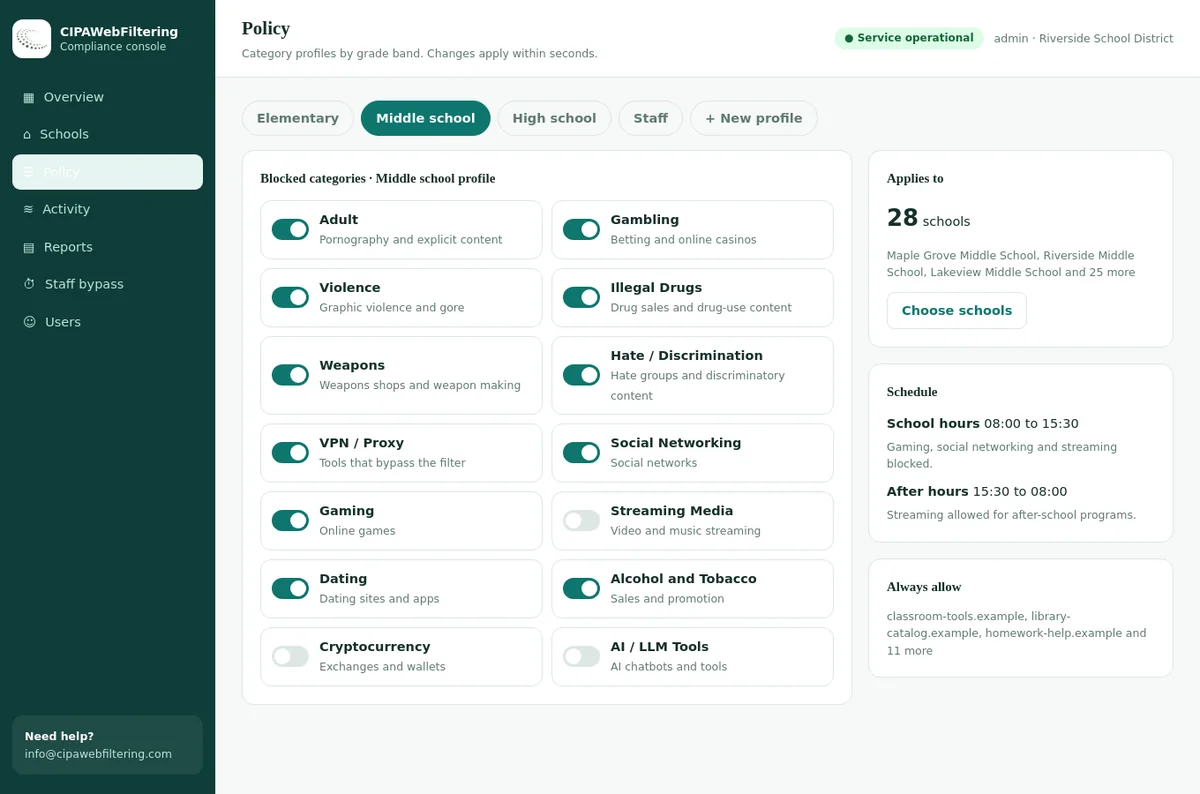
The KCSIE 2023 filtering and monitoring changes, as listed by the DfE
KCSIE 2023 ended with a table of substantive changes. These are the entries that relate to online safety, summarised in our own words with what each one means for a school.
| Where | Type | What changed | What it means for you |
|---|---|---|---|
| Part one, paragraph 14 | New text | Raised awareness that relevant staff are already expected to understand filtering and monitoring. Induction training on online safety includes the expectations, roles and responsibilities around it. | Every member of staff, not only IT, should know what the filter and monitoring do and how to report a problem. |
| Part two, paragraph 103 | New text | The DSL's lead responsibility for safeguarding, including online safety, now explicitly includes understanding the filtering and monitoring systems and processes in place. | The DSL needs a working knowledge of the systems, what reports exist and how alerts arrive. |
| Part two, paragraph 124 | New text | Staff training should include understanding roles and responsibilities in relation to filtering and monitoring. | Add a filtering and monitoring slot to induction and annual refresher training, and keep attendance records. |
| Part two, paragraph 138 | Reference | Child protection policies should cover appropriate filtering and monitoring on school devices and school networks. | Your child protection policy, not just an IT policy, should describe the arrangements. |
| Part two, paragraph 142 | New section | Introduced the DfE filtering and monitoring standards. The DfE said they support schools in meeting an existing duty and are not a new burden. | Use the four standards as the checklist for what "appropriate" looks like. |
| Part two, paragraph 144 | Reference | Schools and colleges should consider meeting the DfE cyber security standards. | Filtering, firewalls and account security now sit in one conversation with IT. |
| Part three, footnote | Clarification | Good practice to tell shortlisted candidates that online searches will be carried out. | Update recruitment packs so candidates know about online checks. |
Paragraph numbers changed in later editions. In the 2026 edition the filtering and monitoring section sits at different numbers, so always cite the edition when you quote a paragraph in a policy.
What the DSL change in KCSIE 2023 really asks for
"Understanding the filtering and monitoring systems and processes" is not a technical job description. It is about knowing enough to act on what the systems show and to tell governors whether they work.
A DSL should be able to answer
- Which filtering and monitoring products do we use, and on which devices?
- Are rules different for younger pupils, older pupils and staff?
- What reports do I receive, how often, and from whom?
- How does an urgent alert reach me, and how fast?
- What happens when a teacher asks to unblock a site?
- Which risks does our filter not cover, such as mobile data?
A DSL does not need to
- Configure the filter or write blocking rules.
- Read every log line or every pupil's history.
- Choose the supplier alone without leadership involvement.
- Be the only person who knows how the system works.
- Replace IT support's role in keeping the system running.
For the full current DSL role, see the KCSIE filtering and monitoring guide. For how filtering, monitoring and classroom tools differ, read web filtering vs monitoring vs classroom management.
Four roles the 2023 standards introduced into everyday practice
The filtering and monitoring standards published alongside KCSIE 2023 split the work between four groups. Schools that wrote these roles down in 2023 found later editions much easier to absorb.
Governing body
Assigns a senior leader and a governor to make sure the standards are met.
- Names the people
- Receives review findings
Senior leadership
Procures systems, documents what is blocked or allowed and why, and oversees reporting.
- Owns decisions
- Leads the review
DSL
Leads on safeguarding and online safety, acts on concerns and assures governors the systems work.
- Reads reports
- Responds to alerts
IT support
Maintains the systems, produces reports and makes agreed changes, in-house or through a provider.
- Keeps it running
- Passes concerns on
The four DfE filtering and monitoring standards, in brief
KCSIE 2023 listed the four standards directly in its text and asked governors to discuss with IT staff and providers what more needed to be done. These four headings have stayed the same in every edition since.
Assign roles
Identify and assign roles and responsibilities to manage filtering and monitoring systems.
Review yearly
Review filtering and monitoring provision at least annually.
Block harm, not learning
Block harmful and inappropriate content without unreasonably affecting teaching and learning.
Monitor effectively
Have monitoring strategies that meet the school's safeguarding needs.
Each standard is unpacked, with evidence to keep, in our guide to the DfE filtering and monitoring standards. The wider family of standards, including broadband, cyber security and IT support, is covered in DfE digital and technology standards.
What filtering and monitoring training for all staff looked like after 2023
KCSIE 2023 did not prescribe a course. Schools built short sessions into induction and annual updates. These six topics cover what most staff need.
What KCSIE 2023 kept from earlier editions
Some of the most quoted lines in 2023 were not new. They still shape how filtering should be set up today.
Proportion and risk
Governors should weigh the number and age range of children, those at greater risk, how often they use the IT system, and cost against safeguarding risk.
The appropriateness of systems is for each school to judge, informed in part by its Prevent duty risk assessment. See Prevent duty and web filtering.
Avoiding over-blocking
Governors should be careful that over-blocking does not create unreasonable limits on what children can be taught about online safety and safeguarding.
A filter with many granular categories makes this easier, because you can block a narrow risk without blocking a whole subject area.
The four Cs of online risk
Content, contact, conduct and commerce remained the frame for online risk. In 2023 content risk listed examples such as pornography, fake news, racism, misogyny, self-harm, suicide, antisemitism, radicalisation and extremism.
Annual review of online safety
Schools were encouraged to consider an annual review of their wider approach to online safety, backed by a risk assessment reflecting the risks their pupils face.
That is separate from, but naturally combined with, the filtering and monitoring review.
Where sites tied to the four Cs sit in our data
The four Cs of online risk are easier to act on when each risky site has a clear category. These labels come from our database.
| Domain | Categories in our data | Risk it illustrates |
|---|---|---|
| discord.com | Email and Messaging, Social Networking, Gaming | Contact with people the school does not know |
| reddit.com | Social Networking, Forums / Message Boards, Community Sites | Conduct in open forums |
| bet365.com | Gambling, Sports & Recreation | Commerce through betting |
| williamhill.com | Gambling | Commerce through betting |
| pornhub.com | Adult | Content that the CIPA preset already blocks |
Support KCSIE 2023 pointed schools to
The 2023 edition listed several sources of help alongside the standards. They remain useful, and later editions kept most of them.
| Source | What it helps with | How to use it in your review |
|---|---|---|
| UK Safer Internet Centre definitions | What "appropriate" filtering and monitoring should include. | Ask your provider for their response to the definitions. |
| UK Safer Internet Centre webinars | Short sessions on filtering and monitoring responsibilities, produced for the DfE. | Use them for governor and DSL training. |
| South West Grid for Learning test tool | Checks whether a provider is signed up to relevant lists, such as child abuse and terrorist content. | Run it from each type of device and connection and record the result. |
| DfE buying guidance | Help on what to buy and how to buy it. | Use it when your filtering contract comes up for renewal. |
| DfE cyber security standards | Firewalls, accounts, updates and backups. | Review alongside filtering, since both depend on the same network. |
Other KCSIE 2023 changes a DSL should know
The rest of the 2023 revision was modest, but several items connect to online risk or to the way concerns are handled.
What the filter leaves behind for the annual review
The hosted filter keeps a policy record and activity reports, and the log can be exported for your evidence file. The yearly review can then start from what was actually switched on, school by school.
A September action plan that still works today
Schools that handled the 2023 changes well tended to follow the same short sequence. It still fits the current edition, with the yearly review now spelled out more firmly.
| Step | Action | Owner | Evidence |
|---|---|---|---|
| 1 | Name the senior leader and governor responsible for filtering and monitoring. | Governing body | Minutes |
| 2 | Write a one-page roles document covering SLT, DSL and IT support. | Senior leader | Roles document |
| 3 | Agree which reports the DSL receives and how urgent alerts arrive. | DSL and IT | Reporting procedure |
| 4 | Add filtering and monitoring to staff induction and refresher training. | DSL | Training slides and attendance |
| 5 | Update the child protection policy to describe the arrangements on devices and networks. | DSL and SLT | Approved policy |
| 6 | Test blocking on each device type and record results. | IT support | Dated test log |
| 7 | Hold and minute the review, then report to governors. | Senior leader | Review record |
Our filtering and monitoring annual review checklist turns step 7 into a reusable agenda.
How category data helps meet the 2023 expectations
Standard three asks for blocking that does not get in the way of learning. That balance depends on the filter knowing what each website is about.
For the DSL
- Reports grouped by category are readable without technical help.
- A rise in Gambling, Violence or VPN / Proxy / Anonymizers traffic stands out.
- Several labels per site explain why a site was blocked.
For the IT lead
- 120 million categorised domains and 58 web filtering categories.
- About 300,000 new domains categorised daily, rechecked after a week and a month.
- Separate profiles by age group and for staff are easy to build.
Category filtering is one layer. It does not monitor messages or behaviour, and it does not replace the IWF and police-assessed terrorism lists from accredited providers. Concerns go to the DSL through your safeguarding process. Learn more about the category database, our hosted DNS filter, or check a site with the domain checker.
Four things KCSIE 2023 did not say
The 2023 changes were widely discussed, and some summaries went further than the text. These misreadings still turn up in policies.
"The DSL now runs IT"
The DSL leads on understanding the systems and acting on concerns. Running and maintaining them remains with IT support or the provider.
"Schools must buy a specific product"
KCSIE and the standards describe outcomes. They do not approve products or name suppliers, and the choice stays with the school or trust.
"Monitoring means watching every screen"
The standards allow a mix of in-person supervision, device monitoring and log review, chosen to fit the school's safeguarding needs.
"The standards were a brand new duty"
The DfE was explicit that the standards help schools meet an existing duty to have appropriate and effective systems.
The four 2023 roles and what the hosted filter does for each
The filter supports the filtering parts and does not stand in for monitoring.
| Role or standard | What it needs | Hosted CIPA filter |
|---|---|---|
| Governing body | Assurance that filtering works | Activity reports and a policy record to read |
| Senior leadership | One accountable owner | One console for every school in the group |
| DSL | Understand what is blocked and why | Plain category names, 58 in all, shown in the reports |
| IT support | Keep lists and settings current | Always-allow and always-block lists, applied in seconds |
| Block harm, not learning | Fast fixes for wrong blocks | Per-school lists, and a PIN bypass that reverts by itself |
| Monitor effectively | A separate safeguarding system | Not provided, as it is not a monitoring tool |
KCSIE 2023 changes: frequently asked questions
What were the main KCSIE 2023 changes?
The biggest change was to filtering and monitoring. The DSL's lead role now included understanding the systems and processes in place, staff training covered filtering and monitoring roles, child protection policies covered school devices and networks, and schools were pointed to the new DfE standards.
When did KCSIE 2023 come into force?
KCSIE 2023 was published for information on 6 June 2023 and came into force on 1 September 2023. On that date the DfE also amended two paragraphs, 142 and 150.
Did KCSIE 2023 create new filtering and monitoring duties?
The DfE described the filtering and monitoring standards as support for meeting the existing duty to have appropriate and effective systems, not as a new burden. In practice the 2023 edition made the existing duty much more specific about who does what.
Does the DSL have to run the filter after KCSIE 2023?
No. The DSL takes lead responsibility for understanding the systems and processes and acting on safeguarding concerns. Technical maintenance stays with IT support or the provider, and a senior leader and governor make sure the standards are met.
Is KCSIE 2023 still current?
No. It was replaced in September 2024 and later editions followed. The 2026 edition has been in force since 1 September 2026. Most of the 2023 filtering and monitoring wording carried forward and was strengthened later.
Related guides
We quote according to the number of schools and devices and reply within one business day. Starting with a single school as a pilot gives your DSL and IT lead real blocks and reports to review together.
Talk to us about your school or trust
Whether you are setting up roles for the first time or tidying settings across a trust, we can show how clear website categories make filtering easier to explain and review.
Talk to us about your school