KCSIE 2022 Changes: What the 2022 Edition Changed for Online Safety, Filtering and Monitoring
The September 2022 edition of Keeping Children Safe in Education did not invent filtering and monitoring duties, but it tightened who owns them and who needs to understand them. This page sets out what changed, why, and what it means if your school policies still carry 2022 wording.
Five KCSIE 2022 changes that touch online safety
Most of the 2022 revision dealt with child-on-child abuse, safer recruitment and low-level concerns. Online safety changes were smaller, but they set up the much bigger filtering and monitoring changes of 2023. Each card compares the position before and after.
Before
Governing bodies were already expected to have appropriate filtering and monitoring. The text was shorter and said less about who inside the school needed to understand it.
From September 2022
Governors should make sure systems are in place and that their effectiveness is reviewed regularly. Leaders and relevant staff should understand the provision, manage it effectively and know how to escalate concerns.
Before
Governor training was covered mainly in other departmental handbooks, and most governors did some safeguarding training, but KCSIE did not spell it out as clearly.
From September 2022
All governors and trustees should receive safeguarding and child protection training, including online safety, at induction. That training should be updated regularly so they can challenge leaders with confidence.
Before
Parental engagement was encouraged in general terms, with links to resources in the annexes.
From September 2022
New paragraphs suggested that routine contact with parents and carers should reinforce online safety, and that parents would find it helpful to understand which systems the school uses to filter and monitor online use.
Before
Remote education was covered mainly by pointing schools to separate guidance on safeguarding and remote learning.
From September 2022
KCSIE reminded schools that parents should know what children are asked to do online, which sites they will use, and who from the school, if anyone, they will be interacting with.
Before
The draft for consultation referred to checking social media on shortlisted candidates.
From September 2022
Schools were asked to consider internet searches on shortlisted candidates as part of due diligence. The final text dropped the specific reference to social media in favour of broader online searches.
The 2022 edition also absorbed the separate advice on sexual violence and sexual harassment between children into Part five, and switched to the term "child-on-child abuse". Those changes matter for online safety too, because so much harassment happens on phones and apps.
Turn the 2022 expectation into something you can switch on and show
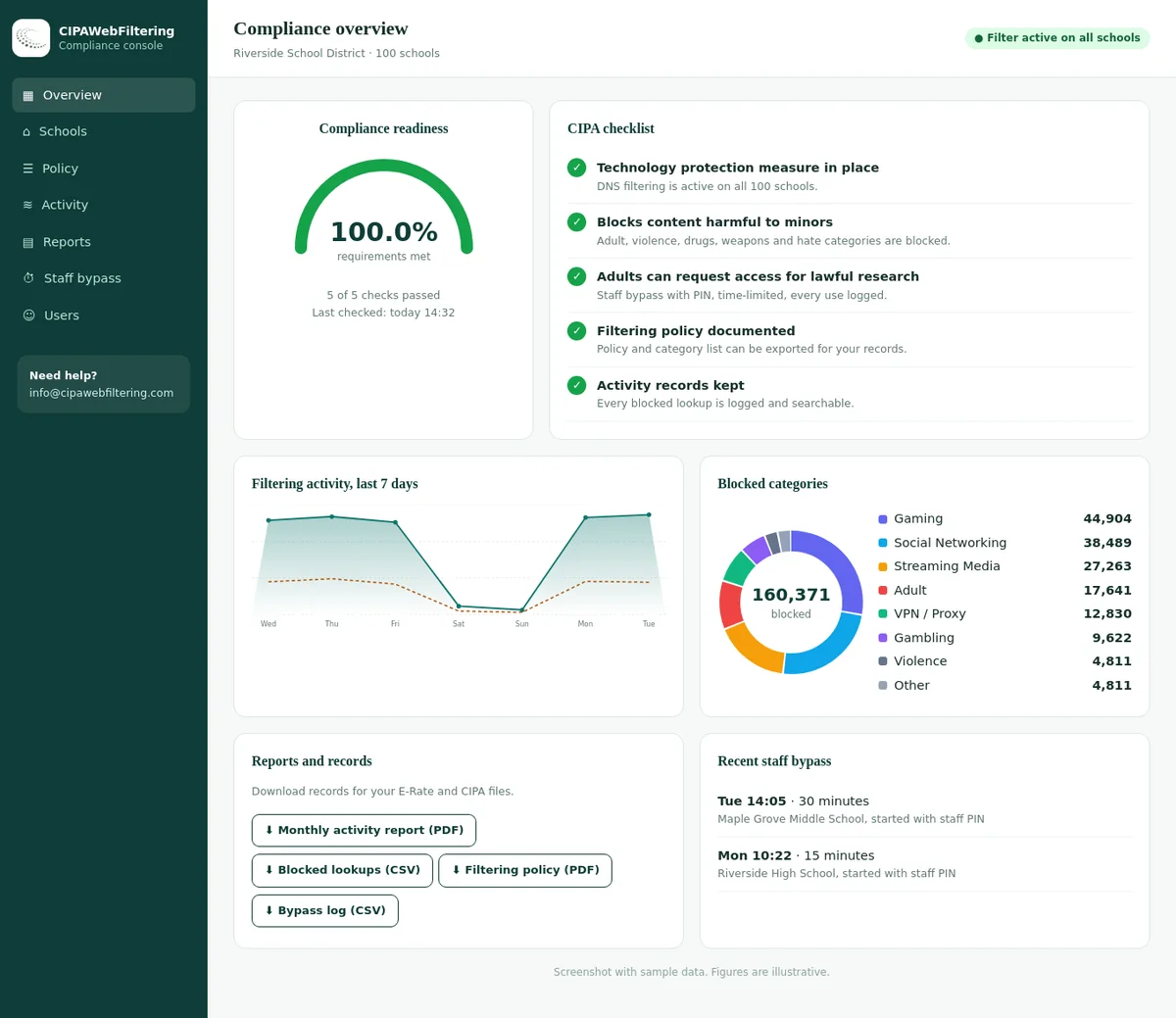
The 2022 edition asked schools to be sure their systems were in place and effective. Our hosted CIPA filter gives you category switches to make those words concrete, and reports that show what the settings did.
- The CIPA preset starts with Adult and VPN/Proxy/Anonymizers switched on
- Each school has its own settings, so schools and trusts can differ where they need to
- A policy record is there if governors ask what was configured
What schools told the DfE about filtering and monitoring in 2022
The 2022 consultation included a question asking whether respondents felt able to make informed decisions about which filtering and monitoring systems to use. The answers explain why the following years focused so heavily on roles and standards.
Why "not my responsibility" mattered
Nearly a third said the choice was not theirs. The DfE noted this was partly because a trust or technical supplier made the decision.
That is exactly the gap the 2022 wording tried to close: even if someone else buys the filter, leaders and relevant staff in the school still need to understand it and know how to escalate concerns.
Reasons people gave for answering "no"
- Not enough technical expertise to judge filtering and monitoring requirements.
- Heads and DSLs wanting more training on what is required.
- Budget worries about buying the "right" software.
- A wish for clearer guidance on what should be filtered.
- Uncertainty about where the school's remit ends and parents' begins.
The DfE said these points needed further work with subject experts. Within a year it published the filtering and monitoring standards, which answered many of them. See our guide to the DfE filtering and monitoring standards.
Three expectations hidden in one paragraph
The filtering and monitoring paragraph in KCSIE 2022 is short, but it asks for three separate things. Schools that read it as "have a filter" missed two of them.
1. Systems in place
Governing bodies and proprietors should make sure appropriate filtering and monitoring is running on the school's IT system.
- Covers devices and network
- Suits the age of pupils
- Fits the school's risks
2. Effectiveness reviewed
Effectiveness should be reviewed regularly. In 2022 there was no fixed interval; later editions moved to an annual review.
- Does blocking work?
- Do reports reach anyone?
- Is teaching being blocked?
3. People who understand it
Leaders and relevant staff should know what is in place, manage it well and know how to escalate a concern when one appears.
- Who reads the reports
- Who decides on changes
- How alerts reach safeguarding
Factors governors were asked to weigh
KCSIE in this period asked governors to think about proportion when deciding what is appropriate, rather than buying the strictest product available.
- How many children use the system and their age range.
- Which children are potentially at greater risk of harm.
- How often children access the IT system.
- The cost of a measure compared with the safeguarding risk it addresses.
The over-blocking warning stayed
KCSIE kept its caution that governors should make sure "over blocking" does not lead to unreasonable limits on what children can be taught about online safety and safeguarding.
In practice this means a filter that blocks health information, history topics or online safety lessons is itself a problem to fix, not a safe default.
What the 2022 governor training change meant in practice
The DfE's reasoning was that governors need enough knowledge to provide strategic challenge and to assure themselves that policies work. For filtering and monitoring, that translates into a handful of practical abilities.
| Governor should be able to | Why it matters for filtering and monitoring | Typical evidence |
|---|---|---|
| Explain the difference between filtering and monitoring | Many schools assumed the filter log was their monitoring. Governors who know the difference ask better questions. | Induction training record including online safety |
| Name who owns the systems | Responsibility often sat with an outside supplier with no clear contact in school. | Roles listed in minutes or a safeguarding policy |
| Ask how concerns are escalated | The 2022 text expected staff to know how to escalate; governors check that route exists. | Flowchart or written procedure for alerts |
| Challenge over-blocking | Teachers' complaints about blocked resources are a sign the balance is wrong. | Unblock request log with outcomes |
| Ask when effectiveness was last reviewed | "Regularly" was the 2022 word, so governors decided what regular meant locally. | Dated review note with findings and actions |
For the current governor role, which is now more specific, see the KCSIE filtering and monitoring guide and the filtering and monitoring annual review checklist.
What a governor can read when they ask if it works
The hosted filter produces activity reports and a policy record, and the log can be exported for the file. A change after a review applies within seconds, so a finding is fixed in the same meeting.
Telling parents about your filtering and monitoring
The 2022 parent communication paragraphs are still a good template. Parents cannot reinforce safe habits at home if they do not know what the school protects against and what it does not.
- Say that a filter existsExplain in plain words that school devices and the school network filter websites by category and age.
- Say that monitoring existsTell parents that activity on school systems can be reviewed by staff, and why.
- Explain the limitsHome broadband and mobile data are outside school systems unless a school device carries its own protection.
- List the sites pupils will useFor homework and remote lessons, name the platforms children are expected to visit.
- Say who pupils will meet onlineMake clear which staff, if any, will interact with pupils during online learning.
- Point to home controlsShare simple advice on home router and device controls so families can match school settings.
- Give a contactTell parents who to contact with a concern about something their child saw online.
- Repeat itUse newsletters and parents' evenings, not a single letter at the start of the year.
Other KCSIE 2022 changes with an online angle
Several changes outside the online safety section still shape how a DSL reads filtering and monitoring reports. These are the ones most worth knowing.
| Change in 2022 | What it said, in short | Online safety link |
|---|---|---|
| Child-on-child abuse | The term replaced "peer-on-peer abuse" and the separate sexual violence and harassment advice was folded into Part five. | Much harassment and image sharing happens through apps and messaging, often outside school filters. |
| Harmful online challenges and hoaxes | The paragraphs were clarified as part of the Part two revisions. | Schools are reminded to respond calmly and avoid spreading a hoax further when warning parents. |
| DSL status and authority | Most DSL detail moved into the full role description in Annex C, so governors read it in one place. | Gave the DSL clearer standing when asking IT for reports or changes. |
| Disclosure | New text on why children may not feel ready, or know how, to tell someone they are being abused. | Online harm is often disclosed late, so staff need to notice signs, not wait for a report. |
| Post-16 providers | Government-funded post-16 providers covered by the Education and Training (Welfare of Children) Act 2021 were referenced throughout. | Colleges and training providers needed filtering that suits learners up to adulthood. |
| Low-level concerns | Language was made consistent and the process for sharing low-level concerns about staff was clarified. | Concerns about staff online conduct follow the same route. |
A note on remit
Respondents in 2022 repeatedly raised where the school's job ends. Pupils meet much of the online world on personal phones and home broadband.
KCSIE's answer was education and parent engagement, not trying to filter everything. That is still the right frame: filter school systems well, teach pupils, and work with families.
What did not change in 2022
- No fixed review interval: "regularly" was the word used.
- No national standard for what a filter must do: schools were pointed to the UK Safer Internet Centre definitions.
- No named senior leader requirement for filtering and monitoring.
- No mention of generative AI tools.
Support and advice sites in our data
Over-blocking was a worry in 2022 and it still is, so it helps to know that help sites are labelled sensibly. These entries come from our database.
| Domain | Categories in our data | Why a school would keep it open |
|---|---|---|
| childline.org.uk | Education/Reference | Where a pupil may turn when they are worried |
| nspcc.org.uk | Business | A children's charity with advice for staff |
| internetmatters.org | Education/Reference, Community Sites | Guidance written for parents |
| bbc.co.uk | News/Media | News and learning material |
| tiktok.com | Social Networking, Streaming Media | A contrast: a site a school will usually choose to block |
How the 2022 wording grew in later editions
KCSIE 2022 is now history. Each later edition built on it, and the filtering and monitoring section today is far more specific. Follow the trail edition by edition.
Clarified paragraphs, governor training including online safety, parent communication.
You are hereDSL lead role covers filtering and monitoring; staff training; DfE standards signposted.
KCSIE 2023 changesMainly alignment with wider safeguarding guidance; standards revised separately.
KCSIE 2024 changesMisinformation as a content risk, generative AI safety link, self-assessment service.
2025 and 2026 changesReview at least every academic year, led by the responsible senior leader, with records of checks.
KCSIE 2026 changesSigns your online safety policy still reads like 2022
Policies are often copied forward year after year. If you spot any of these phrases or gaps, your policy needs a refresh against the current edition.
"Reviewed regularly"
The current edition expects a review at least once every academic year, led by the responsible senior leader with the DSL and IT support, and a record of checks.
No named senior leader
Since 2023 the standards expect a named senior leader and a named governor. A 2022-era policy often names only the IT provider.
DSL role without systems
Since 2023 the DSL's lead responsibility explicitly includes understanding the filtering and monitoring systems and processes.
No mention of AI
Later editions bring generative AI into scope. A policy silent on AI tools is out of date.
"Fake news" only
Content risk now names misinformation, disinformation and conspiracy theories. The wording changed in 2025.
No device coverage statement
The 2026 edition asks for checks that filtering works on all internet-connected devices in all relevant locations.
Turning "appropriate" filtering into settings you can explain
KCSIE 2022 asked leaders and relevant staff to understand the provision in place. That is much easier when the filter groups websites into clear categories that match the risks staff already talk about.
What clear categories give a school
- Readable reports: "Gambling" or "VPN / Proxy / Anonymizers" instead of raw web addresses.
- Separate rules for younger pupils, older pupils and staff.
- A simple way to show governors what is blocked and why.
- Fewer uncategorised sites slipping through.
What our data covers
Our category database labels 120 million domains with 58 web filtering categories. The 20 million most visited domains cover 99.99% of web traffic and usage.
About 300,000 newly registered domains are categorised every day and checked again later. See the category database or look a site up with the domain category checker.
Website category filtering is one layer. It does not read messages or watch pupil behaviour, and it does not replace the IWF and police-assessed terrorism lists supplied through accredited filtering providers. Concerns always go through your school's safeguarding process and the DSL. Schools wanting a hosted DNS option can read about our hosted filter.
Meeting the 2022 wording with a hosted filter
Each row takes a phrase from the 2022 edition and shows what the filter offers beside it.
| 2022 expectation | The usual difficulty | Hosted CIPA filter |
|---|---|---|
| Systems in place | Hardware to buy and maintain | One DNS setting on the router or firewall |
| Effectiveness reviewed | No record of what was set | Activity reports, a policy record and a log export |
| Appropriate for the age group | One rule for every pupil | Separate settings per school or branch in one console |
| Avoid over-blocking | Slow requests to unblock a page | Always-allow lists per site, applied in seconds |
| Devices pupils take home | Rules that stop at the gate | A private encrypted link keeps the same rules on the device |
| Workarounds | Proxy sites appear faster than lists | VPN/Proxy/Anonymizers blocked as a category |
KCSIE 2022 changes: common questions
When did KCSIE 2022 come into force?
The 2022 edition of Keeping Children Safe in Education came into force on 1 September 2022. It was first published for information in May 2022, after a public consultation that ran from 11 January to 11 March 2022.
What did KCSIE 2022 change about filtering and monitoring?
The filtering and monitoring paragraphs were clarified. Governing bodies and proprietors were to make sure appropriate systems were in place and their effectiveness regularly reviewed, and that leaders and relevant staff understood the provision, managed it well and knew how to escalate concerns. New text also covered telling parents about the filtering and monitoring systems in use.
Did KCSIE 2022 require governor training on online safety?
Yes. The 2022 edition set out that governors and trustees should receive safeguarding and child protection training, including online safety, at induction, and that this training should be regularly updated.
Is KCSIE 2022 still in force?
No. It was replaced by later editions. The edition in force from 1 September 2026 is KCSIE 2026. The 2022 edition is useful history, but policies should be written against the current edition.
Did KCSIE 2022 introduce the DfE filtering and monitoring standards?
No. The DfE filtering and monitoring standards were published in March 2023, and KCSIE 2023 was the first edition to point schools to them. KCSIE 2022 pointed schools to the UK Safer Internet Centre advice on appropriate filtering and monitoring.
The price depends on the number of schools and devices, and we send a quote within one business day. A pilot on one site would let you see the settings working and read the reports before you take the 2022 wording any further.
Talk to us about your school or trust
If you are bringing an old policy up to date, or choosing filtering for a school or trust, we can show how clear website categories help you explain your settings to governors and inspectors.