North Dakota School Internet Safety Laws
North Dakota came close to a state filtering rule in 2023, but the bill was vetoed. Filtering in North Dakota schools still rests on federal CIPA. What the state has added is a full-day phone storage law, a library collections law and student data policy rules.
For North Dakota technology coordinators, school librarians and administrators. Planning guidance, not legal advice.
Which rules apply to you?
In North Dakota the school device is now the only way online, so filter it properly
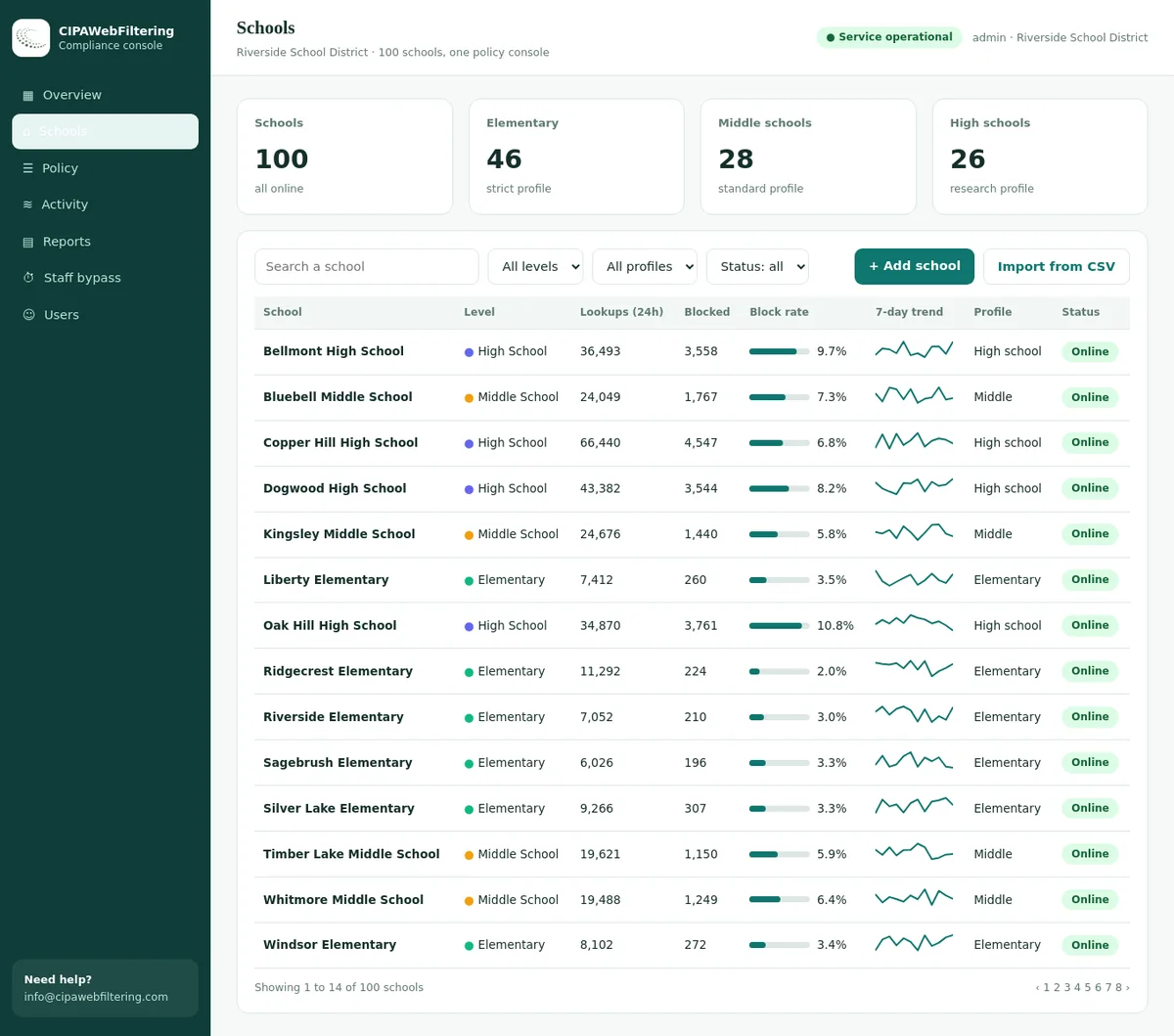
HB 1160 puts phones in pouches and lockers for the whole day, which sends nearly all student browsing to school devices. Our hosted CIPA filter is a DNS filter that we run for you, covering those devices on campus and wherever they travel.
- CIPA preset on from the start, with VPN/Proxy/Anonymizers blocked against tunnelling
- Exempt devices that join the Wi-Fi can be given the student rules rather than open guest access
- Long bus rides and home use are covered by a private encrypted link to the same rules
The CIPA baseline in North Dakota
CIPA is the only law that requires a filter in North Dakota schools and libraries. It applies when you take E-Rate discounts for internet access or internal connections. Background is in what is CIPA.
Technology protection measure
Block or filter visual depictions that are obscene or child pornography for all users, and harmful-to-minors depictions for minors.
Internet safety policy
Covers inappropriate material, messaging safety, hacking, disclosure of minors' data and the filter. Adopted after public notice and a hearing or meeting.
Monitoring and teaching
Monitor minors' online activity and teach online behavior, social networking safety and cyberbullying awareness.
Certification
File FCC Form 486, or Form 479 for consortium members, each funding year. Adults may have the filter disabled for lawful research.
What North Dakota adds: four measures to know
The short answer: North Dakota adds no filtering standard of its own. Here is what it does add, and the vetoed bill that people still ask about.
Would have added safety policy and technology protection measure requirements, with reports to the attorney general on provider compliance, penalties and withholding of funds for entities that refused to comply.
- Governor Burgum vetoed it in April 2023, citing the cost and the threat of criminal prosecution for library staff.
- The Senate voted 33 to 14 to override; the House fell short at 53 to 41, so the veto stands.
Requires public libraries to remove or relocate explicit sexual material from children's collections and to review those collections over time.
- Compliance report to legislative management before May 1, 2024.
- Applies to children's book inventory maintained after March 31, 2024.
- It is about collections, not web filters. Check the current text for how it reaches school libraries.
Requires public school districts to have policies keeping student phones and similar devices silenced and stored out of reach for the entire school day on school grounds.
- Passed the House 82 to 8 and, after reconsideration, the Senate 42 to 4.
- A planned grant pool for lock-away storage was removed before passage.
Amended the student data protection policy rule in NDCC 15.1-07-25.3. Boards adopt a policy, and student data goes to outside entities only with board permission, with exceptions such as parents.
- Sharing with the state student information system runs under a data sharing agreement with the Department of Public Instruction.
- That agreement is linked to approved-school status, per the bill text.
Lawmakers have kept returning to library and obscenity rules, with later bills such as SB 2307 in 2025 proposing changes to definitions. Check the Legislative Assembly records for the current text before relying on any section number.
HB 1160: the full-day phone storage law
North Dakota went further than many states. The law expects devices to be silenced and put away for the whole school day, not just during class. Districts were applying it during the 2025-26 school year; check Department of Public Instruction guidance for dates and details.
What the law sets
- Devices silenced and stored in a lockable pouch, locker or another place students cannot reach.
- Applies for the entire school day on school grounds.
- Exemptions for students who need a device for medical monitoring and for IEP needs.
- Districts write their own rules for bus rides, field trips, games and dances.
- Students may use phones while privately traveling to an off-site educational location.
What it means for your network
- Almost all student browsing during the day moves to school devices.
- Exempt devices should join the student Wi-Fi profile, never open guest access.
- Expect more attempts to bypass the filter on school devices. Block VPN / Proxy / Anonymizers for students.
- Enforcement has varied between schools, so write clear, consistent steps.
A companion bill, SB 2354, carried the same rules and would have covered private schools too. Check its final status. For personal device and network wording, see acceptable use policies for schools.
Year two of HB 1160: what to review
Reports from the first year showed schools applying the law in different ways, from strict to lenient. A short review in year two keeps the phone policy and the filter working together.
Bypass attempts
Compare blocked VPN, proxy and game attempts on school devices before and after the law. Rising numbers show where students went.
Consistent discipline
Check that schools in the district apply the same steps for the same breach, and that families know them.
Exemption list
Confirm each medical or IEP exemption is still needed and that those devices use the student Wi-Fi profile.
Non-instructional time
Review your local rules for buses, trips and events, and whether school devices used there stay filtered.
Which category a bypass or game attempt falls into
The year-two review asks you to compare VPN, proxy and game attempts on school devices. These are some familiar names and the labels they carry in our database.
| Domain | Categories in our data | Reading in a log review |
|---|---|---|
| surfshark.com | VPN / Proxy / Anonymizers | A student trying to tunnel out of the school network |
| tunnelbear.com | VPN / Proxy / Anonymizers | The same bypass category under another brand |
| proxysite.com | VPN / Proxy / Anonymizers | A web proxy that needs no install |
| steampowered.com | Gaming | Game time on a school device |
| minecraft.net | Gaming | A gaming label, not a safety one, so the call is local |
Libraries: HB 1205, CIPA and the web filter
North Dakota library staff now work under two separate sets of rules. One covers the books on the shelves. The other covers what patrons reach online. Keeping them apart avoids confusion.
| Question | HB 1205 (collections) | CIPA (internet access) |
|---|---|---|
| What does it cover? | Explicit sexual material in children's collections | Visual depictions reached online |
| Who must act? | Public libraries | Libraries and schools that take E-Rate, and libraries using LSTA funds for internet access |
| What is required? | Remove or relocate material, review collections, report | Filter, internet safety policy, monitoring for minors |
| Adults? | Adult collections are not the target | Adults may have the filter disabled for lawful research |
| Proof | Compliance report and review records | Form 486 or 479 and policy records |
For library-specific filtering, read our public library internet filtering policy guide and web filtering for libraries.
What it means for filtering and monitoring in North Dakota
With CIPA as the only filter mandate, each district decides the details. These are the decisions that make the biggest difference, especially now that phones are stored all day.
Block the CIPA core
Obscene and child pornography content for all users; harmful-to-minors content on every student device.
Adult · Lingerie/Swimsuits/Intimate ApparelStudent categories by grade
Tighter rules for younger students, with some loosening for high school research.
Gambling · Illegal Drugs · Weapons · Violence · Hate/Discrimination · DatingClose bypass routes
With phones away, school devices are the only way online. Watch for tunnels.
VPN / Proxy / Anonymizers · Remote Access ToolsFilter at home too
Rural students often take school devices home. Filtering should follow them. See enforcing CIPA off campus.
Decide on AI tools
No North Dakota law requires blocking AI tools. Use an AI tools blocklist for schools to allow what you approve.
Monitor with clear owners
Name who reviews alerts and how cyberbullying alerts feed your bullying policy. See filtering vs monitoring.
New proxy, game and AI sites appear every day. Category data that adds newly registered domains daily keeps rules current. Spot-check a site with the domain category checker or read how to block proxy sites in schools.
North Dakota timeline
The dates behind North Dakota's current rules, with their status at our last check in October 2026.
| When | Measure | Status | What it touches |
|---|---|---|---|
| 2001 onward | CIPA | In force | Filters and safety policies for E-Rate schools and libraries |
| April 2023 | HB 1205 | Signed | Children's collections in public libraries |
| April 2023 | SB 2360 | Vetoed; override failed in the House | Would have added filter and safety policy rules |
| May 1, 2024 | HB 1205 report deadline | Passed | Library compliance reports to legislative management |
| March 2025 | HB 1357 | Signed | Student data policies and sharing agreements |
| April 25, 2025 | HB 1160 | Signed | Full-day phone storage in public schools |
| 2025-26 school year | Phone policies in use | In practice | Enforcement varied between schools |
Small and rural district setups
Many North Dakota districts have a handful of schools and a very small technology team, often shared with neighbours. The filter has to run without constant attention.
| Situation | Risk | What helps |
|---|---|---|
| One technology person for the district | Unblock requests and new sites pile up | Category rules that update on their own, plus a short teacher request form |
| Long bus rides with school devices | Students use hotspots or home internet | Filtering that follows the device, such as 1:1 Chromebook filtering |
| School and public library in one building | Adults and students on one network | Separate adult and minor profiles with clear signage |
| Shared services or consortium E-Rate | Unclear who certifies what | Each member keeps its own policy and evidence folder |
| Limited budget for new tools | Manual block lists go stale | A hosted option such as our hosted CIPA filter with clear reports |
No server to run and nothing to install on student computers
The filter is run for you, so a district with one technology person has no appliance to host and no software to roll out. Each school keeps its own settings, always-allow and always-block lists in a single console.
Student data: your board policy and your filter provider
Filter and monitoring logs tie browsing to named students. Under North Dakota's student data policy rule, sending that data to an outside company needs board permission unless an exception applies.
Board steps
- Adopt or update the student data protection policy under NDCC 15.1-07-25.3.
- Approve each outside provider that will receive student data, including filter and monitoring services.
- Keep the data sharing agreement with the Department of Public Instruction current.
Provider questions
- Which student data does the service collect, and why?
- How long are logs kept, and who can see them?
- Is any data used for advertising or passed to others?
- How will a breach be reported to you?
Federal rules apply as well. Read student data privacy, FERPA and filtering. A filter that runs on category data inside your own environment keeps browsing logs off outside systems.
Common North Dakota misreadings
The 2023 library debate and the 2025 phone law produced a lot of confusion. These are the points we hear most.
| What people say | What applies |
|---|---|
| "North Dakota passed a school filter law in 2023." | SB 2360, which had filter provisions, was vetoed and the veto stood. HB 1205 covers library collections, not filters. |
| "HB 1160 is only about class time." | It covers the entire school day on school grounds. Districts set rules for other school-related time. |
| "Phones put away means filtering matters less." | The opposite. School devices now carry nearly all student browsing. |
| "Our filter provider can see what it likes." | Student data goes to outside entities only with board permission, and contracts should limit use. |
| "Small districts are exempt from CIPA." | Size does not matter. Any E-Rate applicant certifies CIPA. |
| "HB 1205 means the library must filter more." | HB 1205 is about physical and catalogued children's collections. Online filtering duties come from CIPA. |
North Dakota compliance checklist
Work through it each spring before the E-Rate window and when a policy changes. The general CIPA compliance checklist has more on each federal item.
- Internet safety policy covers every CIPA topicCIPA
- Public notice and hearing or meeting documentedCIPA
- CIPA core blocked for all usersCIPA
- Student categories set by grade bandLocal
- VPN and proxy categories blocked for studentsLocal
- Filtering tested on devices at homeCIPA
- Monitoring owners named and trainedCIPA
- Online safety lessons delivered and recordedCIPA
- Full-day phone storage policy adoptedHB 1160
- Medical and IEP exemptions recordedHB 1160
- Exempt devices on the student Wi-Fi profileHB 1160
- Student data protection policy current15.1-07-25.3
- Board approval recorded for each data provider15.1-07-25.3
- Form 486 or 479 filed on timeCIPA
- Local rules set for buses, trips and eventsHB 1160
- Unblock request process published to teachersLocal
- Adult filter disable procedure written downCIPA
- AI tools allow and block lists agreed with teachersLocal
Evidence to keep
Keep one folder per funding year. These records answer most review questions and board requests.
Adopted policies
Internet safety, phone storage and student data policies, with board minutes and dates.
Public process
Notice and agenda for the CIPA hearing or meeting.
Filter records
Rule set exports and dated block tests on each device type.
Teaching records
Dates, grades and topics of online safety lessons.
Exemption records
Medical and IEP device exemptions, stored with privacy in mind.
Provider approvals
Board approvals and signed data agreements for each provider.
Library reports
For public libraries, HB 1205 review records and the compliance report.
E-Rate forms
Copies of Form 486 or 479 and confirmations.
Our internet safety policy guide lists each CIPA topic, and E-Rate and CIPA funding explains the forms.
Small and rural North Dakota districts: hosted filter or a self-run setup
The rows reuse the rural situations listed earlier, one against the other.
| Rural situation | Hosted CIPA filter | Self-run setup |
|---|---|---|
| One technology person for the district | Categories do the sorting, with one console for every school | Block lists and rules maintained by that person |
| Long bus rides with school devices | A private encrypted link keeps the same rules on the device | Rules apply only on the school network |
| Exempt phones on Wi-Fi | Can use the same student rules as school devices | Often left on open guest access |
| Tight budget | A quote based on schools and devices, with the filter run for you | Hardware and updates to fund |
| Unblock requests from teachers | Always-allow entry for one school | Manual edits to shared lists |
| Library and school in one building | Staff PIN for adult research, 15, 30 or 60 minutes, logged | Filter turned off by hand |
North Dakota school internet safety FAQ
Does North Dakota require schools to filter the internet under state law?
We found no state filtering standard in force. SB 2360 (2023) had filter provisions but was vetoed. E-Rate schools and libraries filter because of CIPA.
What does North Dakota HB 1160 require?
Public districts must keep student phones and similar devices silenced and stored for the entire school day on school grounds, with medical and IEP exemptions and local rules for other school time.
What did HB 1205 (2023) change for libraries?
Public libraries remove or relocate explicit sexual material from children's collections, review those collections and reported on compliance before May 1, 2024.
Which North Dakota law covers student data?
NDCC 15.1-07-25.3, amended by HB 1357 in 2025. Boards adopt a policy, approve outside data sharing, and share with the state system under an agreement with the Department of Public Instruction.
Does the phone law apply to private schools?
HB 1160 covers public districts. Companion SB 2354 would also have covered private schools; check its status. E-Rate private schools still meet CIPA.
Does the phone law change E-Rate or CIPA certification?
No. CIPA certification on Form 486 or 479 is unchanged.
Compare with other states
See how nearby and peer states handle filtering, phones and student data, or open the full list of school internet safety laws by state.
Related guides
Cost depends on how many North Dakota schools and devices you have, and a quote follows within one business day. Starting with a pilot at one school is a way to see the blocks and reports before taking it district-wide.
Talk to us about your district
With phones stored all day, school devices carry the load. We can show how CIPA category filtering that follows the device can fit your North Dakota schools.
Talk to us about your district