South Dakota School Internet Safety Laws
South Dakota has its own school filtering statute, and it has tightened it twice in two years. Every public school must filter, publish a policy on obscene matter and let people appeal to the school board.
This guide for South Dakota technology coordinators, school librarians and superintendents explains how SDCL 22-24-55 sits next to federal CIPA and what to configure and record. Planning guidance, not legal advice.
- 1999SDCL 22-24-55 is first enacted. Under the early text, schools could adopt a policy in place of filtering.
- 2024: HB 1197Revised: filtering on public access computers, plus a local policy by January 1, 2025, published on the district website or in the legal newspaper.
- 2025: HB 1239The policy must offer an appeal to the school board on whether material is obscene, with judicial review.
- 2026: SB 198A statewide school phone restriction is rejected in the House. Phone rules stay local.
The CIPA baseline for South Dakota
The Children's Internet Protection Act applies to every South Dakota school or library that takes E-Rate discounts for internet access or internal connections. For a full primer, read what is CIPA.
Technology protection measure
Blocks visual depictions that are obscene or child pornography for all users, and harmful to minors on computers minors use.
Internet safety policy
Covers inappropriate material, email and chat safety, hacking, minors' personal data and the filter. Public notice and a hearing or meeting first.
Monitoring and education
Schools monitor minors' online activity and teach online behavior, social networking safety and cyberbullying awareness.
Certification
FCC Form 486 each funding year, or Form 479 for consortium members. Adults may have the filter disabled for lawful research.
A filtered connection and a policy the board can stand behind
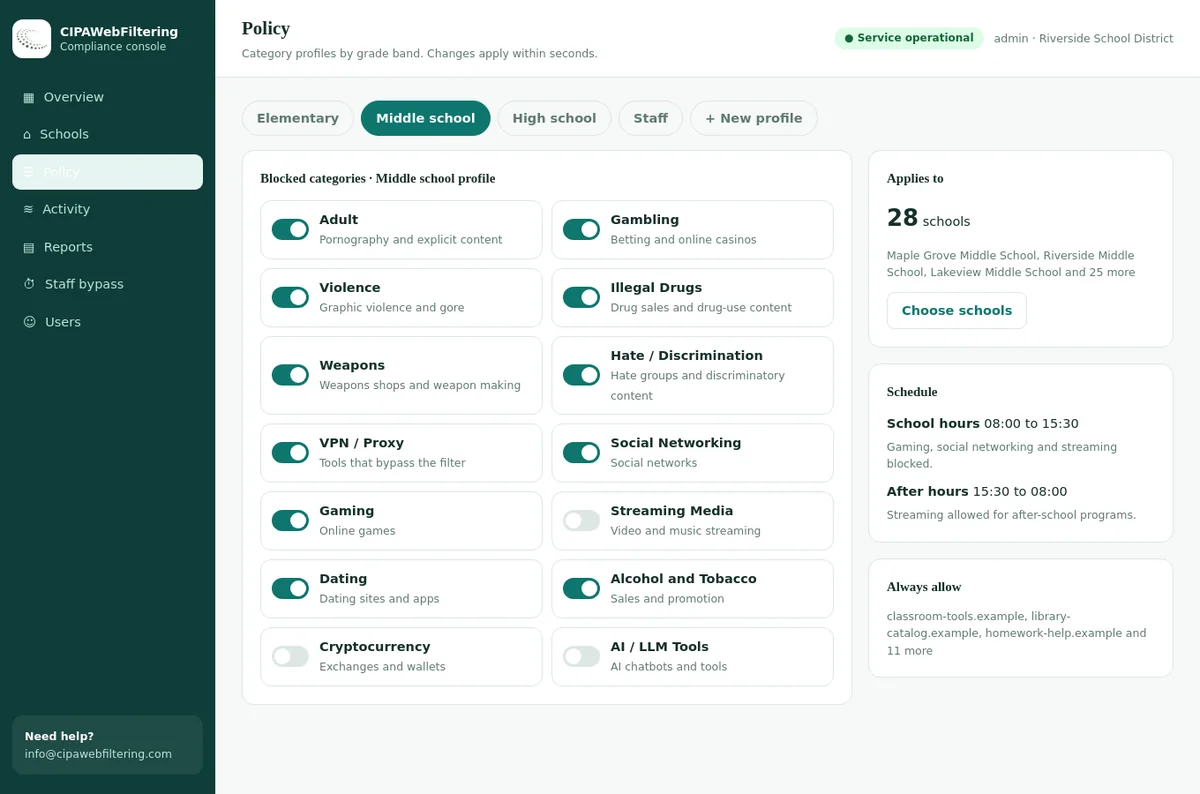
SDCL 22-24-55 reaches every public school, and since 2025 a board decision on obscene matter can be appealed and reviewed in court. Our hosted CIPA filter is a DNS filter that we run for you, so the filtering half of the statute is settled with one change at the firewall.
- You see and set the blocked categories yourself, so the published policy matches what the network does
- An always-block or always-allow entry applies in seconds once the board has ruled
- Laptops that go home keep the same rules over a private encrypted link
What South Dakota adds: SDCL 22-24-55
Section 22-24-55 sits in the criminal code chapter on obscenity, next to section 22-24-56 for public libraries. It applies to each public school in the state, whether or not the school takes E-Rate.
Part 1: a filtering measure
- Equip each public access computer with software that limits minors' ability to reach obscene matter or materials, as defined in SDCL 22-24-27.
- Or buy internet connectivity from a provider that filters to limit access to obscene materials.
- Either path satisfies the filtering part. Most districts use both: a network filter plus device-level filtering.
Part 2: a published local policy
- Develop and implement, by January 1, 2025, a local policy with measures that restrict minors from accessing obscene matter or materials.
- Allow an individual to appeal to the school board to decide whether matter or material is obscene.
- The board's decision is subject to judicial review.
- Publish the policy on the district website, or annually in the legal newspaper the board designates under SDCL 13-8-10.
Two ways to meet the filtering part
The statute lets a school choose software on each public access computer or a filtered internet connection. Each has strengths, and the gaps matter for CIPA.
Filtering software on each computer
- Good for
- Take-home and one-to-one devices that leave the school network.
- Watch for
- Unmanaged devices and guest machines that never get the software.
- CIPA fit
- Strong, if the same rule set applies on and off campus. See filtering school devices off campus.
Filtered internet from a provider
- Good for
- Small districts that want one control point for every device on the network.
- Watch for
- Devices at home are not covered, and you may not control the category list.
- CIPA fit
- Fine on campus, if you can see and change which categories are blocked for minors.
Questions to ask if you use Path B
| Question | Why it matters |
|---|---|
| Which categories are blocked, and can we see the list? | Your published policy should match what the connection actually blocks. |
| Can we set different rules for students and staff? | CIPA holds minors to the harmful to minors test, while adults need research access. |
| How fast are new domains categorized? | New proxy and adult sites appear daily; slow updates leave gaps. |
| Can we unblock a site quickly after a board decision? | An appeal outcome should take effect without waiting on a ticket queue. |
| What logs are kept, and for how long? | Student browsing data has privacy duties attached to it. |
The 2025 appeal route, rung by rung
HB 1239 added the right to appeal to the school board. Building a simple, written process now saves a lot of stress when the first appeal arrives.
Concern raised
A parent, student or staff member questions a site, book or resource.
Staff review
Check the item, its category and the policy. Many questions end here.
Written appeal
The person appeals to the school board, as the policy allows.
Board decision
The board decides whether the matter or material is obscene and records why.
Judicial review
The board's decision can be reviewed by a court of competent jurisdiction.
Acting on a ruling the same day
If the board finds a site obscene, an always-block entry for that school takes effect in seconds. If it rules the other way, the policy record shows what the setting was and when it changed, which helps if a court looks at the file.
South Dakota standard vs CIPA standard
The two laws use different words. An E-Rate school in South Dakota must satisfy both, so it usually filters to the broader federal standard for minors.
| Question | SDCL 22-24-55 | Federal CIPA |
|---|---|---|
| Who it applies to | Every public school in the state | Schools and libraries that take E-Rate or certain grants |
| Content standard | Obscene matter or materials, as defined in SDCL 22-24-27 | Visual depictions that are obscene or child pornography; harmful to minors for minors |
| Where the filter applies | Each public access computer, or the internet connection | Computers with internet access, with minors' computers held to the harmful to minors test |
| Policy process | Local policy, published on the website or annually in the legal newspaper | Internet safety policy after public notice and a hearing or meeting |
| Appeals | Appeal to the school board, then judicial review | No appeal process set by statute |
| Certification | None set in the statute | FCC Form 486 or Form 479 |
Phones and other related rules
South Dakota has left phone rules to school boards. Here is what we found at our last check in October 2026.
No statewide phone statute
In March 2026 the House rejected SB 198, which would have restricted phone use during the school day. Local control won the debate.
Local phone policies
A survey cited in the debate found most districts already had a phone policy. The Legislature also passed a non-binding resolution encouraging them.
Libraries in parallel
SDCL 22-24-56 gives public libraries the same filtering duty. See web filtering for libraries.
What it means for filtering and monitoring in South Dakota
The statute is short, but it puts the filter, the policy and the board in one chain. These settings keep that chain defensible.
Adult blocked everywhere
Block Adult on every public access computer and network. That meets both the state obscene matter duty and CIPA. See blocking adult content on school networks.
Harmful to minors set
For students add Gambling, Illegal Drugs, Weapons, Violence, Hate/Discrimination, Dating, Lingerie/Swimsuits/Intimate Apparel and VPN / Proxy / Anonymizers.
Close the bypass routes
Proxy and VPN sites defeat both laws. Block the category and the browser extensions that do the same.
AI image tools
Unreviewed AI image generators can produce explicit images. The AI tools blocklist for schools lets you block them while allowing approved tools.
Answer appeals with data
When an appeal names a website, look up its category with the domain category checker and attach the result to the file.
Light monitoring
CIPA monitoring can be supervision plus category reports. Read student data privacy and filtering before keeping named-student logs.
Labels for the bypass, AI image and student-set sites a South Dakota board worries about
These lookups come straight from our database. Some AI sites carry several categories, which is worth knowing before an appeal names one.
| Domain | Categories in our data | Why it comes up |
|---|---|---|
| psiphon.ca | VPN / Proxy / Anonymizers | A bypass tool that defeats the statute and CIPA at once |
| windscribe.com | VPN / Proxy / Anonymizers | A second name in the same category, so one switch covers both |
| nightcafe.studio | AI / LLM Tools | An AI image site a board may hold back until reviewed |
| leonardo.ai | AI / LLM Tools, Freeware/Software | An AI image maker that sits in two categories |
| bovada.lv | Gambling | Part of the harmful-to-minors set for students |
| grindr.com | Dating | A dating category entry for the student rule set |
South Dakota compliance checklist
Open each group and work through it before the school year and before the E-Rate form window. The general CIPA compliance checklist has more detail on the federal items.
Filtering SDCL 22-24-55 part 1 and CIPA
- Every public access computer has filtering software, or the connection is filtered
- Library, lab, classroom and guest computers all covered
- Adult blocked for all users; student categories by grade band
- VPN and proxy categories blocked for students
- Take-home devices filtered off campus
- Filter tested each term with results saved
Local policy SDCL 22-24-55 part 2
- Policy with measures to restrict minors from obscene matter adopted and implemented
- Policy published on the district website, or annually in the designated legal newspaper
- Appeal to the school board described with a clear form and timeline
- Board decision template records the item, reasons and date
- Library materials policy aligned with the filtering policy
Federal CIPA E-Rate schools
- Internet safety policy covers every CIPA topic
- Public notice and hearing or meeting held
- Online safety education delivered and logged
- Form 486 or 479 filed on time
Local choices phones, AI, privacy
- Board phone policy current and matched to the acceptable use policy
- AI tools decision written down and reflected in filter rules
- Vendor contracts reviewed for student data terms
- Log retention period set
Writing the appeal section of your policy
The statute requires an appeal route but leaves the details to each board. These elements make the process fair, quick and easy to defend if a court reviews a decision.
Who may appeal
The statute says "an individual". Decide whether you ask for a connection to the district, and have counsel check that choice against the wording.
What to submit
The site, book or resource, where it was found and why the person thinks it is or is not obscene. One short form is enough.
Timelines
Set dates for staff review and for a board agenda slot, so appeals do not sit for months.
The standard applied
Quote the SDCL 22-24-27 definition in the policy so the board applies the same test every time.
Written decision
Record the decision, the reasons and the vote. A short written decision is what a court would look at first.
Acting on the result
If the board finds a site obscene, block it at once and check its category. If not, record whether it stays blocked for another reason.
Common South Dakota misreadings
The state law has changed twice in quick succession, so older summaries still circulate. These are the points we see most often confused.
| What people say | What the current law says |
|---|---|
| "A policy is enough, we do not need a filter." | That reflects the early text. The current section requires filtering software or a filtered connection, plus a policy. |
| "Only E-Rate schools have to filter." | CIPA is tied to E-Rate, but SDCL 22-24-55 applies to each public school in the state. |
| "Posting the policy once is fine." | Website publication meets the duty; the newspaper option is annual. |
| "Appeals go to the superintendent." | Staff can review first, but the statute gives a right to appeal to the school board. |
| "The law only covers websites." | The 2025 bill deals with obscene materials in public school libraries too, so books and other resources can come up in appeals. |
Evidence to keep
The appeal route and judicial review make records more important in South Dakota than in many states. Green cards are state items, blue cards are federal.
Filter inventory
List of public access computers and how each is filtered, or the filtered service contract.
Adopted local policy
Board minutes, adoption date and the policy text in force.
Proof of publication
Dated screenshot of the website page, or the newspaper notice each year.
Appeal files
Each appeal, staff review, board decision, reasons and any court filing.
Rule set exports
Categories blocked for staff and each grade band, with the date exported.
Hearing records
Notice and minutes for the internet safety policy hearing or meeting.
Education records
Lesson plans and dates for online safety instruction.
Certifications
Filed Form 486 or 479 and confirmation for each funding year.
Software on each computer, a provider's filter, or our hosted filter
The statute lets you choose how to filter, so this table sets the practical differences beside the hosted CIPA filter.
| Question for your district | Software on every computer | Filter from the internet provider | Hosted CIPA filter |
|---|---|---|---|
| Can you see the blocked categories? | Yes, on each machine | Often not | Yes, category switches per school |
| Do guest and unmanaged devices get filtered? | Only if the software reaches them | Yes, on the network | Yes, through the one DNS setting |
| Do take-home laptops keep the rules? | Yes, if the software travels | No | Yes, via a private encrypted link |
| Can the board's ruling apply quickly? | A change on every device | A request to the provider | An always-allow or always-block entry in seconds |
| Is there a record for a court file? | Per-device logs | Whatever the provider keeps | Activity reports, policy record and a log export |
South Dakota school internet safety FAQ
Does South Dakota require schools to filter the internet?
Yes. SDCL 22-24-55 requires filtering software on each public access computer, or filtered internet from a provider. It applies whether or not the school takes E-Rate.
What policy must a school board adopt?
A local policy with measures to restrict minors from obscene matter, in place by January 1, 2025, and published on the district website or annually in the legal newspaper.
What is the appeal right added in 2025?
HB 1239 requires the policy to let an individual appeal to the school board on whether material is obscene. The board's decision is subject to judicial review.
How does the state standard compare with CIPA?
The state law covers obscene matter under SDCL 22-24-27. CIPA adds child pornography and harmful to minors for minors. E-Rate schools meet both by filtering to the CIPA standard.
Does South Dakota have a school cellphone ban?
Not by statute at our last check. The House rejected SB 198 in 2026, and phone rules are set by local boards.
Does the law also apply to public libraries?
Yes. SDCL 22-24-56 sets a parallel filtering duty for public libraries, revised in 2025 alongside the school section.
Does South Dakota require blocking AI tools?
We found no such statute. AI image tools that can make explicit images fall under the obscene matter policy and CIPA, so many districts block unreviewed ones for students.
Other state school internet safety laws
Compare South Dakota with nearby states, or browse every guide on the school internet safety laws by state hub.
Related guides
- What Is CIPA? Children's Internet Protection Act Requirements
- Web Filtering for Small and Rural School Districts
- Presenting Web Filtering to the School Board: Budget, Risk, Metrics
- Wyoming School Internet Safety Laws: CIPA and Phone Policy
- North Dakota School Internet Safety Laws: CIPA, HB 1160, HB 1205
Pricing follows the number of schools and devices in your South Dakota district, and a quote arrives within one business day. A pilot on one site lets your superintendent see the blocks and reports before the policy goes to the full board.
Talk to us about your district
We can show how CIPA category filtering, clear category lookups for appeals and off-campus coverage can fit a South Dakota district of any size.
Talk to us about your district